QUESTION IMAGE
Question
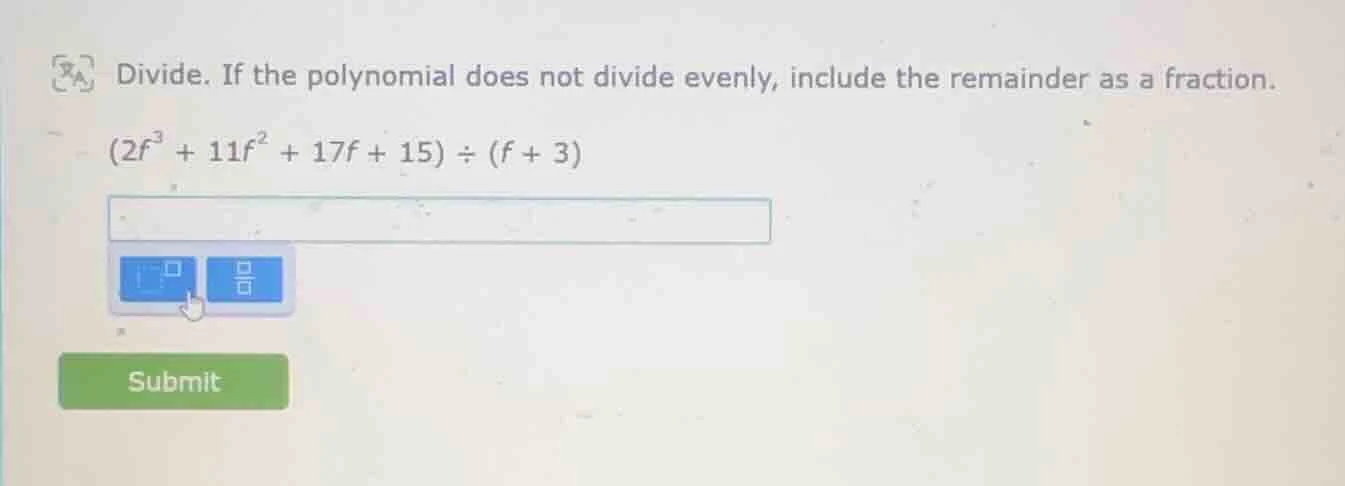
divide. if the polynomial does not divide evenly, include the remainder as a fraction.
$(2f^{3} + 11f^{2} + 17f + 15) \div (f + 3)$
Step1: Use polynomial long division
Divide the leading term of the dividend \(2f^3\) by the leading term of the divisor \(f\), we get \(2f^2\). Multiply the divisor \((f + 3)\) by \(2f^2\) to get \(2f^3+6f^2\). Subtract this from the dividend:
\[
\]
Step2: Divide the new leading term
Divide the leading term of \(5f^2\) by \(f\) to get \(5f\). Multiply the divisor \((f + 3)\) by \(5f\) to get \(5f^2+15f\). Subtract this from \(5f^2+17f + 15\):
\[
\]
Step3: Divide the new leading term again
Divide the leading term of \(2f\) by \(f\) to get \(2\). Multiply the divisor \((f + 3)\) by \(2\) to get \(2f+6\). Subtract this from \(2f + 15\):
\[
\]
Step4: Combine the results
The quotient is \(2f^2 + 5f+2\) and the remainder is \(9\). So we can write the division as:
\[
\frac{2f^3 + 11f^2 + 17f + 15}{f + 3}=2f^2 + 5f + 2+\frac{9}{f + 3}
\]
But wait, let's check using synthetic division. The root of \(f + 3 = 0\) is \(f=-3\).
Set up synthetic division:
\[
\]
So the quotient is \(2f^2+5f + 2\) and the remainder is \(9\). Wait, but when we do \((2f^3 + 11f^2 + 17f + 15)\div(f + 3)\), using synthetic division, the coefficients of the quotient are \(2,5,2\) and remainder \(9\). Wait, but let's multiply \((f + 3)(2f^2+5f + 2)+9\):
\[
\]
Wait, but the problem says "if the polynomial does not divide evenly, include the remainder as a fraction". But in this case, when we do the division, the remainder is \(9\), so the result is \(2f^2 + 5f+2+\frac{9}{f + 3}\)? Wait, no, wait, maybe I made a mistake in synthetic division. Wait, let's recalculate synthetic division:
Coefficients of dividend: \(2\) (for \(f^3\)), \(11\) (for \(f^2\)), \(17\) (for \(f\)), \(15\) (constant term).
Bring down the \(2\).
Multiply \(2\) by \(-3\) to get \(-6\). Add to \(11\): \(11-6 = 5\).
Multiply \(5\) by \(-3\) to get \(-15\). Add to \(17\): \(17-15 = 2\).
Multiply \(2\) by \(-3\) to get \(-6\). Add to \(15\): \(15-6 = 9\). Oh! I see, I made a mistake earlier in the last multiplication. So the remainder is \(9\), and the quotient is \(2f^2+5f + 2\). Wait, but when we multiply \((f + 3)(2f^2+5f + 2)\) we get \(2f^3+5f^2+2f+6f^2+15f+6=2f^3+11f^2+17f+6\), then add the remainder \(9\) gives \(2f^3+11f^2+17f+15\), which is correct. So the division is \((2f^3 + 11f^2 + 17f + 15)\div(f + 3)=2f^2 + 5f+2+\frac{9}{f + 3}\)? Wait, no, the quotient is \(2f^2+5f + 2\) and the remainder is \(9\), so the result is \(2f^2 + 5f + 2+\frac{9}{f + 3}\). But wait, let's check with another method, like polynomial long division again.
Divide \(2f^3+11f^2+17f+15\) by \(f + 3\):
- \(2f^3\div f=2f^2\). Multiply \((f + 3)\) by \(2f^2\): \(2f^3+6f^2\). Subtract from dividend: \(2f^3+11f^2+17f+15-(2f^3+6f^2)=5f^2+17f+15\).
- \(5f^2\div f = 5f\). Multiply \((f + 3)\) by \(5f\): \(5f^2+15f\). Subtract: \(5f^2+17f+15-(5f^2+15f)=2f+15\).
- \(2f\div f=2\). Multiply \((f + 3)\) by \(2\): \(2f+6\). Subtract: \(2f+15-(2f+6)=9\).
So the quotient is \(2f^2+5f + 2\) and the remainder is \(9\), so the division is \(2f^2 + 5f+2+\frac{9}{f + 3}\). Wait, but the problem says "if the polynomi…

Snap & solve any problem in the app
Get step-by-step solutions on Sovi AI
Photo-based solutions with guided steps
Explore more problems and detailed explanations
\(2f^2 + 5f + 2+\frac{9}{f + 3}\)