QUESTION IMAGE
Question
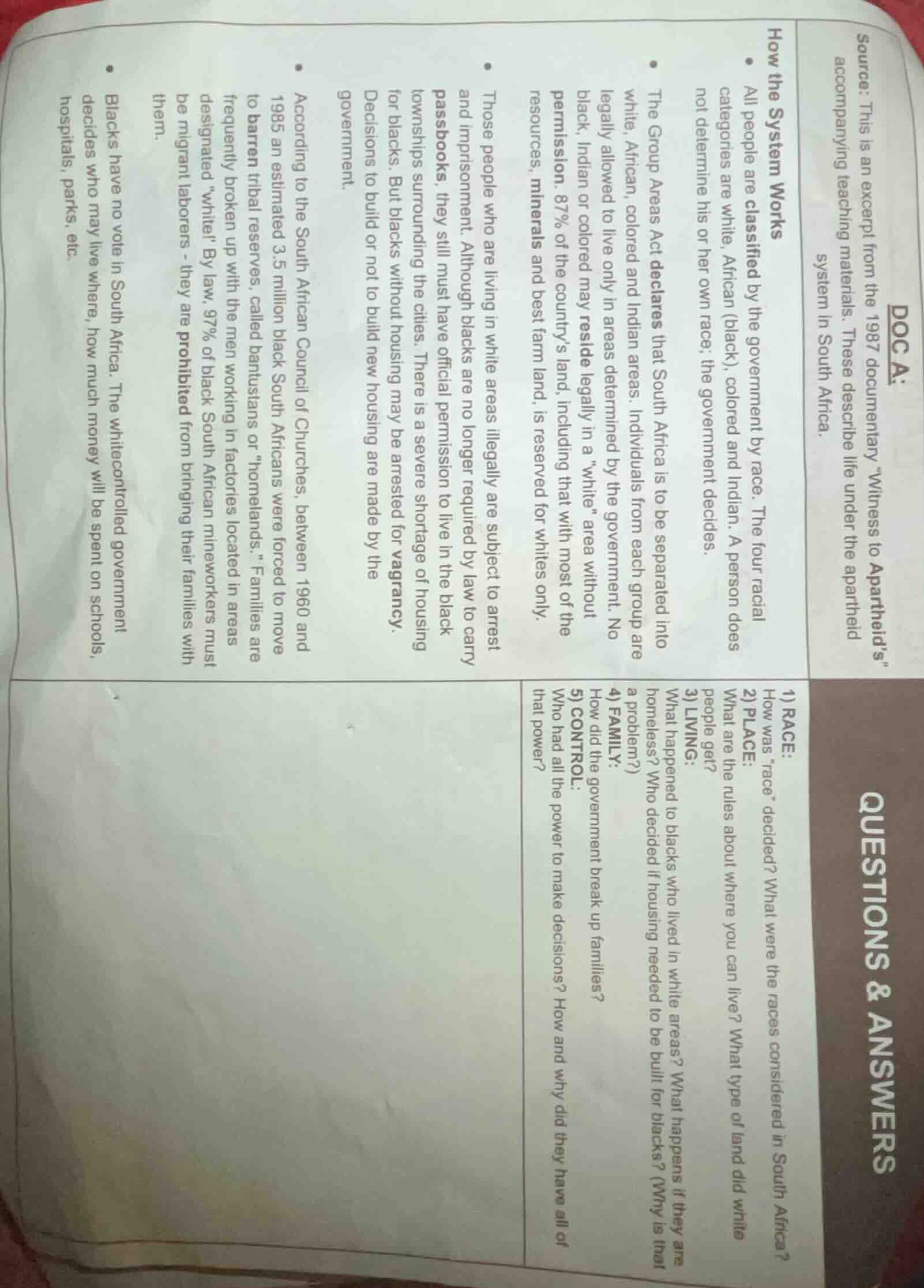
doc a: source: this is an excerpt from the 1987 documentary \witness to apartheids\ accompanying teaching materials. these describe life under the apartheid system in south africa. how the system works - all people are classified by the government by race. the four racial categories are white, african (black), colored and indian. a person does not determine his or her own race; the government decides. - the group areas act declares that south africa is to be separated into white, african, colored and indian areas. individuals from each group are legally allowed to live only in areas determined by the government. no black, indian or colored may reside legally in a \white\ area without permission. 87% of the country’s land, including that with most of the resources, minerals and best farm land, is reserved for whites only. - those people who are living in white areas illegally are subject to arrest and imprisonment. although blacks are no longer required by law to carry passbooks, they still must have official permission to live in the black townships surrounding the cities. there is a severe shortage of housing for blacks. but blacks without housing may be arrested for vagrancy. decisions to build or not to build new housing are made by the government. - according to the south african council of churches, between 1960 and 1985 an estimated 3.5 million black south africans were forced to move to barren tribal reserves, called bantustans or \homelands.\ families are frequently broken up with the men working in factories located in areas designated \white\ by law, 97% of black south african mineworkers must be migrant laborers - they are prohibited from bringing their families with them. - blacks have no vote in south africa. the white - controlled government decides who may live where, how much money will be spent on schools, hospitals, parks, etc. questions & answers 1) race: how was
ace\ decided? what were the races considered in south africa? 2) place: what are the rules about where you can live? what type of land did white people get? 3) living: what happened to blacks who lived in white areas? what happens if they are homeless? who decided if housing needed to be built for blacks? (why is that a problem?) 4) family: how did the government break up families? 5) control: who had all the power to make decisions? how and why did they have all of that power?
To answer these questions, we analyze the provided document about apartheid in South Africa:
1) RACE:
- How was "race" decided? The government decided a person’s race; individuals couldn’t determine their own.
- What were the races considered? The four racial categories were white, African (black), colored, and Indian.
2) PLACE:
- What were the rules about where you can live? The Group Areas Act separated people by race: whites, Africans, coloreds, and Indians were legally restricted to government - designated areas. No black, Indian, or colored person could reside in a “white” area without permission. 87% of the country’s land (including the best farmland, minerals, and resources) was reserved for whites only.
- What type of land did white people get? White people got the most valuable land, including the best farmland, mineral - rich areas, and areas with the most resources.
3) LIVING:
- What happened to blacks who lived in white areas? Blacks living in white areas illegally were subject to arrest and imprisonment. They also had to carry passbooks and needed official permission to live in black townships near cities.
- What happens if they are homeless? There was a severe housing shortage for blacks. Blacks without housing could be arrested for vagrancy.
- Who decided if housing needed to be built for blacks? (Why is this a problem?) The government decided if new housing for blacks would be built. This is a problem because the government had little incentive to provide adequate housing for blacks, leading to a chronic housing crisis and poor living conditions for the black population.
4) FAMILY:
- How did the government break up families? Between 1960 and 1985, an estimated 3.5 million black South Africans were forced to move to barren tribal reserves (bantustans or “homelands”). Families were frequently broken up as 97% of black mineworkers had to be migrant laborers, prohibited from bringing their families with them.
5) CONTROL:
- Who had all the power to make decisions? The white - controlled government had all the power.
- How and why did they have all of that power? They had power through legalized racial segregation (apartheid laws) that enforced racial hierarchy. They had this power to maintain white supremacy, ensure white control over resources, land, and the economy, and suppress the black majority to preserve their privileged social, economic, and political status.

Snap & solve any problem in the app
Get step-by-step solutions on Sovi AI
Photo-based solutions with guided steps
Explore more problems and detailed explanations
s:
- Race was decided by the government. The races considered were white, African (black), colored, and Indian.
- Rules: Races were separated by the Group Areas Act; 87% of land for whites. White people got the most valuable land (best farmland, resources, minerals).
- Blacks in white areas: arrested/imprisoned. Homeless blacks: arrested for vagrancy. Government decided housing for blacks (problem: neglect of black housing needs).
- Government broke up families by forcing 3.5 million blacks to homelands and making 97% of black mineworkers migrant laborers (no family with them).
- White - controlled government had power. They had it via apartheid laws to maintain white supremacy and control over resources/land.