QUESTION IMAGE
Question
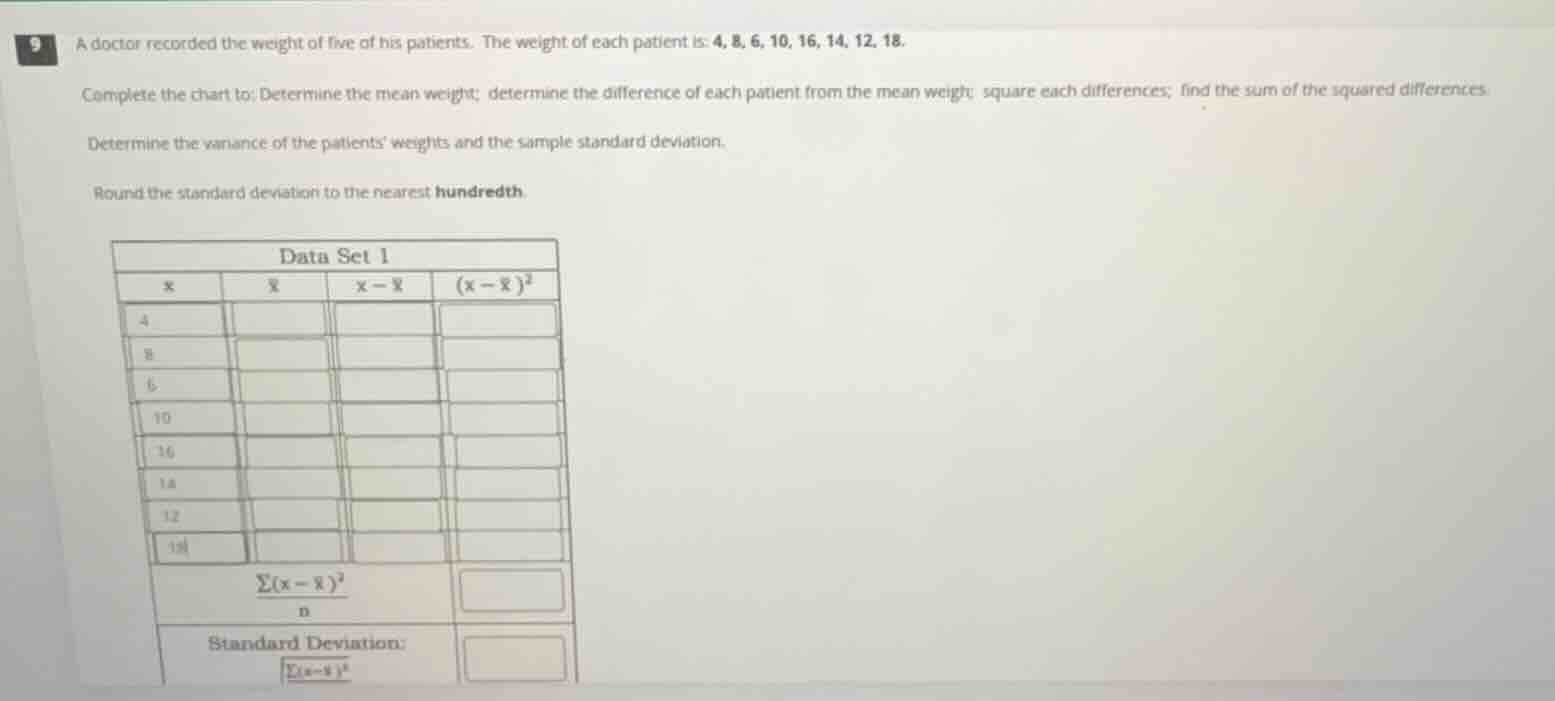
a doctor recorded the weight of five of his patients. the weight of each patient is: 4, 8, 6, 10, 16, 14, 12, 18. complete the chart to: determine the mean weight; determine the difference of each patient from the mean weight; square each differences; find the sum of the squared differences. determine the variance of the patients weights and the sample standard deviation. round the standard deviation to the nearest hundredth. data set 1 with columns x, \\(\bar{x}\\), \\(x - \bar{x}\\), \\((x - \bar{x})^2\\) and rows for 4, 8, 6, 10, 16, 14, 12, 18, then \\(\frac{\sum (x - \bar{x})^2}{n}\\) and standard deviation: \\(\sqrt{\frac{\sum (x - \bar{x})^2}{n}}\\)
Step1: Calculate the mean ($\bar{x}$)
First, we find the sum of the weights. The weights are 4, 8, 6, 10, 16, 14, 12, 18. Wait, the problem says five patients, but the data has 8 values? Wait, maybe a typo, but let's check the numbers: 4,8,6,10,16,14,12,18. Let's sum them: 4 + 8 + 6 + 10 + 16 + 14 + 12 + 18. Let's calculate: 4+8=12; 12+6=18; 18+10=28; 28+16=44; 44+14=58; 58+12=70; 70+18=88. Wait, no, 4+8=12, +6=18, +10=28, +16=44, +14=58, +12=70, +18=88? Wait, no, 4+8=12, +6=18, +10=28, +16=44, +14=58, +12=70, +18=88? Wait, that's 8 numbers. Wait, the problem says five patients, but the data has 8. Maybe it's a mistake, but let's proceed with the given data. The number of data points $n = 8$. Sum $\sum x = 4 + 8 + 6 + 10 + 16 + 14 + 12 + 18$. Let's recalculate: 4+8=12, +6=18, +10=28, +16=44, +14=58, +12=70, +18=88. So $\bar{x} = \frac{\sum x}{n} = \frac{88}{8} = 11$.
Step2: Fill the table for each $x$
For each $x$, calculate $x - \bar{x}$ and $(x - \bar{x})^2$.
- For $x = 4$: $x - \bar{x} = 4 - 11 = -7$; $(x - \bar{x})^2 = (-7)^2 = 49$
- For $x = 8$: $x - \bar{x} = 8 - 11 = -3$; $(x - \bar{x})^2 = (-3)^2 = 9$
- For $x = 6$: $x - \bar{x} = 6 - 11 = -5$; $(x - \bar{x})^2 = (-5)^2 = 25$
- For $x = 10$: $x - \bar{x} = 10 - 11 = -1$; $(x - \bar{x})^2 = (-1)^2 = 1$
- For $x = 16$: $x - \bar{x} = 16 - 11 = 5$; $(x - \bar{x})^2 = 5^2 = 25$
- For $x = 14$: $x - \bar{x} = 14 - 11 = 3$; $(x - \bar{x})^2 = 3^2 = 9$
- For $x = 12$: $x - \bar{x} = 12 - 11 = 1$; $(x - \bar{x})^2 = 1^2 = 1$
- For $x = 18$: $x - \bar{x} = 18 - 11 = 7$; $(x - \bar{x})^2 = 7^2 = 49$
Step3: Calculate $\sum (x - \bar{x})^2$
Sum the squared differences: 49 + 9 + 25 + 1 + 25 + 9 + 1 + 49. Let's calculate: 49+9=58; 58+25=83; 83+1=84; 84+25=109; 109+9=118; 118+1=119; 119+49=168. So $\sum (x - \bar{x})^2 = 168$.
Step4: Calculate variance (population variance, since it's all patients? Wait, the problem says "variance of the patients' weights" and "sample standard deviation". Wait, if it's a sample, we use $n - 1$, but the problem says "variance" (maybe population) and "sample standard deviation". Wait, let's check the table: the variance is $\frac{\sum (x - \bar{x})^2}{n}$, and sample standard deviation is $\sqrt{\frac{\sum (x - \bar{x})^2}{n - 1}}$. Wait, the table has $\frac{\sum (x - \bar{x})^2}{n}$ for variance, and standard deviation as $\sqrt{\frac{\sum (x - \bar{x})^2}{n - 1}}$? Wait, the table shows "Standard Deviation: $\sqrt{\frac{\sum (x - \bar{x})^2}{n - 1}}$"? Wait, the user's table: the last row has "Standard Deviation: $\sqrt{\frac{\sum (x - \bar{x})^2}{n - 1}}$"? Wait, let's check the problem statement: "Determine the variance of the patients' weights and the sample standard deviation." So variance (population) is $\sigma^2 = \frac{\sum (x - \bar{x})^2}{n}$, and sample standard deviation is $s = \sqrt{\frac{\sum (x - \bar{x})^2}{n - 1}}$.
First, variance (population): $\frac{168}{8} = 21$.
Sample standard deviation: $\sqrt{\frac{168}{8 - 1}} = \sqrt{\frac{168}{7}} = \sqrt{24} \approx 4.89898 \approx 4.90$ (rounded to nearest hundredth).
Wait, let's verify:
- $\sum x = 4 + 8 + 6 + 10 + 16 + 14 + 12 + 18 = 88$, $n = 8$, so $\bar{x} = 88 / 8 = 11$. Correct.
- Squared differences:
4: (4-11)^2=49
8: (8-11)^2=9
6: (6-11)^2=25
10: (10-11)^2=1
16: (16-11)^2=25
14: (14-11)^2=9
12: (12-11)^2=1
18: (18-11)^2=49
Sum: 49+9=58, +25=83, +1=84, +25=109, +9=118, +1=119, +49=168. Correct.
Variance (population): 168 / 8 = 21.
Sample standard deviation: 168 / 7 = 24, square root of 24 is approximately 4.89898, which is 4.90 when rounded to the neare…

Snap & solve any problem in the app
Get step-by-step solutions on Sovi AI
Photo-based solutions with guided steps
Explore more problems and detailed explanations
First, filling the table:
| $x$ | $\bar{x}$ | $x - \bar{x}$ | $(x - \bar{x})^2$ |
|---|---|---|---|
| 8 | 11 | -3 | 9 |
| 6 | 11 | -5 | 25 |
| 10 | 11 | -1 | 1 |
| 16 | 11 | 5 | 25 |
| 14 | 11 | 3 | 9 |
| 12 | 11 | 1 | 1 |
| 18 | 11 | 7 | 49 |
$\sum (x - \bar{x})^2 = 168$
Variance ( $\frac{\sum (x - \bar{x})^2}{n}$ ) = 21
Sample Standard Deviation: $\approx 4.90$
So, the variance is 21, and the sample standard deviation is approximately 4.90.