QUESTION IMAGE
Question
document 3
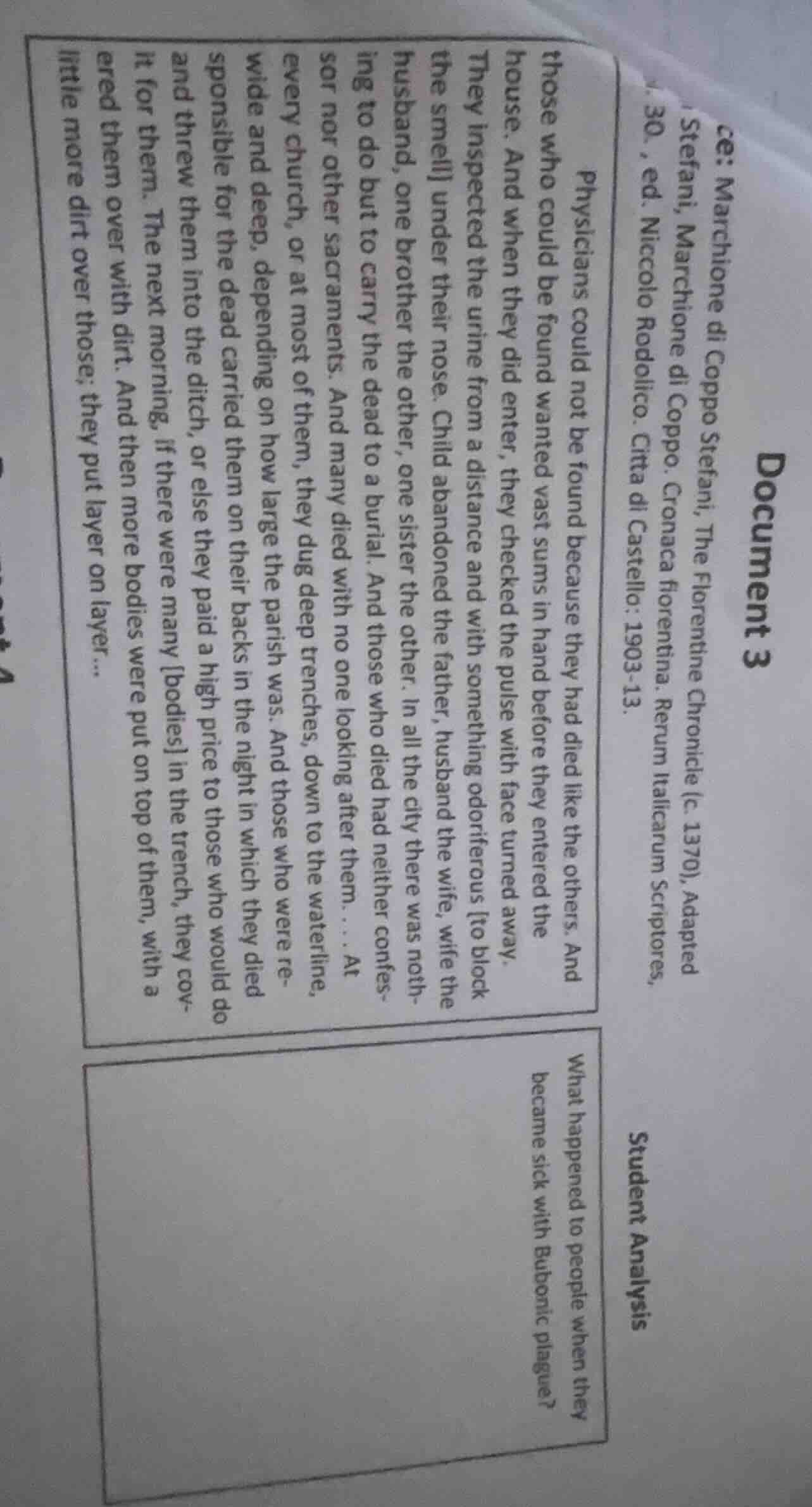
ce: marchione di coppo stefani, the florentine chronicle (c. 1370), adapted from stefani, marchione di coppo. cronaca fiorentina. rerum italicarum scriptores, 30, ed. niccolo rodolico. citta di castello: 1903-13.
physicians could not be found because they had died like the others. and those who could be found wanted vast sums in hand before they entered the house. and when they did enter, they checked the pulse with face turned away. they inspected the urine from a distance and with something odoriferous to block the smell under their nose. child abandoned the father, husband the wife, wife the husband, one brother the other, one sister the other. in all the city there was nothing to do but to carry the dead to a burial. and those who died had neither confessor nor other sacraments. and many died with no one looking after them. ... at every church, or at most of them, they dug deep trenches, down to the waterline, wide and deep, depending on how large the parish was. and those who were responsible for the dead carried them on their backs in the night in which they died and threw them into the ditch, or else they paid a high price to those who would do it for them. the next morning, if there were many bodies in the trench, they covered them over with dirt. and then more bodies were put on top of them, with a little more dirt over those; they put layer on layer...
student analysis
what happened to people when they became sick with bubonic plague?
The document describes the impact of the Bubonic plague. Physicians couldn't be found as many died. People died in large numbers, bodies were abandoned or buried in trenches. Daily life (like church, sacraments) was disrupted. Burial practices changed due to the high death toll.

Snap & solve any problem in the app
Get step-by-step solutions on Sovi AI
Photo-based solutions with guided steps
Explore more problems and detailed explanations
When people became sick with the Bubonic plague:
- Physicians were scarce (many died, others couldn't be found as they feared death or high fees weren't enough incentive).
- People died in large numbers (family members like fathers, husbands, wives, siblings died; many died with no one to care for them).
- Burial practices changed: deep trenches were dug at churches, bodies were carried at night (based on parish size), thrown in ditches or buried in mass graves (multiple bodies in trenches, layered with dirt).
- Daily religious and social practices (like sacraments) were disrupted, and normal care for the dead ended.