QUESTION IMAGE
Question
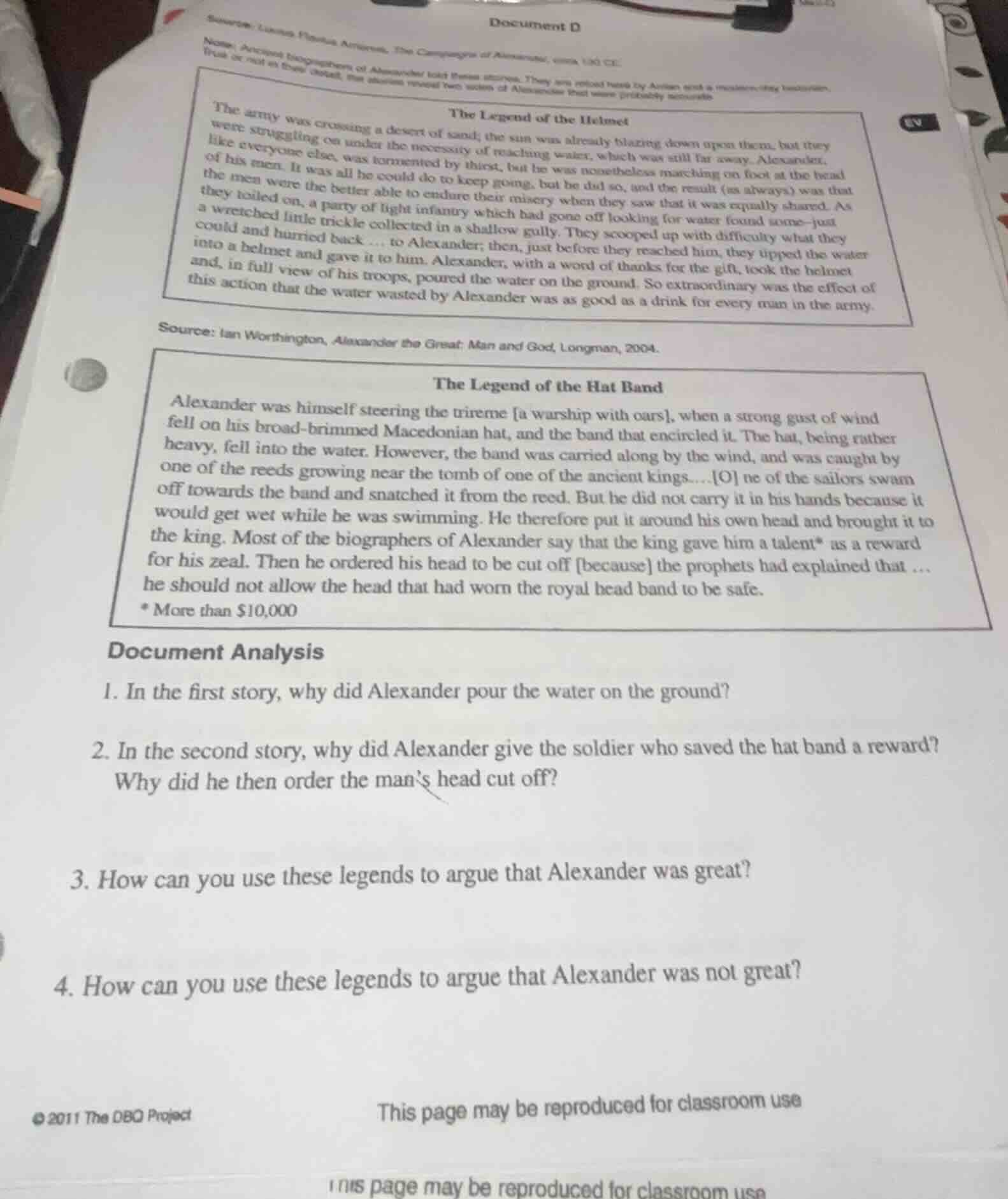
document d
the legend of the helmet
the army was crossing a desert of sand; the sun was already blazing down upon them, but they were struggling on under the necessity of reaching water, which was still far away. alexander, like everyone else, was tormented by thirst, but he was nonetheless marching on foot at the head of his men. it was all he could do to keep going, but he did so, and the result (as always) was that the men were the better able to endure their misery when they saw that it was equally shared. as they toiled on, a party of light infantry which had gone off looking for water found some - just a wretched little trickle collected in a shallow gully. they scooped up with difficulty what they could and hurried back... to alexander; then, just before they reached him, they tipped the water into a helmet and gave it to him. alexander, with a word of thanks for the gift, took the helmet and, in full view of his troops, poured the water on the ground. so extraordinary was the effect of this action that the water wasted by alexander was as good as a drink for every man in the army.
source: ian worthington, alexander the great: man and god, longman, 2004.
the legend of the hat band
alexander was himself steering the trireme a warship with oars, when a strong gust of wind fell on his broad - brimmed macedonian hat, and the band that encircled it. the hat, being rather heavy, fell into the water. however, the band was carried along by the wind, and was caught by one of the reeds growing near the tomb of one of the ancient kings... one of the sailors swam off towards the band and snatched it from the reed. but he did not carry it in his hands because it would get wet while he was swimming. he therefore put it around his own head and brought it to the king. most of the biographers of alexander say that the king gave him a talent* as a reward for his zeal. then he ordered his head to be cut off because the prophets had explained that... he should not allow the head that had worn the royal head band to be safe.
- more than $10,000
document analysis
- in the first story, why did alexander pour the water on the ground?
- in the second story, why did alexander give the soldier who saved the hat band a reward? why did he then order the man’s head cut off?
- how can you use these legends to argue that alexander was great?
- how can you use these legends to argue that alexander was not great?
1. In the first story, why did Alexander pour the water on the ground?
From "The Legend of the Helmet", Alexander and his army were suffering from thirst in the desert. The soldiers found a little water and gave it to him. By pouring the water on the ground, he showed that he shared the hardship (since he was also thirsty but gave up the water) and this act inspired the troops—making them feel their misery was equally shared, boosting morale so they could endure better.
- Reward Reason: In "The Legend of the Hat Band", the soldier swam to retrieve the royal hat band with zeal (effort/dedication), so Alexander rewarded him (with a talent) to recognize his enthusiastic service.
- Execution Reason: The prophets explained Alexander should not let the head that wore the royal head - band be safe. So, despite the reward, he ordered the soldier’s head cut off to follow the prophets’ advice (or due to superstitious beliefs tied to the royal head - band).
- From "The Legend of the Helmet", Alexander’s act of pouring water (giving up his chance at relief) showed self - sacrifice and leadership—sharing soldiers’ suffering to boost morale, proving he cared for his men and led by example.
- In "The Legend of the Hat Band", his reward for the soldier’s zeal showed he recognized and valued dedication, a sign of a good leader. Even the harsh execution (while extreme) could be framed as following divine/prophetic guidance, showing his adherence to “higher” rules (though this is more complex). Overall, these acts (sacrifice, recognizing merit) highlight leadership and noble traits.

Snap & solve any problem in the app
Get step-by-step solutions on Sovi AI
Photo-based solutions with guided steps
Explore more problems and detailed explanations
Alexander poured the water on the ground to show he shared the army’s hardship (he was also thirsty but gave up the water), which boosted the troops’ morale by making them feel their suffering was equally borne, helping them endure the misery of thirst and the desert march better.