QUESTION IMAGE
Question
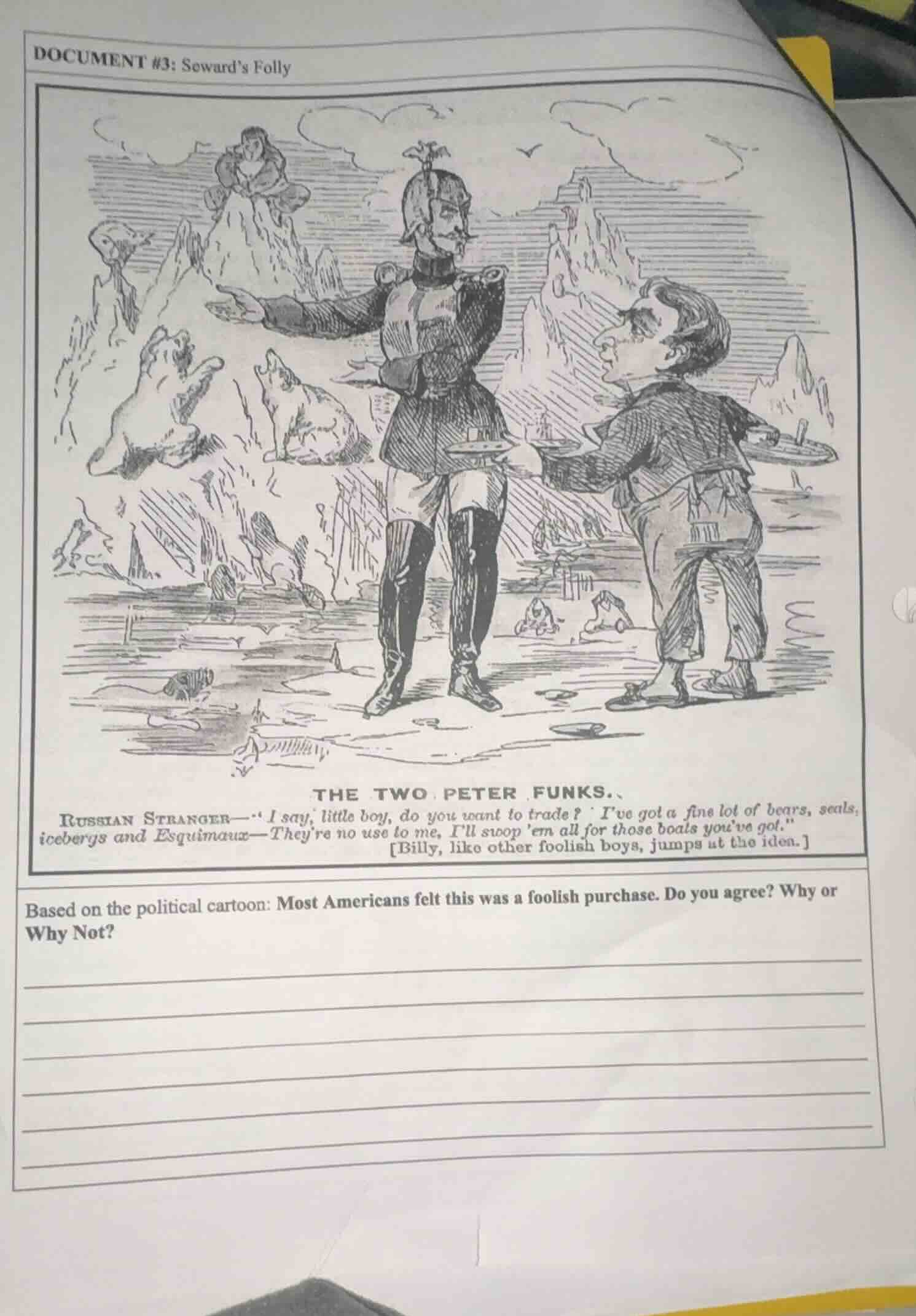
document #3: seward’s folly
the two peter funks.
russian stranger—‘ i say, little boy, do you want to trade? i’ve got a fine lot of bears, seals, iceberys and esquimaux—they’re no use to me, i’ll swoop ’em all for those boats you’ve got.”
billy, like other foolish boys, jumps at the idea.
based on the political cartoon: most americans felt this was a foolish purchase. do you agree? why or why not?
This cartoon satirizes the 1867 Alaska Purchase (called "Seward's Folly"), framing it as a bad trade of valuable U.S. assets for seemingly useless frozen land, animals, and Indigenous people. In hindsight, the purchase was not foolish: Alaska later proved to have massive natural resources (gold, oil, fish, timber) and strategic geopolitical value for the U.S. At the time, critics underestimated its potential, but subsequent developments showed it was a long-term beneficial acquisition.

Snap & solve any problem in the app
Get step-by-step solutions on Sovi AI
Photo-based solutions with guided steps
Explore more problems and detailed explanations
I do not agree that the purchase was foolish. While 19th-century Americans saw Alaska as a frozen, worthless territory, it later became extremely valuable for its abundant natural resources (gold, oil, fisheries, and timber) and provided important strategic geopolitical positioning for the United States in the Pacific and Arctic regions. The cartoon's satire reflected short-sighted contemporary views, not the long-term merit of the acquisition.