QUESTION IMAGE
Question
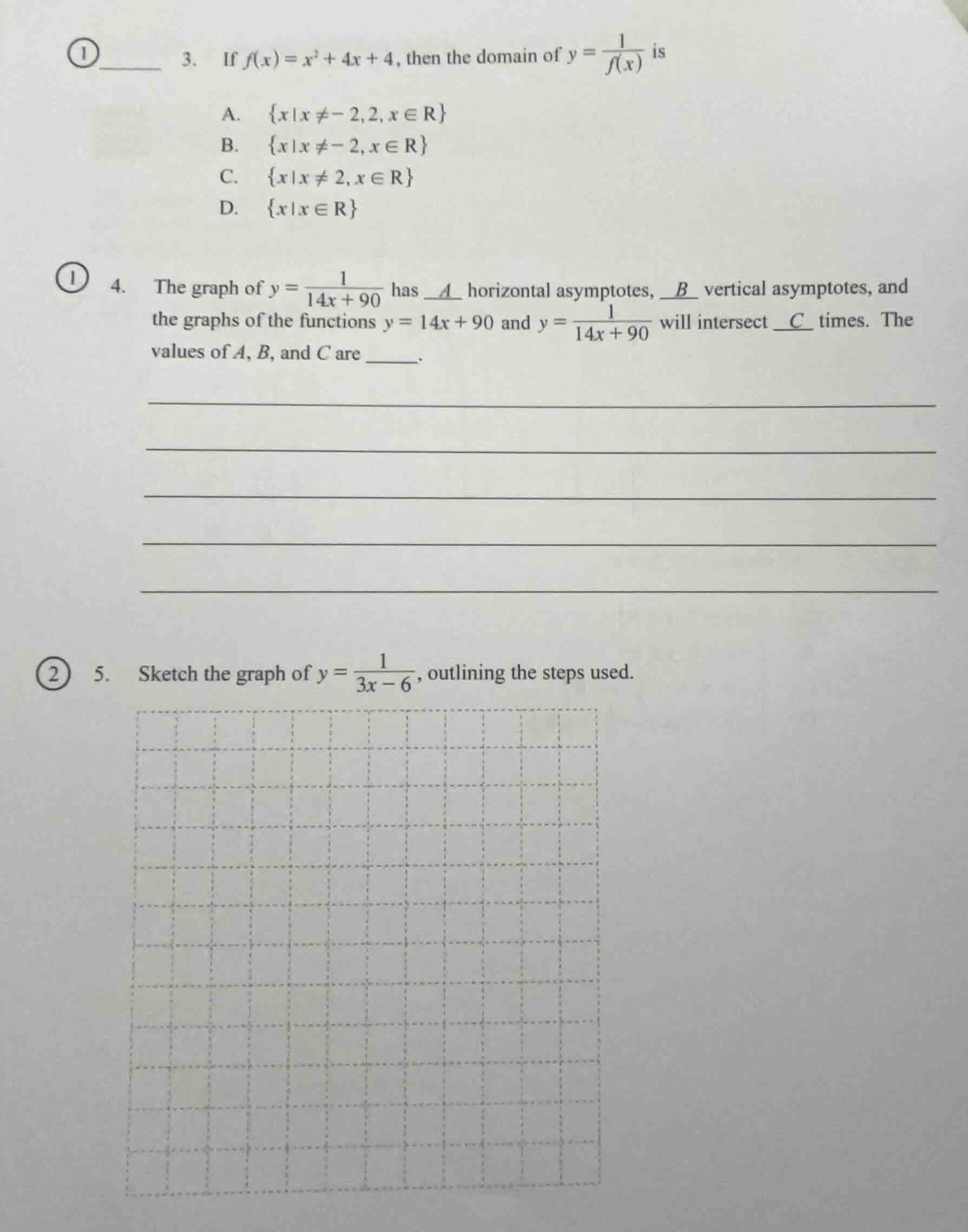
- if $f(x)=x^2 + 4x + 4$, then the domain of $y = \frac{1}{f(x)}$ is
a. $\\{x|x \
eq -2, 2, x \in \mathrm{r}\\}$
b. $\\{x|x \
eq -2, x \in \mathrm{r}\\}$
c. $\\{x|x \
eq 2, x \in \mathrm{r}\\}$
d. $\\{x|x \in \mathrm{r}\\}$
- the graph of $y = \frac{1}{14x + 90}$ has $a$ horizontal asymptotes, $b$ vertical asymptotes, and the graphs of the functions $y = 14x + 90$ and $y = \frac{1}{14x + 90}$ will intersect $c$ times. the values of $a$, $b$, and $c$ are ______.
- sketch the graph of $y = \frac{1}{3x - 6}$, outlining the steps used.
Question 3
Step1: Factor the denominator
$f(x)=x^2+4x+4=(x+2)^2$
Step2: Find undefined points
Set $(x+2)^2=0$, solve: $x=-2$
Step3: Define the domain
All real numbers except $x=-2$
Step1: Find horizontal asymptote (A)
For $y=\frac{1}{14x+90}$, as $x\to\pm\infty$, $y\to0$. So $A=1$.
Step2: Find vertical asymptote (B)
Set $14x+90=0$, solve: $x=-\frac{90}{14}=-\frac{45}{7}$. So $B=1$.
Step3: Find intersection count (C)
Set $14x+90=\frac{1}{14x+90}$. Let $t=14x+90$, so $t^2=1$, $t=\pm1$.
- $14x+90=1 \implies 14x=-89 \implies x=-\frac{89}{14}$
- $14x+90=-1 \implies 14x=-91 \implies x=-\frac{13}{2}$
Two valid solutions, so $C=2$.
Step1: Identify undefined points
Set $3x-6=0$, solve: $x=2$. Vertical asymptote: $x=2$.
Step2: Find horizontal asymptote
As $x\to\pm\infty$, $y=\frac{1}{3x-6}\to0$. Horizontal asymptote: $y=0$.
Step3: Plot key points
- For $x>2$: $x=3$, $y=\frac{1}{3(3)-6}=\frac{1}{3}$; $x=4$, $y=\frac{1}{6}$
- For $x<2$: $x=1$, $y=\frac{1}{3(1)-6}=-\frac{1}{3}$; $x=0$, $y=-\frac{1}{6}$
Step4: Sketch the graph
Draw asymptotes $x=2$ (dashed vertical) and $y=0$ (dashed horizontal). Plot the points, then draw two curves: one in the right half ($x>2$, above $y=0$) and one in the left half ($x<2$, below $y=0$), approaching the asymptotes.

Snap & solve any problem in the app
Get step-by-step solutions on Sovi AI
Photo-based solutions with guided steps
Explore more problems and detailed explanations
B. $\{x|x
eq -2, x \in \mathbb{R}\}$
---