QUESTION IMAGE
Question
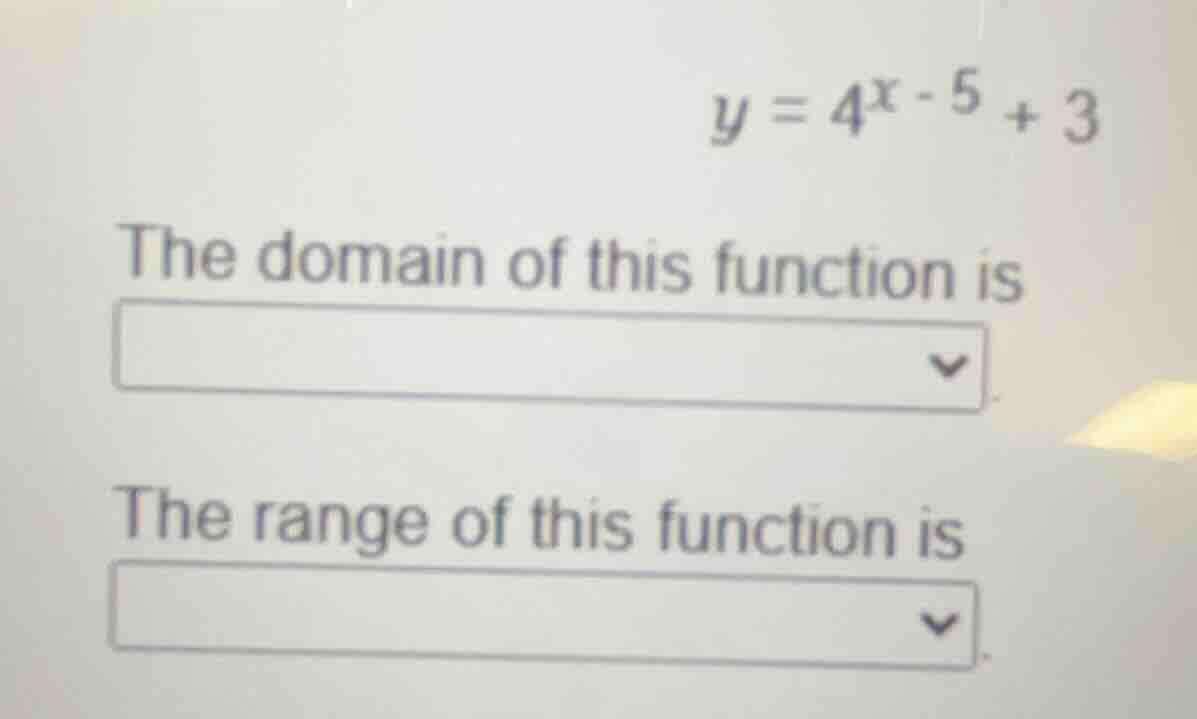
y = 4^{x - 5} + 3
the domain of this function is
the range of this function is
Step1: Analyze the domain of the exponential function
For the function \( y = 4^{x - 5}+3 \), the base of the exponential function is \( 4>0 \) and the exponent is a linear function of \( x \) (i.e., \( x - 5 \)). There are no restrictions on the value of \( x \) for which the exponential function is defined. So, \( x \) can be any real number. Mathematically, the domain is all real numbers, which can be written as \( (-\infty, \infty) \) or \( \mathbb{R} \).
Step2: Analyze the range of the exponential function
Recall the property of the exponential function \( a^{x} \) where \( a>0,a
eq1 \). The range of \( a^{x} \) is \( (0, \infty) \). For the function \( y = 4^{x - 5}+3 \), let \( u=x - 5 \). Then \( y = 4^{u}+3 \). Since the range of \( 4^{u} \) is \( (0, \infty) \), when we add 3 to each value in the range of \( 4^{u} \), we get the range of \( y \) as \( (0 + 3,\infty)=(3, \infty) \).

Snap & solve any problem in the app
Get step-by-step solutions on Sovi AI
Photo-based solutions with guided steps
Explore more problems and detailed explanations
- The domain of this function is all real numbers (or \( (-\infty, \infty) \) or \( \mathbb{R} \)).
- The range of this function is \( (3, \infty) \).