QUESTION IMAGE
Question
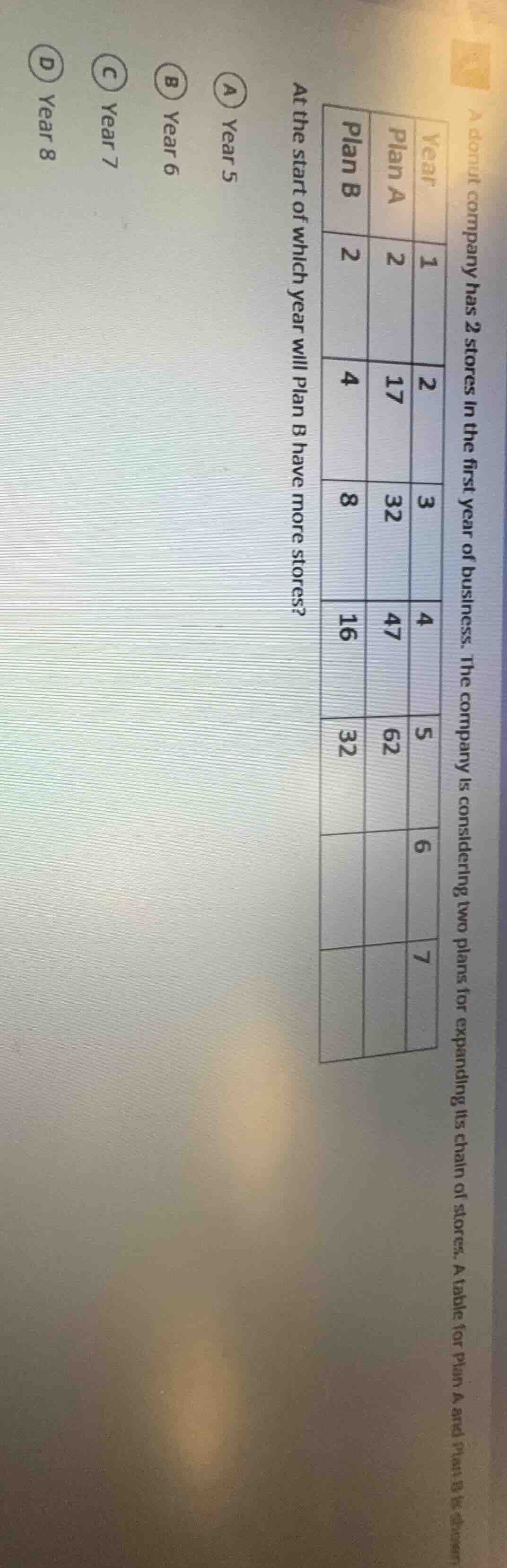
a donut company has 2 stores in the first year of business. the company is considering two plans for expanding its chain of stores. a table for plan a and plan b is shown. at the start of which year will plan b have more stores? a year 5 b year 6 c year 7 d year 8
Step1: Analyze Plan B's pattern
Looking at Plan B: Year 1: 2, Year 2: 4, Year 3: 8, Year 4: 16, Year 5: 32. We can see it's a geometric sequence with first term \(a = 2\) and common ratio \(r = 2\) (since \(4\div2 = 2\), \(8\div4 = 2\), etc.). The formula for the \(n\)-th term of a geometric sequence is \(a_n=a\times r^{n - 1}\).
Step2: Analyze Plan A's pattern
For Plan A: Year 1: 2, Year 2: 17, Year 3: 32, Year 4: 47, Year 5: 62. The difference between consecutive terms: \(17 - 2=15\), \(32 - 17 = 15\), \(47 - 32=15\), \(62 - 47 = 15\). So it's an arithmetic sequence with first term \(a = 2\) and common difference \(d = 15\). The formula for the \(n\)-th term of an arithmetic sequence is \(a_n=a+(n - 1)d\).
Step3: Calculate Plan B's terms for Year 6,7,8
- Year 6 (n = 6): \(a_6=2\times2^{6 - 1}=2\times32 = 64\)
- Year 7 (n = 7): \(a_7=2\times2^{7 - 1}=2\times64 = 128\)
- Year 8 (n = 8): \(a_8=2\times2^{8 - 1}=2\times128 = 256\)
Step4: Calculate Plan A's terms for Year 6,7,8
- Year 6 (n = 6): \(a_6=2+(6 - 1)\times15=2 + 75=77\)
- Year 7 (n = 7): \(a_7=2+(7 - 1)\times15=2+90 = 92\)
- Year 8 (n = 8): \(a_8=2+(8 - 1)\times15=2 + 105=107\)
Step5: Compare Plan B and Plan A for each year
- Year 5: Plan B = 32, Plan A = 62 (Plan B < Plan A)
- Year 6: Plan B = 64, Plan A = 77 (Plan B < Plan A)
- Year 7: Plan B = 128, Plan A = 92 (Plan B > Plan A)
- Year 8: Plan B = 256, Plan A = 107 (Plan B > Plan A)
But we need to find the start of which year Plan B has more stores. Let's check the start of Year 7 (i.e., end of Year 6 or start of Year 7). Wait, actually, the "start of year" means the beginning of that year, so we need to see when Plan B's store count at the start of the year (which is the store count at the end of the previous year) exceeds Plan A's. Wait, maybe I misinterpreted. Let's re - check the table:
Wait the table for Plan A: Year 1:2, Year 2:17, Year 3:32, Year 4:47, Year 5:62.
Plan B: Year 1:2, Year 2:4, Year 3:8, Year 4:16, Year 5:32.
Now let's calculate for Year 6:
Plan A: The pattern is +15 each year. So Year 6: 62 + 15=77
Plan B: The pattern is \(2^n\) (since Year 1: \(2^1 = 2\), Year 2: \(2^2 = 4\), Year 3: \(2^3 = 8\), Year 4: \(2^4 = 16\), Year 5: \(2^5 = 32\), Year 6: \(2^6 = 64\), Year 7: \(2^7 = 128\))
Now compare:
- Start of Year 5: Plan A at start of Year 5 is Plan A's Year 4 value? Wait no, the start of year \(n\) would be the number of stores at the end of year \(n - 1\). Wait maybe the table is the number of stores at the end of each year.
Wait the problem says "at the start of which year will Plan B have more stores". So start of Year \(n\) is the number of stores at the end of Year \(n - 1\).
- Start of Year 5: End of Year 4. Plan A: 47, Plan B:16 (Plan B < Plan A)
- Start of Year 6: End of Year 5. Plan A:62, Plan B:32 (Plan B < Plan A)
- Start of Year 7: End of Year 6. Plan A:62 + 15=77, Plan B: \(2^6 = 64\)? Wait no, earlier calculation of Plan B's Year 6 (end of Year 6) is \(2^6=64\)? Wait no, Year 1:2 (end of Year 1), Year 2:4 (end of Year 2), so Year \(n\) end is \(2^n\). So end of Year 5: \(2^5 = 32\), end of Year 6: \(2^6 = 64\), end of Year 7: \(2^7 = 128\)
Plan A: end of Year 1:2, end of Year 2:17, end of Year 3:32, end of Year 4:47, end of Year 5:62, end of Year 6:62 + 15=77, end of Year 7:77+15 = 92
Now start of Year 7: end of Year 6. Plan A:77, Plan B:64 (Plan B < Plan A)
Start of Year 8: end of Year 7. Plan A:92, Plan B:128 (Plan B > Plan A)
Wait but the options are Year 5,6,7,8. Wait maybe my initial analysis of Plan A is wrong. Wait let's re - check the Plan A numbers…

Snap & solve any problem in the app
Get step-by-step solutions on Sovi AI
Photo-based solutions with guided steps
Explore more problems and detailed explanations
D. Year 8