QUESTION IMAGE
Question
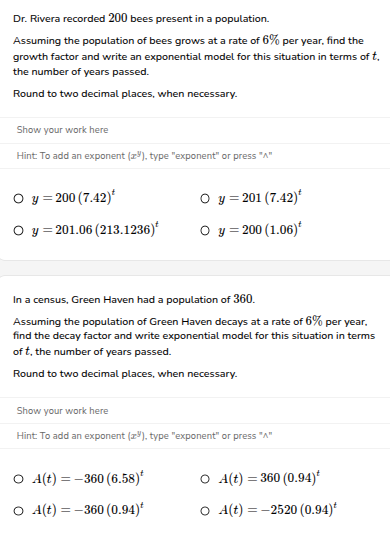
dr. rivera recorded 200 bees present in a population. assuming the population of bees grows at a rate of 6% per year, find the growth factor and write an exponential model for this situation in terms of t, the number of years passed. round to two decimal places, when necessary. show your work here hint: to add an exponent x^t, type \exponent\ or press \^\ \\( y = 200(7.42)^t \\) \\( y = 201(7.42)^t \\) \\( y = 201.06(213.1236)^t \\) \\( y = 200(1.06)^t \\) in a census, green haven had a population of 360. assuming the population of green haven decays at a rate of 6% per year, find the decay factor and write exponential model for this situation in terms of t, the number of years passed. round to two decimal places, when necessary. show your work here hint: to add an exponent x^t, type \exponent\ or press \^\ \\( a(t) = -360(6.58)^t \\) \\( a(t) = 360(0.94)^t \\) \\( a(t) = -360(0.94)^t \\) \\( a(t) = -2520(0.94)^t \\)
First Problem (Bee Population Growth)
Step1: Recall exponential growth formula
The general form of an exponential growth model is \( y = a(1 + r)^t \), where \( a \) is the initial amount, \( r \) is the growth rate (as a decimal), and \( t \) is time.
Here, \( a = 200 \) (initial number of bees), and \( r = 6\% = 0.06 \).
Step2: Calculate the growth factor
The growth factor is \( 1 + r \). Substituting \( r = 0.06 \), we get \( 1 + 0.06 = 1.06 \).
Step3: Write the exponential model
Substituting \( a = 200 \) and the growth factor \( 1.06 \) into the formula, we get \( y = 200(1.06)^t \).
Step1: Recall exponential decay formula
The general form of an exponential decay model is \( A(t)=a(1 - r)^t \), where \( a \) is the initial amount, \( r \) is the decay rate (as a decimal), and \( t \) is time.
Here, \( a = 360 \) (initial population), and \( r = 6\% = 0.06 \).
Step2: Calculate the decay factor
The decay factor is \( 1 - r \). Substituting \( r = 0.06 \), we get \( 1 - 0.06 = 0.94 \).
Step3: Write the exponential model
Substituting \( a = 360 \) and the decay factor \( 0.94 \) into the formula, we get \( A(t)=360(0.94)^t \). Also, population can't be negative, so we discard options with negative coefficients.

Snap & solve any problem in the app
Get step-by-step solutions on Sovi AI
Photo-based solutions with guided steps
Explore more problems and detailed explanations
\( y = 200(1.06)^t \) (corresponding to the option \( y = 200(1.06)^t \))