QUESTION IMAGE
Question
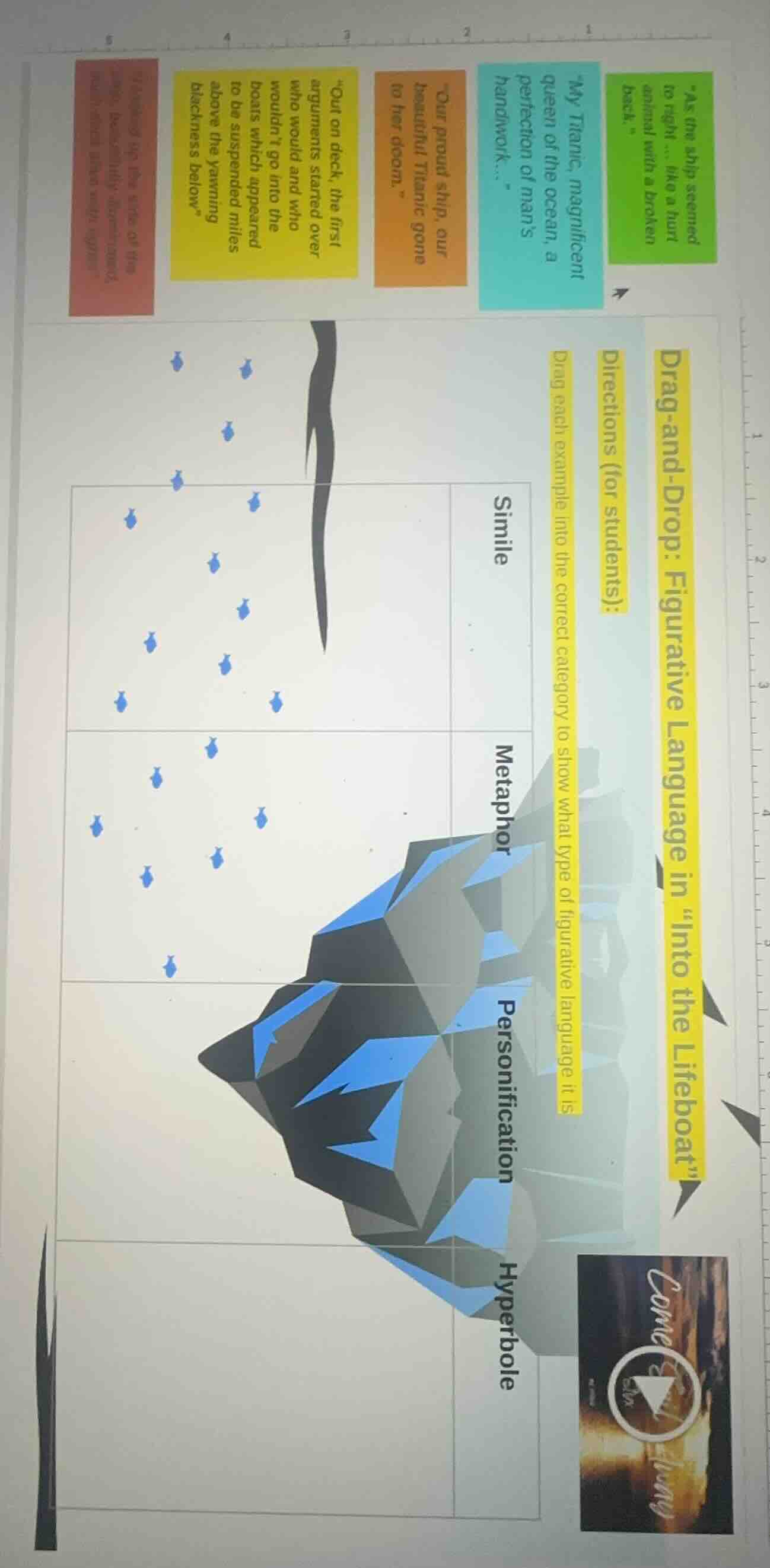
drag-and-drop: figurative language in \into the lifeboat\
directions (for students):
drag each example into the correct category to show what type of figurative language it is
simile
metaphor
personification
hyperbole
\as the ship seemed to right ... like a hurt animal with a broken back.\
\my titanic, magnificent queen of the ocean, a perfection of man’s handiwork...\
\our proud ship, our beautiful titanic gone to her doom.\
\out on deck, the first arguments started over who would and who wouldn’t go into the boats which appeared to be suspended miles above the yawning blackness below\
\i hung up the wire of the ... box, carefully disconnected ... now, still live with venom.\
To solve this drag - and - drop problem about figurative language in the text "Into the Lifeboat", we first need to recall the definitions of each type of figurative language:
1. Simile
A simile is a figure of speech that makes a comparison between two different things using the words "like" or "as".
- The sentence "As the ship seemed to right... like a hurt animal with a broken back" uses "like" to compare the ship to a hurt animal. So this sentence should be dragged to the "Simile" category.
2. Metaphor
A metaphor is a figure of speech that directly compares two unrelated things, without using "like" or "as".
- The sentence "My Titanic, magnificent queen of the ocean, a perfection of man’s handiwork" directly compares the Titanic to a queen of the ocean. So this sentence should be dragged to the "Metaphor" category.
3. Personification
Personification is a figure of speech in which non - human entities are given human qualities or actions.
- The sentence "Our proud ship, our beautiful Titanic gone to her doom" gives the ship (a non - human entity) the human quality of being "proud" and also refers to the ship as "her", which is a human - like way of referring to it. So this sentence should be dragged to the "Personification" category.
4. Hyperbole
Hyperbole is an exaggeration used for emphasis or effect.
- The sentence "Out on deck, the first arguments started over who would and who wouldn't go into the boats which appeared to be suspended miles above the yawning blackness below" uses the exaggeration "suspended miles above" to emphasize the height of the boats above the water (or the appearance of that height). Also, the sentence "It loomed up like the side of a... no, positively mountainous... and, still black with people" uses "mountainous" and the description of the ship being "black with people" (an exaggeration of the number of people) and the earlier "miles above" - type exaggeration. So these sentences (the yellow and red ones related to the boats' height and the ship's appearance with people) should be dragged to the "Hyperbole" category.
Final Categorization:
- Simile: "As the ship seemed to right... like a hurt animal with a broken back"
- Metaphor: "My Titanic, magnificent queen of the ocean, a perfection of man’s handiwork"
- Personification: "Our proud ship, our beautiful Titanic gone to her doom"
- Hyperbole: "Out on deck, the first arguments started over who would and who wouldn't go into the boats which appeared to be suspended miles above the yawning blackness below"; "It loomed up like the side of a... no, positively mountainous... and, still black with people" (the red - colored sentence)

Snap & solve any problem in the app
Get step-by-step solutions on Sovi AI
Photo-based solutions with guided steps
Explore more problems and detailed explanations
To solve this drag - and - drop problem about figurative language in the text "Into the Lifeboat", we first need to recall the definitions of each type of figurative language:
1. Simile
A simile is a figure of speech that makes a comparison between two different things using the words "like" or "as".
- The sentence "As the ship seemed to right... like a hurt animal with a broken back" uses "like" to compare the ship to a hurt animal. So this sentence should be dragged to the "Simile" category.
2. Metaphor
A metaphor is a figure of speech that directly compares two unrelated things, without using "like" or "as".
- The sentence "My Titanic, magnificent queen of the ocean, a perfection of man’s handiwork" directly compares the Titanic to a queen of the ocean. So this sentence should be dragged to the "Metaphor" category.
3. Personification
Personification is a figure of speech in which non - human entities are given human qualities or actions.
- The sentence "Our proud ship, our beautiful Titanic gone to her doom" gives the ship (a non - human entity) the human quality of being "proud" and also refers to the ship as "her", which is a human - like way of referring to it. So this sentence should be dragged to the "Personification" category.
4. Hyperbole
Hyperbole is an exaggeration used for emphasis or effect.
- The sentence "Out on deck, the first arguments started over who would and who wouldn't go into the boats which appeared to be suspended miles above the yawning blackness below" uses the exaggeration "suspended miles above" to emphasize the height of the boats above the water (or the appearance of that height). Also, the sentence "It loomed up like the side of a... no, positively mountainous... and, still black with people" uses "mountainous" and the description of the ship being "black with people" (an exaggeration of the number of people) and the earlier "miles above" - type exaggeration. So these sentences (the yellow and red ones related to the boats' height and the ship's appearance with people) should be dragged to the "Hyperbole" category.
Final Categorization:
- Simile: "As the ship seemed to right... like a hurt animal with a broken back"
- Metaphor: "My Titanic, magnificent queen of the ocean, a perfection of man’s handiwork"
- Personification: "Our proud ship, our beautiful Titanic gone to her doom"
- Hyperbole: "Out on deck, the first arguments started over who would and who wouldn't go into the boats which appeared to be suspended miles above the yawning blackness below"; "It loomed up like the side of a... no, positively mountainous... and, still black with people" (the red - colored sentence)