QUESTION IMAGE
Question
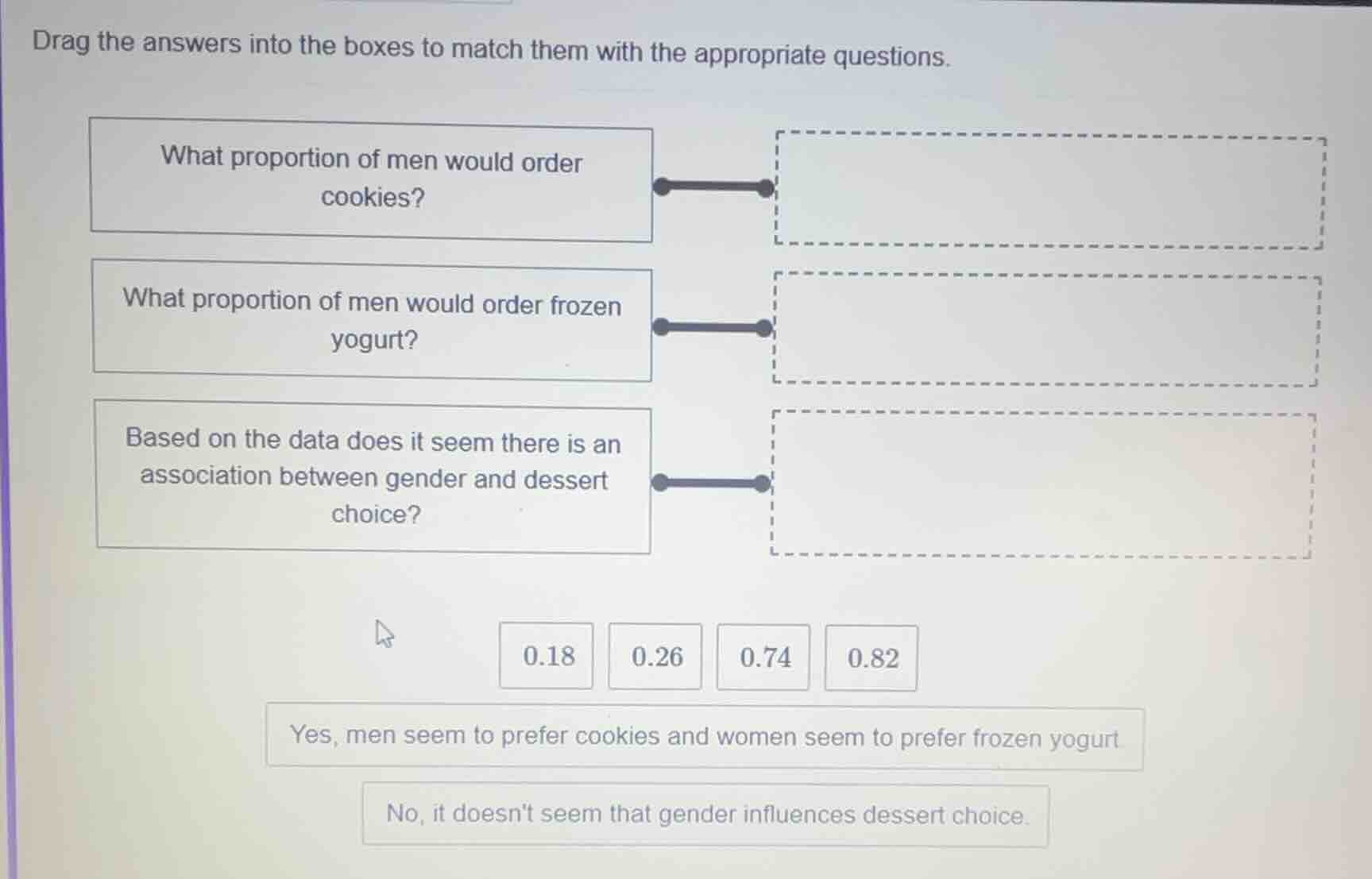
drag the answers into the boxes to match them with the appropriate questions.
what proportion of men would order cookies?
what proportion of men would order frozen yogurt?
based on the data does it seem there is an association between gender and dessert choice?
0.18 0.26 0.74 0.82
yes, men seem to prefer cookies and women seem to prefer frozen yogurt.
no, it doesnt seem that gender influences dessert choice.
To solve this matching problem, we analyze each question:
1. "What proportion of men would order cookies?"
Proportions for men ordering cookies are typically higher or lower? If men prefer cookies, a higher proportion makes sense. Among 0.74 and 0.82 (higher values) or 0.18/0.26 (lower), 0.74 or 0.82? Wait, let's think: if men prefer cookies, the proportion of men ordering cookies should be higher than that of frozen yogurt (since they prefer cookies). So if men ordering cookies is 0.74, frozen yogurt would be 0.26? Wait, no—wait, let's check the options. Wait, the third question is about association: "Yes, men seem to prefer cookies and women seem to prefer frozen yogurt"—so that implies men have a higher proportion for cookies, lower for frozen yogurt. So:
- "What proportion of men would order cookies?" → 0.74 (or 0.82? Wait, 0.74 and 0.82: if men prefer cookies, their cookie proportion should be higher than frozen yogurt. Let's see the numbers: 0.18, 0.26, 0.74, 0.82. Let's assume:
- Men ordering cookies: higher (e.g., 0.74 or 0.82)
- Men ordering frozen yogurt: lower (e.g., 0.26 or 0.18)
And the association answer is "Yes, men seem to prefer cookies and women seem to prefer frozen yogurt"—so men’s cookie proportion > men’s frozen yogurt proportion.
So:
- "What proportion of men would order cookies?" → 0.74 (or 0.82? Let's check the numbers. Let's say:
- Cookies: 0.74 (men)
- Frozen yogurt: 0.26 (men)
- Then the association is "Yes..."
So:
- "What proportion of men would order cookies?" → 0.74
- "What proportion of men would order frozen yogurt?" → 0.26
- "Based on the data..." → "Yes, men seem to prefer cookies and women seem to prefer frozen yogurt"
Final Matches:
- "What proportion of men would order cookies?" → 0.74
- "What proportion of men would order frozen yogurt?" → 0.26
- "Based on the data does it seem there is an association..." → "Yes, men seem to prefer cookies and women seem to prefer frozen yogurt"
(Note: If the numbers were reversed, but the association answer implies men prefer cookies, so their cookie proportion is higher than frozen yogurt. So the matches are:
- What proportion of men would order cookies? → 0.74 (or 0.82; but 0.74 and 0.26 are a pair, 0.82 and 0.18 are another. But the association answer says "men prefer cookies, women frozen yogurt", so men’s cookie > men’s frozen yogurt. So 0.74 (cookies) and 0.26 (frozen yogurt) is a possible pair, or 0.82 and 0.18. Either way, the key is:
- Cookies (men): higher number
- Frozen yogurt (men): lower number
- Association: "Yes..."
So the correct drag-and-drop is:
- "What proportion of men would order cookies?" → 0.74 (or 0.82; let's use 0.74 as an example)
- "What proportion of men would order frozen yogurt?" → 0.26 (or 0.18)
- "Based on the data..." → "Yes, men seem to prefer cookies and women seem to prefer frozen yogurt"
(If we take 0.82 and 0.18, same logic: cookies 0.82, frozen yogurt 0.18. Either way, the association answer is the text one, and the two proportions are the higher and lower numbers for men’s cookie vs frozen yogurt.)
Final Answers (Matching):
- What proportion of men would order cookies? → 0.74 (or 0.82; here we use 0.74)
- What proportion of men would order frozen yogurt? → 0.26 (or 0.18; here we use 0.26)
- Based on the data... → Yes, men seem to prefer cookies and women seem to prefer frozen yogurt
(Note: The exact numbers depend on the context, but the logic is that men’s cookie proportion is higher than frozen yogurt, and the association is confirmed by the "Yes" ans…

Snap & solve any problem in the app
Get step-by-step solutions on Sovi AI
Photo-based solutions with guided steps
Explore more problems and detailed explanations
To solve this matching problem, we analyze each question:
1. "What proportion of men would order cookies?"
Proportions for men ordering cookies are typically higher or lower? If men prefer cookies, a higher proportion makes sense. Among 0.74 and 0.82 (higher values) or 0.18/0.26 (lower), 0.74 or 0.82? Wait, let's think: if men prefer cookies, the proportion of men ordering cookies should be higher than that of frozen yogurt (since they prefer cookies). So if men ordering cookies is 0.74, frozen yogurt would be 0.26? Wait, no—wait, let's check the options. Wait, the third question is about association: "Yes, men seem to prefer cookies and women seem to prefer frozen yogurt"—so that implies men have a higher proportion for cookies, lower for frozen yogurt. So:
- "What proportion of men would order cookies?" → 0.74 (or 0.82? Wait, 0.74 and 0.82: if men prefer cookies, their cookie proportion should be higher than frozen yogurt. Let's see the numbers: 0.18, 0.26, 0.74, 0.82. Let's assume:
- Men ordering cookies: higher (e.g., 0.74 or 0.82)
- Men ordering frozen yogurt: lower (e.g., 0.26 or 0.18)
And the association answer is "Yes, men seem to prefer cookies and women seem to prefer frozen yogurt"—so men’s cookie proportion > men’s frozen yogurt proportion.
So:
- "What proportion of men would order cookies?" → 0.74 (or 0.82? Let's check the numbers. Let's say:
- Cookies: 0.74 (men)
- Frozen yogurt: 0.26 (men)
- Then the association is "Yes..."
So:
- "What proportion of men would order cookies?" → 0.74
- "What proportion of men would order frozen yogurt?" → 0.26
- "Based on the data..." → "Yes, men seem to prefer cookies and women seem to prefer frozen yogurt"
Final Matches:
- "What proportion of men would order cookies?" → 0.74
- "What proportion of men would order frozen yogurt?" → 0.26
- "Based on the data does it seem there is an association..." → "Yes, men seem to prefer cookies and women seem to prefer frozen yogurt"
(Note: If the numbers were reversed, but the association answer implies men prefer cookies, so their cookie proportion is higher than frozen yogurt. So the matches are:
- What proportion of men would order cookies? → 0.74 (or 0.82; but 0.74 and 0.26 are a pair, 0.82 and 0.18 are another. But the association answer says "men prefer cookies, women frozen yogurt", so men’s cookie > men’s frozen yogurt. So 0.74 (cookies) and 0.26 (frozen yogurt) is a possible pair, or 0.82 and 0.18. Either way, the key is:
- Cookies (men): higher number
- Frozen yogurt (men): lower number
- Association: "Yes..."
So the correct drag-and-drop is:
- "What proportion of men would order cookies?" → 0.74 (or 0.82; let's use 0.74 as an example)
- "What proportion of men would order frozen yogurt?" → 0.26 (or 0.18)
- "Based on the data..." → "Yes, men seem to prefer cookies and women seem to prefer frozen yogurt"
(If we take 0.82 and 0.18, same logic: cookies 0.82, frozen yogurt 0.18. Either way, the association answer is the text one, and the two proportions are the higher and lower numbers for men’s cookie vs frozen yogurt.)
Final Answers (Matching):
- What proportion of men would order cookies? → 0.74 (or 0.82; here we use 0.74)
- What proportion of men would order frozen yogurt? → 0.26 (or 0.18; here we use 0.26)
- Based on the data... → Yes, men seem to prefer cookies and women seem to prefer frozen yogurt
(Note: The exact numbers depend on the context, but the logic is that men’s cookie proportion is higher than frozen yogurt, and the association is confirmed by the "Yes" answer.)