QUESTION IMAGE
Question
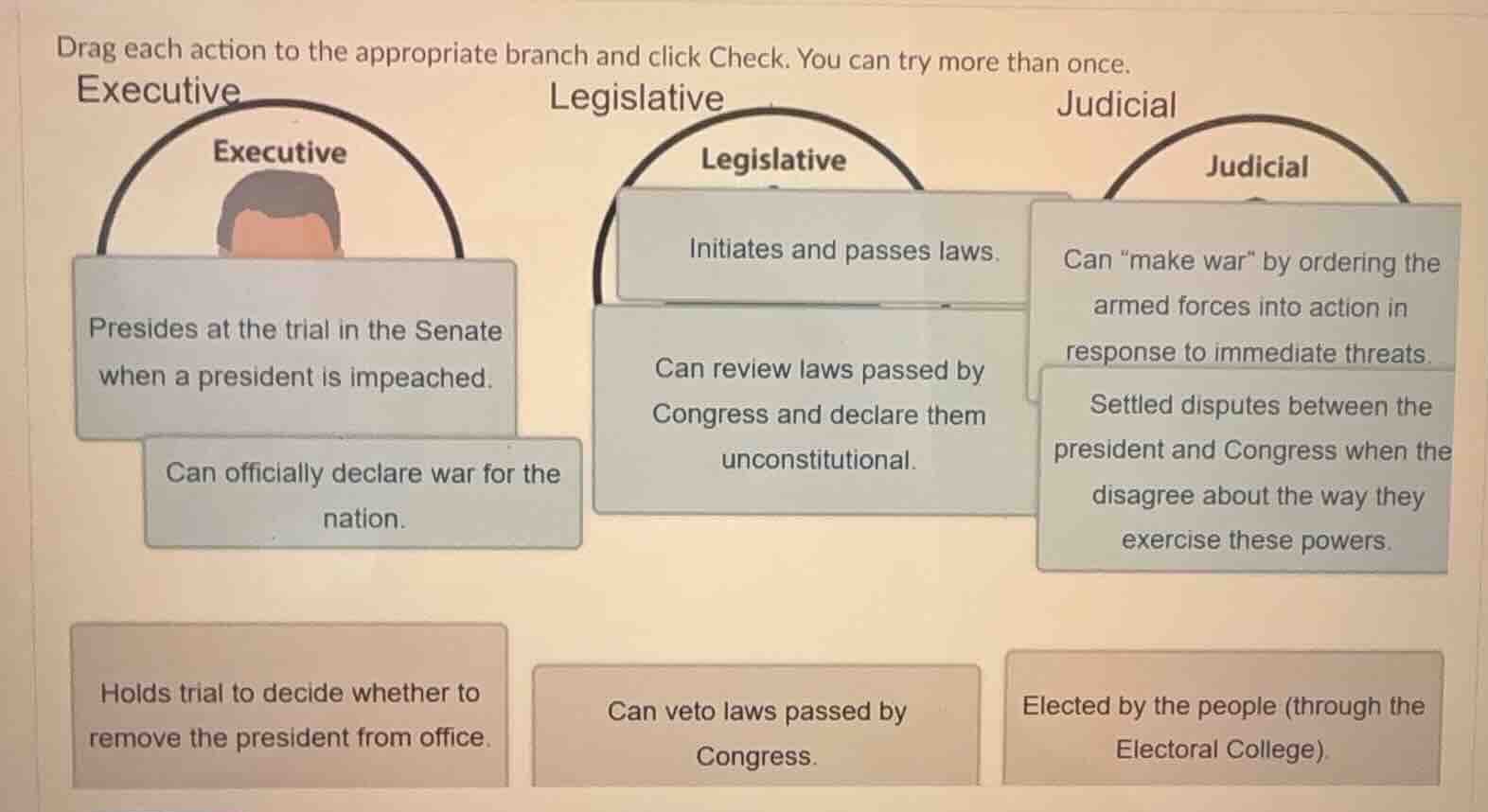
drag each action to the appropriate branch and click check. you can try more than once.
executive
legislative
judicial
executive
legislative
judicial
presides at the trial in the senate when a president is impeached.
initiates and passes laws.
can \make war\ by ordering the armed forces into action in response to immediate threats.
can officially declare war for the nation.
can review laws passed by congress and declare them unconstitutional.
settled disputes between the president and congress when the disagree about the way they exercise these powers.
holds trial to decide whether to remove the president from office.
can veto laws passed by congress.
elected by the people (through the electoral college).
To solve this, we match each action to the correct branch of the US government (Executive, Legislative, Judicial) based on their powers:
Executive Branch Actions:
- "Can 'make war' by ordering the armed forces into action in response to immediate threats." (The President, as head of Executive, commands the military for immediate threats.)
- "Can veto laws passed by Congress." (The President, part of Executive, can veto legislative bills.)
- "Elected by the people (through the Electoral College)." (The President (Executive) is elected via Electoral College.)
Legislative Branch Actions:
- "Initiates and passes laws." (Congress (Legislative) is responsible for lawmaking.)
- "Can officially declare war for the nation." (Congress (Legislative) has the power to declare war.)
- "Holds trial to decide whether to remove the president from office." (The Senate (part of Legislative) holds impeachment trials.)
Judicial Branch Actions:
- "Presides at the trial in the Senate when a president is impeached." (The Chief Justice (Judicial) presides over presidential impeachment trials in the Senate.)
- "Can review laws passed by Congress and declare them unconstitutional." (The Supreme Court (Judicial) exercises judicial review.)
- "Settled disputes between the president and Congress when they disagree about the way they exercise these powers." (The Judiciary resolves disputes between branches.)
Final Matching:
- Executive:
- Can "make war" by ordering the armed forces into action in response to immediate threats.
- Can veto laws passed by Congress.
- Elected by the people (through the Electoral College).
- Legislative:
- Initiates and passes laws.
- Can officially declare war for the nation.
- Holds trial to decide whether to remove the president from office.
- Judicial:
- Presides at the trial in the Senate when a president is impeached.
- Can review laws passed by Congress and declare them unconstitutional.
- Settled disputes between the president and Congress when they disagree about the way they exercise these powers.

Snap & solve any problem in the app
Get step-by-step solutions on Sovi AI
Photo-based solutions with guided steps
Explore more problems and detailed explanations
To solve this, we match each action to the correct branch of the US government (Executive, Legislative, Judicial) based on their powers:
Executive Branch Actions:
- "Can 'make war' by ordering the armed forces into action in response to immediate threats." (The President, as head of Executive, commands the military for immediate threats.)
- "Can veto laws passed by Congress." (The President, part of Executive, can veto legislative bills.)
- "Elected by the people (through the Electoral College)." (The President (Executive) is elected via Electoral College.)
Legislative Branch Actions:
- "Initiates and passes laws." (Congress (Legislative) is responsible for lawmaking.)
- "Can officially declare war for the nation." (Congress (Legislative) has the power to declare war.)
- "Holds trial to decide whether to remove the president from office." (The Senate (part of Legislative) holds impeachment trials.)
Judicial Branch Actions:
- "Presides at the trial in the Senate when a president is impeached." (The Chief Justice (Judicial) presides over presidential impeachment trials in the Senate.)
- "Can review laws passed by Congress and declare them unconstitutional." (The Supreme Court (Judicial) exercises judicial review.)
- "Settled disputes between the president and Congress when they disagree about the way they exercise these powers." (The Judiciary resolves disputes between branches.)
Final Matching:
- Executive:
- Can "make war" by ordering the armed forces into action in response to immediate threats.
- Can veto laws passed by Congress.
- Elected by the people (through the Electoral College).
- Legislative:
- Initiates and passes laws.
- Can officially declare war for the nation.
- Holds trial to decide whether to remove the president from office.
- Judicial:
- Presides at the trial in the Senate when a president is impeached.
- Can review laws passed by Congress and declare them unconstitutional.
- Settled disputes between the president and Congress when they disagree about the way they exercise these powers.