QUESTION IMAGE
Question
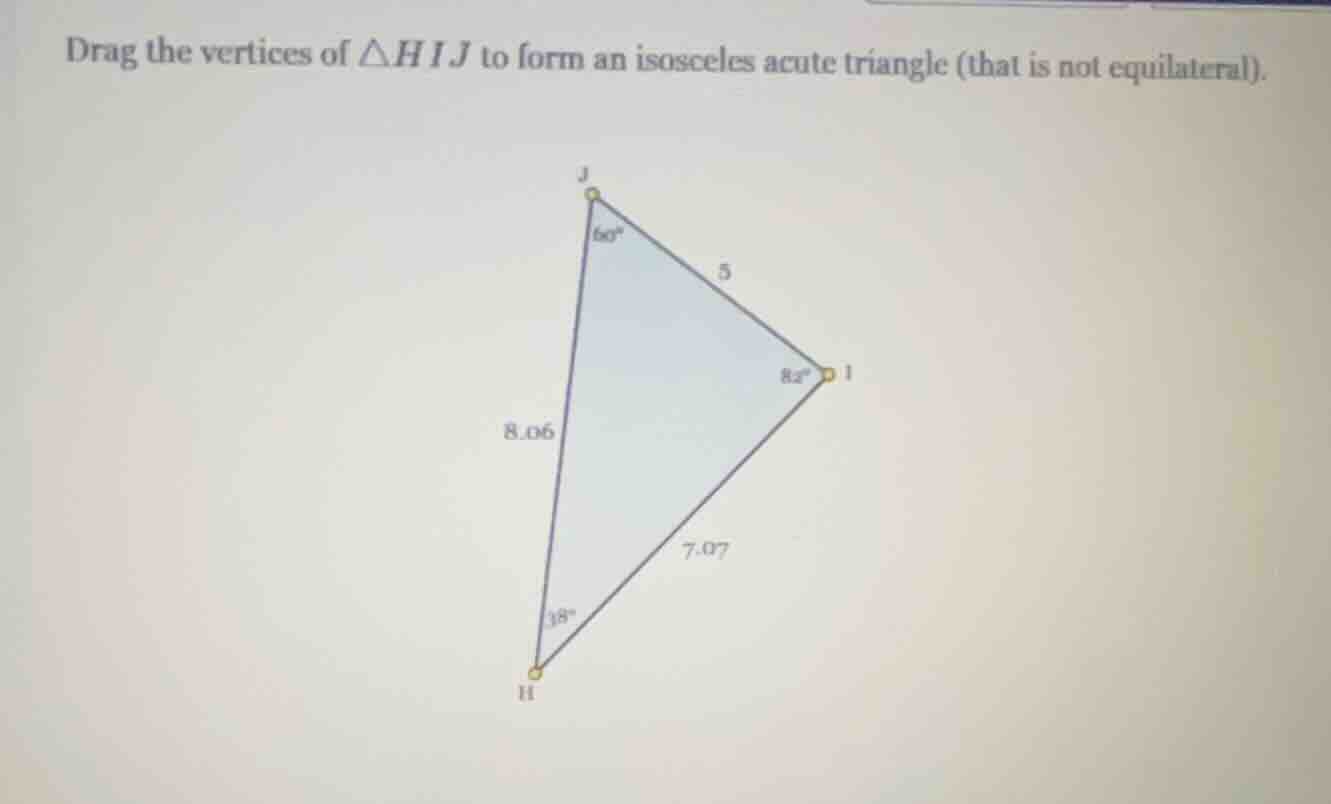
drag the vertices of $\triangle hij$ to form an isosceles acute triangle (that is not equilateral).
Step1: Recall triangle definitions
An isosceles acute triangle has exactly two equal side lengths (not three, so not equilateral) and all three angles < 90°.
Step2: Adjust vertices for two equal sides
Drag vertices so that two sides of $\triangle HIJ$ have the same length (e.g., set $HI = HJ$, or $IJ = HI$, or $IJ = HJ$).
Step3: Verify all angles are acute
Ensure every internal angle of the triangle measures less than $90^\circ$, and confirm no angle is $60^\circ$ for all three angles (to avoid an equilateral triangle). For example, create a triangle with two sides of length 6, base of length 7: the base angles will be ~57°, the vertex angle ~66°, all acute, and it is isosceles (not equilateral).

Snap & solve any problem in the app
Get step-by-step solutions on Sovi AI
Photo-based solutions with guided steps
Explore more problems and detailed explanations
A valid isosceles acute (non-equilateral) $\triangle HIJ$ will have exactly two congruent sides, and all three internal angles will measure between $0^\circ$ and $90^\circ$. One example is a triangle with side lengths $HI=HJ=6$, $IJ=7$, with corresponding angles $\angle I = \angle J \approx 57^\circ$, $\angle H \approx 66^\circ$.