QUESTION IMAGE
Question
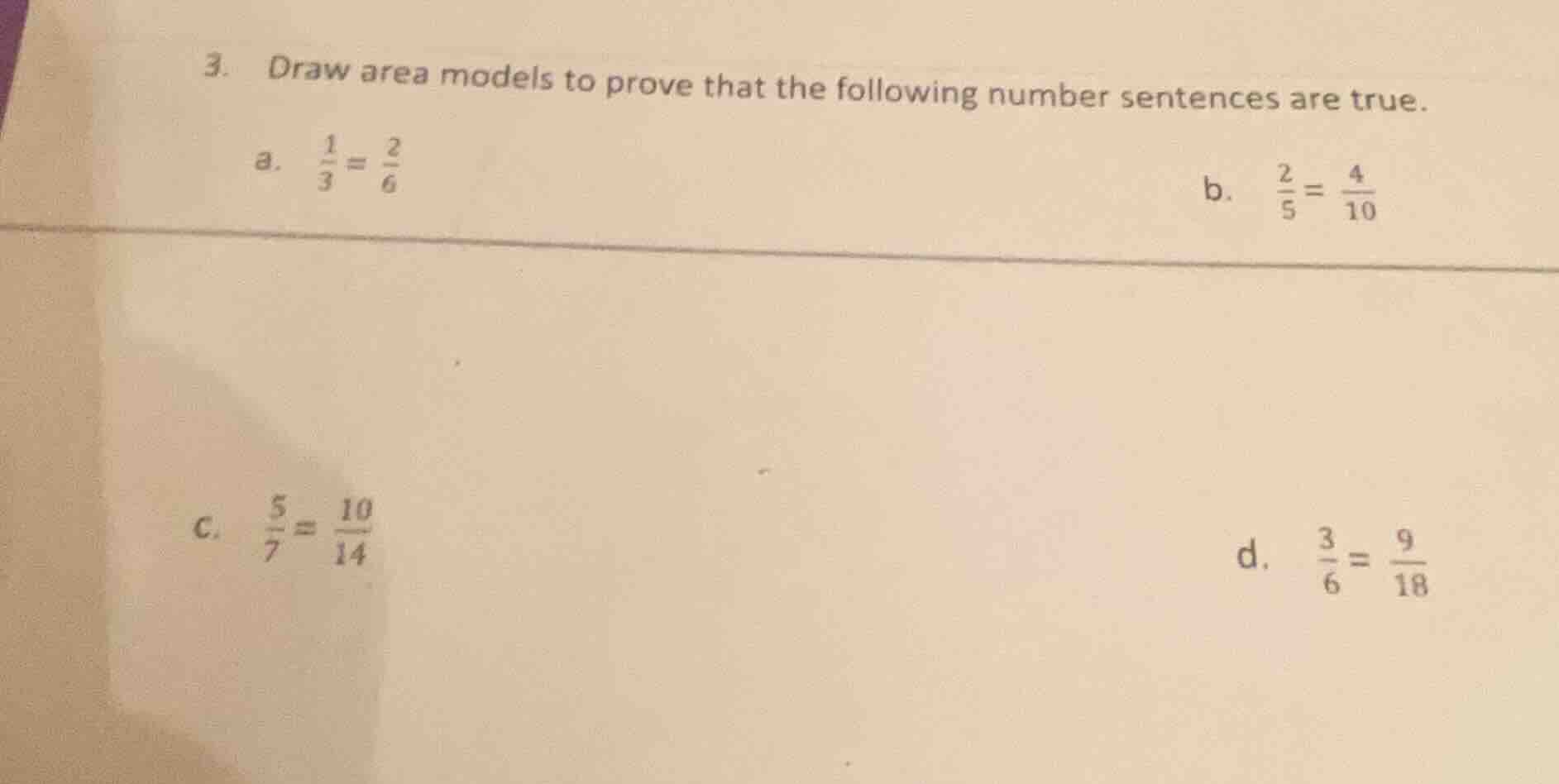
- draw area models to prove that the following number sentences are true. a. \\(\frac{1}{3}=\frac{2}{6}\\) b. \\(\frac{2}{5}=\frac{4}{10}\\) c. \\(\frac{5}{7}=\frac{10}{14}\\) d. \\(\frac{3}{6}=\frac{9}{18}\\)
Part a: Prove \(\boldsymbol{\frac{1}{3}=\frac{2}{6}}\)
Step 1: Draw a rectangle for \(\frac{1}{3}\)
Draw a rectangle. Divide it into 3 equal - sized columns (since the denominator of \(\frac{1}{3}\) is 3). Shade 1 out of the 3 columns. This shaded region represents \(\frac{1}{3}\) of the rectangle.
Step 2: Draw a rectangle for \(\frac{2}{6}\)
Draw another rectangle with the same overall size as the first one. Divide it into 6 equal - sized columns (since the denominator of \(\frac{2}{6}\) is 6). Shade 2 out of the 6 columns.
Step 3: Compare the shaded areas
Notice that the area of the shaded region in the first rectangle (representing \(\frac{1}{3}\)) is equal to the area of the shaded region in the second rectangle (representing \(\frac{2}{6}\)). This is because when we divide the first rectangle (with 3 columns) into 2 smaller columns per original column, we get 6 columns in total, and the 1 shaded column in the first rectangle becomes 2 shaded columns in the second rectangle.
Part b: Prove \(\boldsymbol{\frac{2}{5}=\frac{4}{10}}\)
Step 1: Draw a rectangle for \(\frac{2}{5}\)
Draw a rectangle. Divide it into 5 equal - sized columns (because the denominator of \(\frac{2}{5}\) is 5). Shade 2 out of the 5 columns. This shaded part is \(\frac{2}{5}\) of the rectangle.
Step 2: Draw a rectangle for \(\frac{4}{10}\)
Draw a rectangle of the same size as the first one. Divide it into 10 equal - sized columns (since the denominator of \(\frac{4}{10}\) is 10). Shade 4 out of the 10 columns.
Step 3: Compare the shaded areas
The area of the shaded region in the first rectangle (for \(\frac{2}{5}\)) is the same as the area of the shaded region in the second rectangle (for \(\frac{4}{10}\)). If we split each of the 5 columns in the first rectangle into 2 smaller columns, we get 10 columns, and the 2 shaded columns in the first rectangle become 4 shaded columns in the second rectangle.
Part c: Prove \(\boldsymbol{\frac{5}{7}=\frac{10}{14}}\)
Step 1: Draw a rectangle for \(\frac{5}{7}\)
Draw a rectangle. Divide it into 7 equal - sized columns (as the denominator of \(\frac{5}{7}\) is 7). Shade 5 out of the 7 columns. This shaded area represents \(\frac{5}{7}\) of the rectangle.
Step 2: Draw a rectangle for \(\frac{10}{14}\)
Draw a rectangle with the same dimensions as the first one. Divide it into 14 equal - sized columns (since the denominator of \(\frac{10}{14}\) is 14). Shade 10 out of the 14 columns.
Step 3: Compare the shaded areas
The area of the shaded region in the first rectangle (for \(\frac{5}{7}\)) is equal to the area of the shaded region in the second rectangle (for \(\frac{10}{14}\)). When we split each of the 7 columns in the first rectangle into 2 smaller columns, we get 14 columns in total, and the 5 shaded columns in the first rectangle become 10 shaded columns in the second rectangle.
Part d: Prove \(\boldsymbol{\frac{3}{6}=\frac{9}{18}}\)
Step 1: Draw a rectangle for \(\frac{3}{6}\)
Draw a rectangle. Divide it into 6 equal - sized columns (because the denominator of \(\frac{3}{6}\) is 6). Shade 3 out of the 6 columns. This shaded region represents \(\frac{3}{6}\) of the rectangle.
Step 2: Draw a rectangle for \(\frac{9}{18}\)
Draw a rectangle with the same size as the first one. Divide it into 18 equal - sized columns (since the denominator of \(\frac{9}{18}\) is 18). Shade 9 out of the 18 columns.
Step 3: Compare the shaded areas
The area of the shaded region in the first rectangle (for \(\frac{3}{6}\)) is equal to the area of the shaded region in t…

Snap & solve any problem in the app
Get step-by-step solutions on Sovi AI
Photo-based solutions with guided steps
Explore more problems and detailed explanations
Part a: Prove \(\boldsymbol{\frac{1}{3}=\frac{2}{6}}\)
Step 1: Draw a rectangle for \(\frac{1}{3}\)
Draw a rectangle. Divide it into 3 equal - sized columns (since the denominator of \(\frac{1}{3}\) is 3). Shade 1 out of the 3 columns. This shaded region represents \(\frac{1}{3}\) of the rectangle.
Step 2: Draw a rectangle for \(\frac{2}{6}\)
Draw another rectangle with the same overall size as the first one. Divide it into 6 equal - sized columns (since the denominator of \(\frac{2}{6}\) is 6). Shade 2 out of the 6 columns.
Step 3: Compare the shaded areas
Notice that the area of the shaded region in the first rectangle (representing \(\frac{1}{3}\)) is equal to the area of the shaded region in the second rectangle (representing \(\frac{2}{6}\)). This is because when we divide the first rectangle (with 3 columns) into 2 smaller columns per original column, we get 6 columns in total, and the 1 shaded column in the first rectangle becomes 2 shaded columns in the second rectangle.
Part b: Prove \(\boldsymbol{\frac{2}{5}=\frac{4}{10}}\)
Step 1: Draw a rectangle for \(\frac{2}{5}\)
Draw a rectangle. Divide it into 5 equal - sized columns (because the denominator of \(\frac{2}{5}\) is 5). Shade 2 out of the 5 columns. This shaded part is \(\frac{2}{5}\) of the rectangle.
Step 2: Draw a rectangle for \(\frac{4}{10}\)
Draw a rectangle of the same size as the first one. Divide it into 10 equal - sized columns (since the denominator of \(\frac{4}{10}\) is 10). Shade 4 out of the 10 columns.
Step 3: Compare the shaded areas
The area of the shaded region in the first rectangle (for \(\frac{2}{5}\)) is the same as the area of the shaded region in the second rectangle (for \(\frac{4}{10}\)). If we split each of the 5 columns in the first rectangle into 2 smaller columns, we get 10 columns, and the 2 shaded columns in the first rectangle become 4 shaded columns in the second rectangle.
Part c: Prove \(\boldsymbol{\frac{5}{7}=\frac{10}{14}}\)
Step 1: Draw a rectangle for \(\frac{5}{7}\)
Draw a rectangle. Divide it into 7 equal - sized columns (as the denominator of \(\frac{5}{7}\) is 7). Shade 5 out of the 7 columns. This shaded area represents \(\frac{5}{7}\) of the rectangle.
Step 2: Draw a rectangle for \(\frac{10}{14}\)
Draw a rectangle with the same dimensions as the first one. Divide it into 14 equal - sized columns (since the denominator of \(\frac{10}{14}\) is 14). Shade 10 out of the 14 columns.
Step 3: Compare the shaded areas
The area of the shaded region in the first rectangle (for \(\frac{5}{7}\)) is equal to the area of the shaded region in the second rectangle (for \(\frac{10}{14}\)). When we split each of the 7 columns in the first rectangle into 2 smaller columns, we get 14 columns in total, and the 5 shaded columns in the first rectangle become 10 shaded columns in the second rectangle.
Part d: Prove \(\boldsymbol{\frac{3}{6}=\frac{9}{18}}\)
Step 1: Draw a rectangle for \(\frac{3}{6}\)
Draw a rectangle. Divide it into 6 equal - sized columns (because the denominator of \(\frac{3}{6}\) is 6). Shade 3 out of the 6 columns. This shaded region represents \(\frac{3}{6}\) of the rectangle.
Step 2: Draw a rectangle for \(\frac{9}{18}\)
Draw a rectangle with the same size as the first one. Divide it into 18 equal - sized columns (since the denominator of \(\frac{9}{18}\) is 18). Shade 9 out of the 18 columns.
Step 3: Compare the shaded areas
The area of the shaded region in the first rectangle (for \(\frac{3}{6}\)) is equal to the area of the shaded region in the second rectangle (for \(\frac{9}{18}\)). If we split each of the 6 columns in the first rectangle into 3 smaller columns, we get 18 columns in total, and the 3 shaded columns in the first rectangle become 9 shaded columns in the second rectangle.
(Note: Since the problem asks to draw area models, the above steps describe how to construct and compare the area models for each fraction equality. If we were to think in terms of fraction equivalence (multiplying numerator and denominator by the same non - zero number), for \(\frac{a}{b}=\frac{a\times k}{b\times k}\) (\(k
eq0\)):
- For \(\frac{1}{3}\), if \(k = 2\), then \(\frac{1\times2}{3\times2}=\frac{2}{6}\)
- For \(\frac{2}{5}\), if \(k = 2\), then \(\frac{2\times2}{5\times2}=\frac{4}{10}\)
- For \(\frac{5}{7}\), if \(k = 2\), then \(\frac{5\times2}{7\times2}=\frac{10}{14}\)
- For \(\frac{3}{6}\), if \(k = 3\), then \(\frac{3\times3}{6\times3}=\frac{9}{18}\)
And the area models visually confirm this equivalence by showing that the shaded portions (representing the fractions) have the same area.)