QUESTION IMAGE
Question
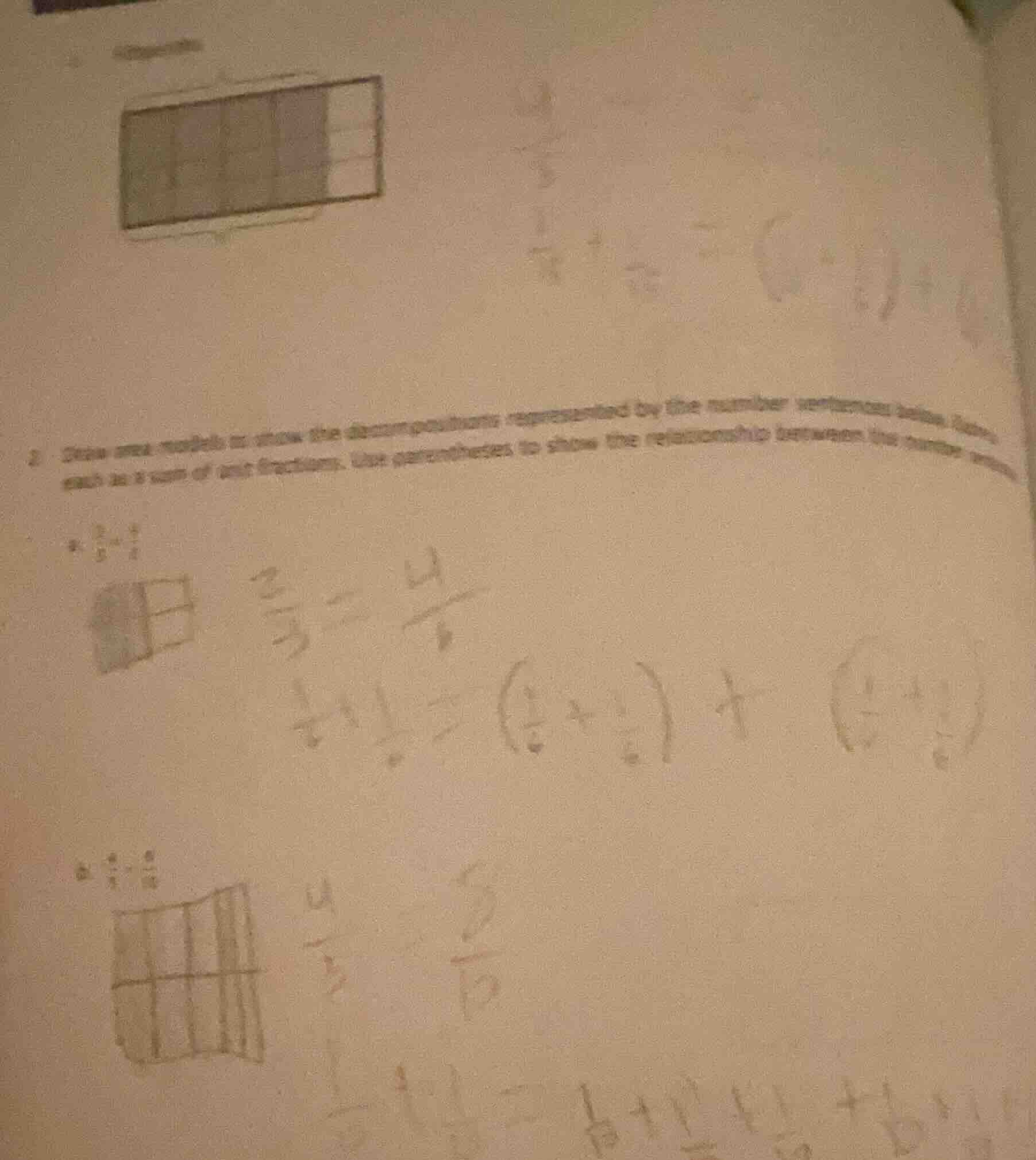
- draw area models to show the decompositions represented by the number sentences below. express each as a sum of unit fractions. use parentheses to show the relationship between the number sentences.
a. \\(\frac{2}{3} = \frac{4}{6}\\)
b. \\(\frac{4}{5} = \frac{8}{10}\\)
Step1: Analyze the fraction decomposition
We need to decompose the fractions and show their relationship using unit fractions (fractions with numerator 1). For example, take the first fraction pair (assuming we are dealing with \(\frac{2}{3}\) and \(\frac{4}{6}\), since \(\frac{2}{3}=\frac{4}{6}\) as they are equivalent fractions).
To decompose \(\frac{2}{3}\) into unit fractions: \(\frac{2}{3}=\frac{1}{3}+\frac{1}{3}\).
To decompose \(\frac{4}{6}\) into unit fractions: \(\frac{4}{6}=\frac{1}{6}+\frac{1}{6}+\frac{1}{6}+\frac{1}{6}\), but also, we can group them as \((\frac{1}{3}+\frac{1}{3})\) since \(\frac{2}{6}=\frac{1}{3}\), so \(\frac{4}{6}=(\frac{1}{3}+\frac{1}{3})\) (because \(\frac{2}{6}=\frac{1}{3}\), so two \(\frac{2}{6}\) is two \(\frac{1}{3}\)).
So, \(\frac{2}{3}=\frac{4}{6}\) can be shown as \(\frac{1}{3}+\frac{1}{3}=(\frac{1}{6}+\frac{1}{6})+(\frac{1}{6}+\frac{1}{6})\) (since \(\frac{1}{3}=\frac{2}{6}=\frac{1}{6}+\frac{1}{6}\)).
For another example, if we take \(\frac{4}{5}\) and \(\frac{8}{10}\) (equivalent fractions), \(\frac{4}{5}=\frac{1}{5}+\frac{1}{5}+\frac{1}{5}+\frac{1}{5}\), and \(\frac{8}{10}=\frac{1}{10}+\frac{1}{10}+\cdots+\frac{1}{10}\) (8 times), but also, \(\frac{4}{5}=\frac{8}{10}\) can be shown by grouping \(\frac{2}{10}=\frac{1}{5}\), so \(\frac{8}{10}=(\frac{1}{5}+\frac{1}{5})+(\frac{1}{5}+\frac{1}{5})\) (since \(\frac{2}{10}=\frac{1}{5}\), four \(\frac{2}{10}\) is four \(\frac{1}{5}\)? Wait, no, \(\frac{8}{10}=\frac{4}{5}\), so \(\frac{4}{5}=\frac{1}{5}+\frac{1}{5}+\frac{1}{5}+\frac{1}{5}\) and \(\frac{8}{10}=\frac{1}{10}+\frac{1}{10}+\frac{1}{10}+\frac{1}{10}+\frac{1}{10}+\frac{1}{10}+\frac{1}{10}+\frac{1}{10}\), but we can also group \(\frac{8}{10}\) as \((\frac{1}{5}+\frac{1}{5})+(\frac{1}{5}+\frac{1}{5})\) because \(\frac{2}{10}=\frac{1}{5}\), so two \(\frac{2}{10}\) is \(\frac{1}{5}\), so four \(\frac{2}{10}\) (which is \(\frac{8}{10}\)) is four \(\frac{1}{5}\)? Wait, no, \(\frac{2}{10}=\frac{1}{5}\), so \(\frac{8}{10}=4\times\frac{2}{10}=4\times\frac{1}{5}=\frac{4}{5}\), so \(\frac{8}{10}=\frac{1}{5}+\frac{1}{5}+\frac{1}{5}+\frac{1}{5}\), same as \(\frac{4}{5}\). So the relationship is that equivalent fractions, when decomposed into unit fractions (or grouped unit fractions), are equal.
For the area models, we can draw a rectangle divided into 3 equal parts for \(\frac{2}{3}\) (shading 2 parts) and a rectangle divided into 6 equal parts for \(\frac{4}{6}\) (shading 4 parts). Then, we can see that the shaded area is the same, showing the equivalence.
Step2: General approach for fraction decomposition and area models
- Equivalent Fractions Check: First, check if the given fractions are equivalent (by cross - multiplying: \(a\times d = b\times c\) for \(\frac{a}{b}\) and \(\frac{c}{d}\)).
- Decompose into Unit Fractions: Decompose each fraction into a sum of unit fractions. For a fraction \(\frac{n}{d}\), it can be written as \(\underbrace{\frac{1}{d}+\frac{1}{d}+\cdots+\frac{1}{d}}_{n\text{ times}}\).
- Grouping for Relationship: Group the unit fractions of one fraction to show it is equal to the other fraction. For example, if we have \(\frac{2}{3}\) and \(\frac{4}{6}\), \(\frac{2}{3}=\frac{1}{3}+\frac{1}{3}\) and \(\frac{4}{6}=\frac{1}{6}+\frac{1}{6}+\frac{1}{6}+\frac{1}{6}\), but since \(\frac{1}{3}=\frac{2}{6}\), we can also write \(\frac{4}{6}=(\frac{1}{3}+\frac{1}{3})\) (because \(\frac{2}{6}+\frac{2}{6}=\frac{1}{3}+\frac{1}{3}\)).
- Area Model Drawing: Draw a shape (like a rectangle or a circle) for each fraction. Divide the first shape into \(b\) equal parts (f…

Snap & solve any problem in the app
Get step-by-step solutions on Sovi AI
Photo-based solutions with guided steps
Explore more problems and detailed explanations
To solve the problem of showing the decomposition of the given fractions (e.g., \(\frac{2}{3}\) and \(\frac{4}{6}\), \(\frac{4}{5}\) and \(\frac{8}{10}\)) and their relationship:
For \(\frac{2}{3}\) and \(\frac{4}{6}\)
- Decomposition into Unit Fractions:
- \(\frac{2}{3}=\frac{1}{3}+\frac{1}{3}\)
- \(\frac{4}{6}=\frac{1}{6}+\frac{1}{6}+\frac{1}{6}+\frac{1}{6}\) or \(\frac{4}{6}=(\frac{1}{3}+\frac{1}{3})\) (since \(\frac{2}{6}=\frac{1}{3}\), so two groups of \(\frac{2}{6}\) is two \(\frac{1}{3}\))
- Relationship: \(\frac{1}{3}+\frac{1}{3}=(\frac{1}{6}+\frac{1}{6})+(\frac{1}{6}+\frac{1}{6})\) (because \(\frac{1}{3}=\frac{2}{6}\), so each \(\frac{1}{3}\) is two \(\frac{1}{6}\)s)
- Area Model:
- Draw a rectangle. Divide it into 3 equal columns. Shade 2 columns (representing \(\frac{2}{3}\)).
- Draw another rectangle of the same size. Divide it into 6 equal columns (2 rows of 3 columns). Shade 4 columns (representing \(\frac{4}{6}\)). Notice that the shaded area is the same in both rectangles.
For \(\frac{4}{5}\) and \(\frac{8}{10}\)
- Decomposition into Unit Fractions:
- \(\frac{4}{5}=\frac{1}{5}+\frac{1}{5}+\frac{1}{5}+\frac{1}{5}\)
- \(\frac{8}{10}=\frac{1}{10}+\frac{1}{10}+\cdots+\frac{1}{10}\) (8 times) or \(\frac{8}{10}=\frac{1}{5}+\frac{1}{5}+\frac{1}{5}+\frac{1}{5}\) (since \(\frac{2}{10}=\frac{1}{5}\), so four groups of \(\frac{2}{10}\) is four \(\frac{1}{5}\))
- Relationship: \(\frac{1}{5}+\frac{1}{5}+\frac{1}{5}+\frac{1}{5}=\frac{1}{10}+\frac{1}{10}+\frac{1}{10}+\frac{1}{10}+\frac{1}{10}+\frac{1}{10}+\frac{1}{10}+\frac{1}{10}\) (or grouped as \((\frac{1}{5}+\frac{1}{5})+(\frac{1}{5}+\frac{1}{5}) = (\frac{2}{10}+\frac{2}{10})+(\frac{2}{10}+\frac{2}{10})\))
- Area Model:
- Draw a circle. Divide it into 5 equal sectors. Shade 4 sectors (representing \(\frac{4}{5}\)).
- Draw another circle of the same size. Divide it into 10 equal sectors. Shade 8 sectors (representing \(\frac{8}{10}\)). The shaded area in both circles is the same.
In general, the key is to show that equivalent fractions, when decomposed into unit fractions (or grouped unit fractions) and represented by area models, have the same value (same shaded area or same sum of unit fractions).