QUESTION IMAGE
Question
draw an arrow connecting this box to one of your hexagon connections and replace this text with your explanation of how and why those items are connected.
sharecropping
segregation
kkk
military reconstruction act
13th amendment
plessy v. ferguson
14th amendment
draw an arrow connecting this box to one of your hexagon connections and replace this text with your explanation of how and why those items are connected.
reconstruction
freedmens bureau
draw an arrow connecting this box to one of your hexagon connections and replace this text with your explanation of how and why those items are connected.
african american office-holders
literacy tests
black codes
15th amendment
poll tax
jim crow laws
compromise of 1877
draw an arrow connecting this box to one of your hexagon connections and replace this text with your explanation of how and why those items are connected.
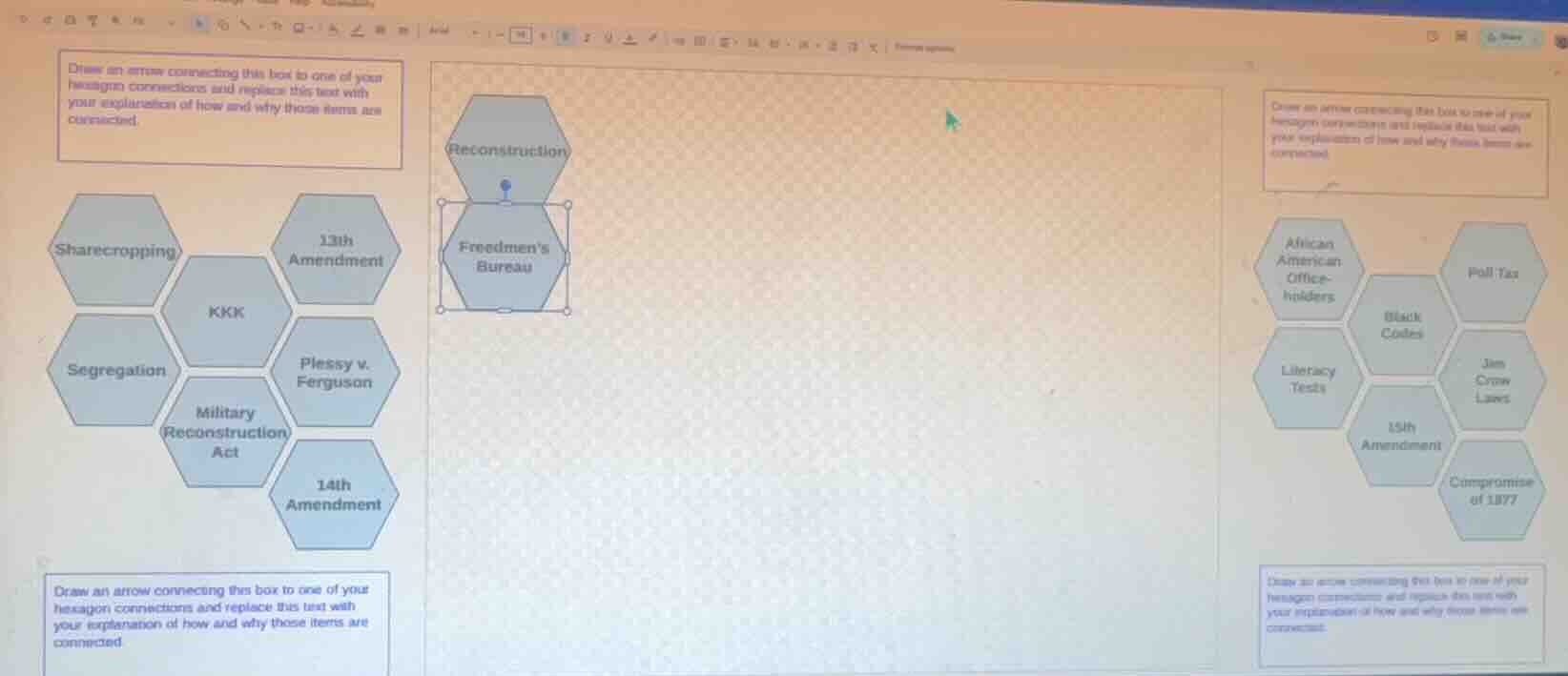
- Reconstruction ↔ Freedmen's Bureau: The Freedmen's Bureau was a federal agency created during Reconstruction (1865-1877) to support newly freed Black Americans with food, housing, education, and labor support, making it a core tool of Reconstruction efforts.
- Freedmen's Bureau ↔ 14th Amendment: The 14th Amendment (1868), passed during Reconstruction, enshrined equal protection under the law for all citizens, which aligned with the Freedmen's Bureau's goal of securing basic rights for formerly enslaved people, providing a legal framework for its work.
- 14th Amendment ↔ Plessy v. Ferguson: The 1896 Plessy v. Ferguson Supreme Court case directly challenged the 14th Amendment's equal protection clause, but the court ruled "separate but equal" facilities were constitutional, undermining the amendment's intent.
- Plessy v. Ferguson ↔ Segregation: The Plessy v. Ferguson decision legally sanctioned state-enforced racial segregation across the South, establishing the legal basis for Jim Crow segregation laws for decades.
- Segregation ↔ Jim Crow Laws: Jim Crow Laws were the state and local statutes that formalized and enforced racial segregation in public spaces, education, and daily life, directly implementing the system of segregation.
- Jim Crow Laws ↔ Compromise of 1877: The Compromise of 1877 ended Reconstruction by withdrawing federal troops from the South, allowing white Southern leaders to implement Jim Crow Laws without federal intervention.

Snap & solve any problem in the app
Get step-by-step solutions on Sovi AI
Photo-based solutions with guided steps
Explore more problems and detailed explanations
- Connect Reconstruction to Freedmen's Bureau: The Freedmen's Bureau was a key Reconstruction agency aiding freedpeople.
- Connect Freedmen's Bureau to 14th Amendment: The 14th Amendment provided legal backing for the bureau's equality goals.
- Connect 14th Amendment to Plessy v. Ferguson: The case undermined the 14th Amendment's equal protection clause.
- Connect Plessy v. Ferguson to Segregation: The ruling legalized state-enforced racial segregation.
- Connect Segregation to Jim Crow Laws: Jim Crow Laws formalized and enforced segregation.
- Connect Jim Crow Laws to Compromise of 1877: The compromise ended federal oversight, enabling Jim Crow.