QUESTION IMAGE
Question
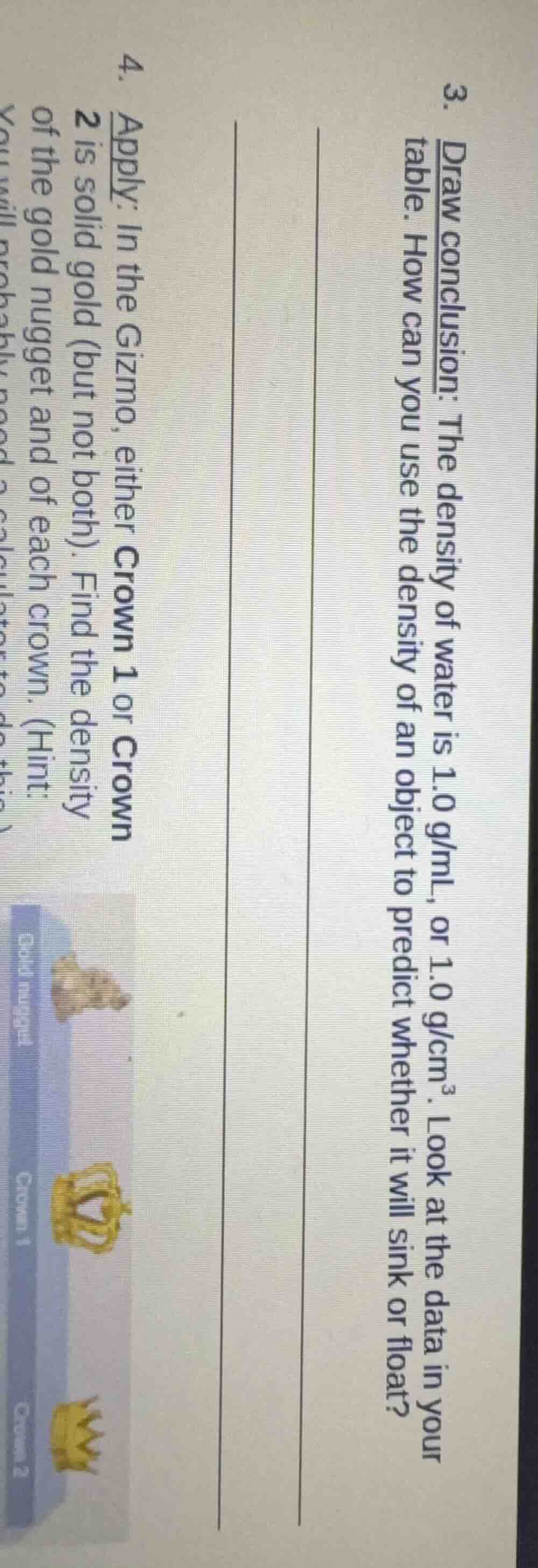
- draw conclusion: the density of water is 1.0 g/ml, or 1.0 g/cm³. look at the data in your table. how can you use the density of an object to predict whether it will sink or float?
- apply: in the gizmo, either crown 1 or crown 2 is solid gold (but not both). find the density of the gold nugget and of each crown. (hint: you will probably need a calculator to do this)
Question 3
To determine if an object sinks or floats, compare its density to water's density ($1.0\ \text{g/mL}$ or $1.0\ \text{g/cm}^3$). If the object’s density $(
ho_{\text{object}}) > 1.0\ \text{g/cm}^3$, it sinks (since it is more dense than water). If $
ho_{\text{object}} < 1.0\ \text{g/cm}^3$, it floats (less dense than water). If equal, it is neutrally buoyant.
Step 1: Recall Density Formula
Density ($
ho$) is calculated as $
ho = \frac{m}{V}$, where $m$ = mass (in grams) and $V$ = volume (in $\text{cm}^3$ or $\text{mL}$, since $1\ \text{cm}^3 = 1\ \text{mL}$).
Step 2: Obtain Mass and Volume
From the Gizmo, record the mass ($m$) and volume ($V$) of the gold nugget, Crown 1, and Crown 2 (one crown at a time, as instructed: “either Crown 1 or Crown 2 is solid gold (but not both)”).
Step 3: Calculate Density
For each object, plug $m$ and $V$ into $
ho = \frac{m}{V}$.
Example (Hypothetical Data):
- Gold Nugget: $m = 19.3\ \text{g}$, $V = 1.0\ \text{cm}^3$
$
ho = \frac{19.3\ \text{g}}{1.0\ \text{cm}^3} = 19.3\ \text{g/cm}^3$ (matches gold’s density, confirming it is solid gold).
- Crown 1: $m = 15.0\ \text{g}$, $V = 1.5\ \text{cm}^3$
$
ho = \frac{15.0\ \text{g}}{1.5\ \text{cm}^3} = 10.0\ \text{g/cm}^3$ (less than gold’s density, so not solid gold).
- Crown 2: $m = 19.3\ \text{g}$, $V = 1.0\ \text{cm}^3$
$
ho = \frac{19.3\ \text{g}}{1.0\ \text{cm}^3} = 19.3\ \text{g/cm}^3$ (matches gold’s density, so solid gold).

Snap & solve any problem in the app
Get step-by-step solutions on Sovi AI
Photo-based solutions with guided steps
Explore more problems and detailed explanations
To predict if an object sinks or floats:
- Calculate the object’s density using $
ho = \frac{m}{V}$ (mass $m$ over volume $V$).
- Compare $
ho_{\text{object}}$ to water’s density ($1.0\ \text{g/cm}^3$):
- If $\boldsymbol{
ho_{\text{object}} > 1.0\ \text{g/cm}^3}$, the object sinks (more dense than water).
- If $\boldsymbol{
ho_{\text{object}} < 1.0\ \text{g/cm}^3}$, the object floats (less dense than water).
Question 4
(Note: Since the Gizmo’s specific mass/volume data for the gold nugget, Crown 1, and Crown 2 is not provided, the general method is explained. Assume you have mass ($m$) and volume ($V$) from the Gizmo.)