QUESTION IMAGE
Question
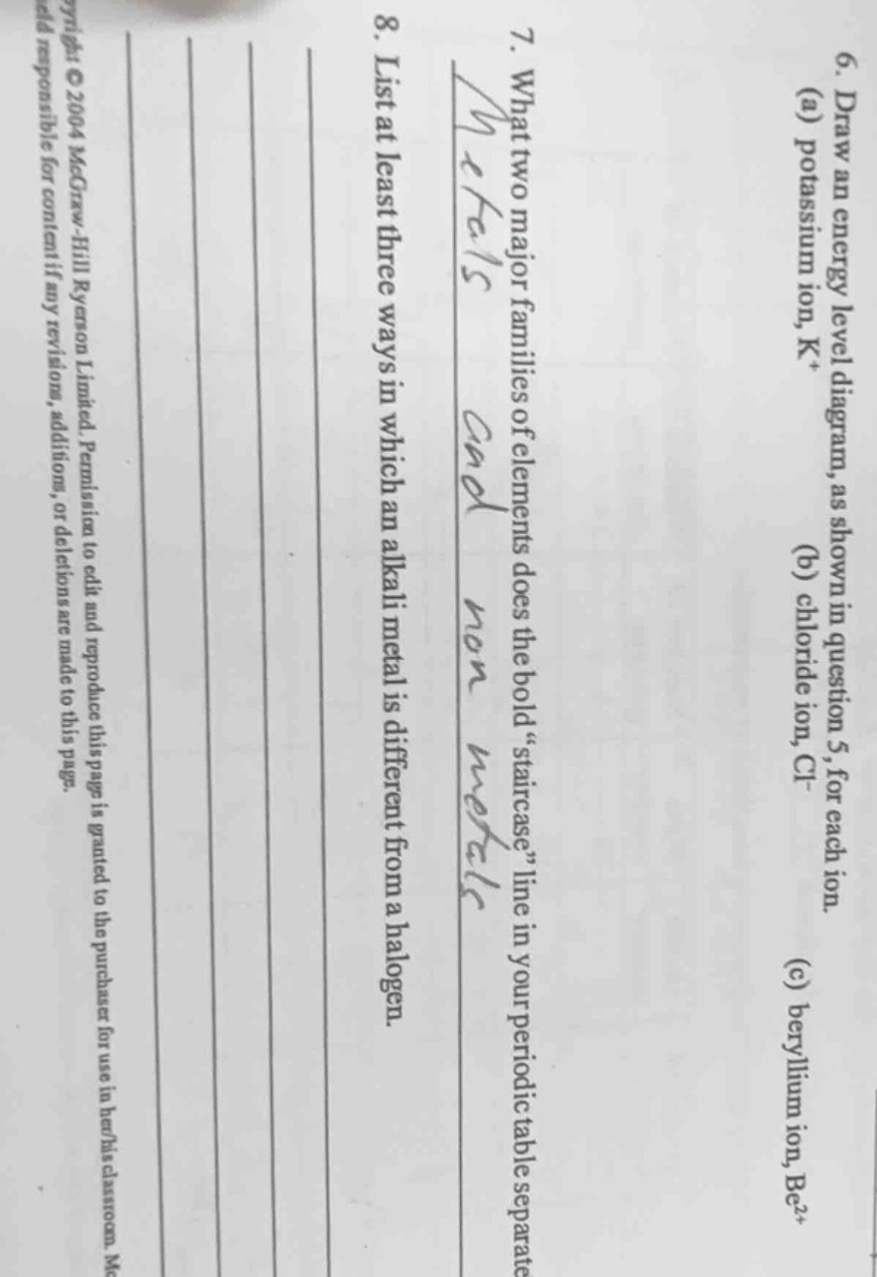
- draw an energy level diagram, as shown in question 5, for each ion.
(a) potassium ion, k⁺
(b) chloride ion, cl⁻
(c) beryllium ion, be²⁺
- what two major families of elements does the bold “staircase” line in your periodic table separate?
- list at least three ways in which an alkali metal is different from a halogen.
copyright © 2004 mcgraw-hill ryerson limited. permission to edit and reproduce this page is granted to the purchaser for use in her/his classroom. may not be reproduced or shared without permission. hold responsible for content if any revisions, additions, or deletions are made to this page.
For Question 7:
The bold "staircase" line on the periodic table runs between groups 13 and 14, separating elements with metallic properties from those with nonmetallic properties. The two major families it divides are metals (to the left of the line) and nonmetals (to the right of the line; metalloids lie along the line).
For Question 8:
- Valence electrons: Alkali metals have 1 valence electron, halogens have 7.
- Ion charge: Alkali metals form +1 cations, halogens form -1 anions.
- Physical state: Alkali metals are soft solids at room temp; halogens are diatomic (gases/liquids/solids, mostly non-solid).

Snap & solve any problem in the app
Get step-by-step solutions on Sovi AI
Photo-based solutions with guided steps
Explore more problems and detailed explanations
- Metals and nonmetals
8.
- Alkali metals have 1 valence electron; halogens have 7.
- Alkali metals form +1 ions; halogens form -1 ions.
- Alkali metals are soft solids; halogens are mostly gases/liquids.