QUESTION IMAGE
Question
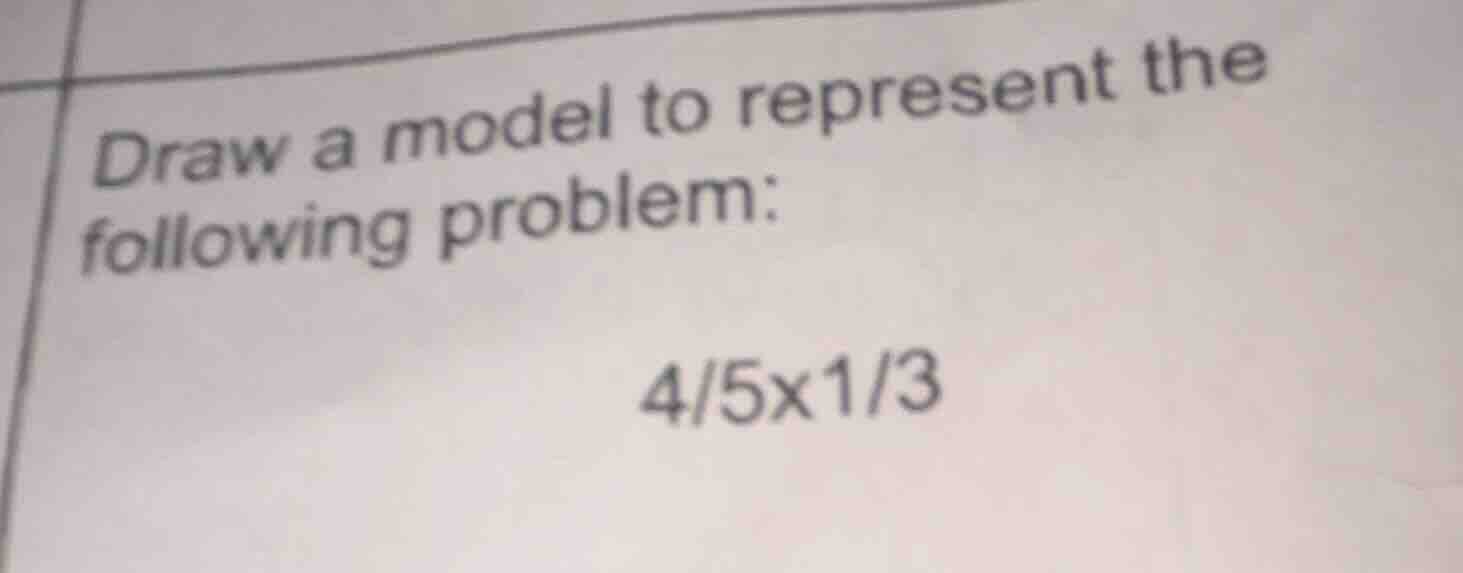
draw a model to represent the following problem: 4/5×1/3
Step1: Represent \(\frac{4}{5}\)
Draw a rectangle. Divide it into 5 equal horizontal parts (columns). Shade 4 out of these 5 parts to represent \(\frac{4}{5}\).
Step2: Represent multiplying by \(\frac{1}{3}\)
Now, divide the same rectangle (or the shaded part) into 3 equal vertical parts (rows). We are interested in \(\frac{1}{3}\) of the already shaded \(\frac{4}{5}\) part. So, shade 1 out of the 3 vertical parts within the previously shaded 4 columns.
The overlapping shaded region (the part that is shaded both horizontally and vertically) will represent \(\frac{4}{5}\times\frac{1}{3}=\frac{4\times1}{5\times3}=\frac{4}{15}\). Visually, the number of small rectangles in the overlapping shaded region will be \(4\times1 = 4\) and the total number of small rectangles in the whole big rectangle will be \(5\times3=15\), so the shaded overlapping region is \(\frac{4}{15}\) of the whole rectangle.

Snap & solve any problem in the app
Get step-by-step solutions on Sovi AI
Photo-based solutions with guided steps
Explore more problems and detailed explanations
To model \(\boldsymbol{\frac{4}{5}\times\frac{1}{3}}\):
- Draw a rectangle. Divide it into 5 equal columns; shade 4 columns (to show \(\frac{4}{5}\)).
- Divide the same rectangle into 3 equal rows. Shade 1 row (to show taking \(\frac{1}{3}\) of the shaded \(\frac{4}{5}\)).
- The overlapping shaded area (4 small rectangles out of \(5\times3 = 15\) total) represents \(\frac{4}{15}\), the product.
(Visually, the model will have a rectangle with 15 small equal - sized sub - rectangles, 4 of which are doubly shaded to represent the product.)