QUESTION IMAGE
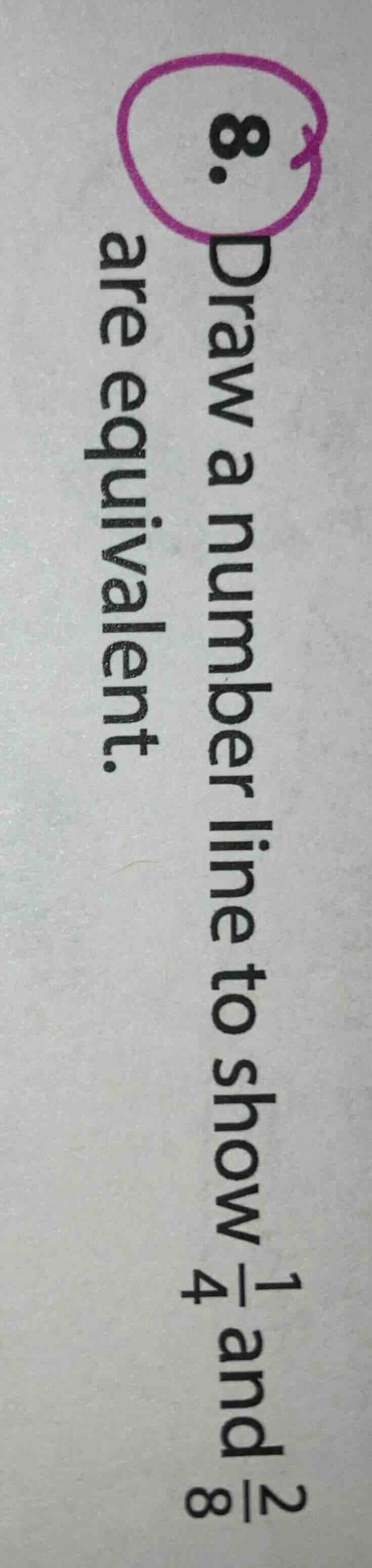
Question
- draw a number line to show $\frac{1}{4}$ and $\frac{2}{8}$ are equivalent.
Step1: Understand the number line
A number line is a straight line with numbers placed at equal intervals. To show fractions, we divide the segment between 0 and 1 into equal parts.
Step2: Represent \(\frac{1}{4}\) on the number line
Divide the segment from 0 to 1 into 4 equal parts. The first mark after 0 (excluding 0) represents \(\frac{1}{4}\) because each part is \(\frac{1}{4}\) of the whole (since \(1\div4 = \frac{1}{4}\)).
Step3: Represent \(\frac{2}{8}\) on the number line
Simplify \(\frac{2}{8}\) to \(\frac{1}{4}\) (by dividing numerator and denominator by 2: \(\frac{2\div2}{8\div2}=\frac{1}{4}\)). Now, divide the segment from 0 to 1 into 8 equal parts. The second mark after 0 (excluding 0) represents \(\frac{2}{8}\) (since each part is \(\frac{1}{8}\), and \(2\times\frac{1}{8}=\frac{2}{8}=\frac{1}{4}\)).
Step4: Observe the positions
Both \(\frac{1}{4}\) (from the 4 - part division) and \(\frac{2}{8}\) (from the 8 - part division) will be at the same point on the number line, showing they are equivalent.
To draw the number line:
- Draw a horizontal line. Mark 0 on the left and 1 on the right.
- For \(\frac{1}{4}\): Divide the interval [0, 1] into 4 equal sub - intervals. The point at \(\frac{1}{4}\) (i.e., 0.25) is the first sub - interval mark after 0.
- For \(\frac{2}{8}\): Divide the interval [0, 1] into 8 equal sub - intervals. The point at \(\frac{2}{8}\) (which is also 0.25) is the second sub - interval mark after 0.

Snap & solve any problem in the app
Get step-by-step solutions on Sovi AI
Photo-based solutions with guided steps
Explore more problems and detailed explanations
To show \(\frac{1}{4}\) and \(\frac{2}{8}\) are equivalent on a number line:
- Draw a line segment with endpoints 0 and 1.
- Divide the segment into 4 equal parts: The first division mark (excluding 0) is \(\frac{1}{4}\).
- Divide the same segment into 8 equal parts: The second division mark (excluding 0) is \(\frac{2}{8}\).
- Observe that both marks coincide, proving \(\frac{1}{4}=\frac{2}{8}\).