QUESTION IMAGE
Question
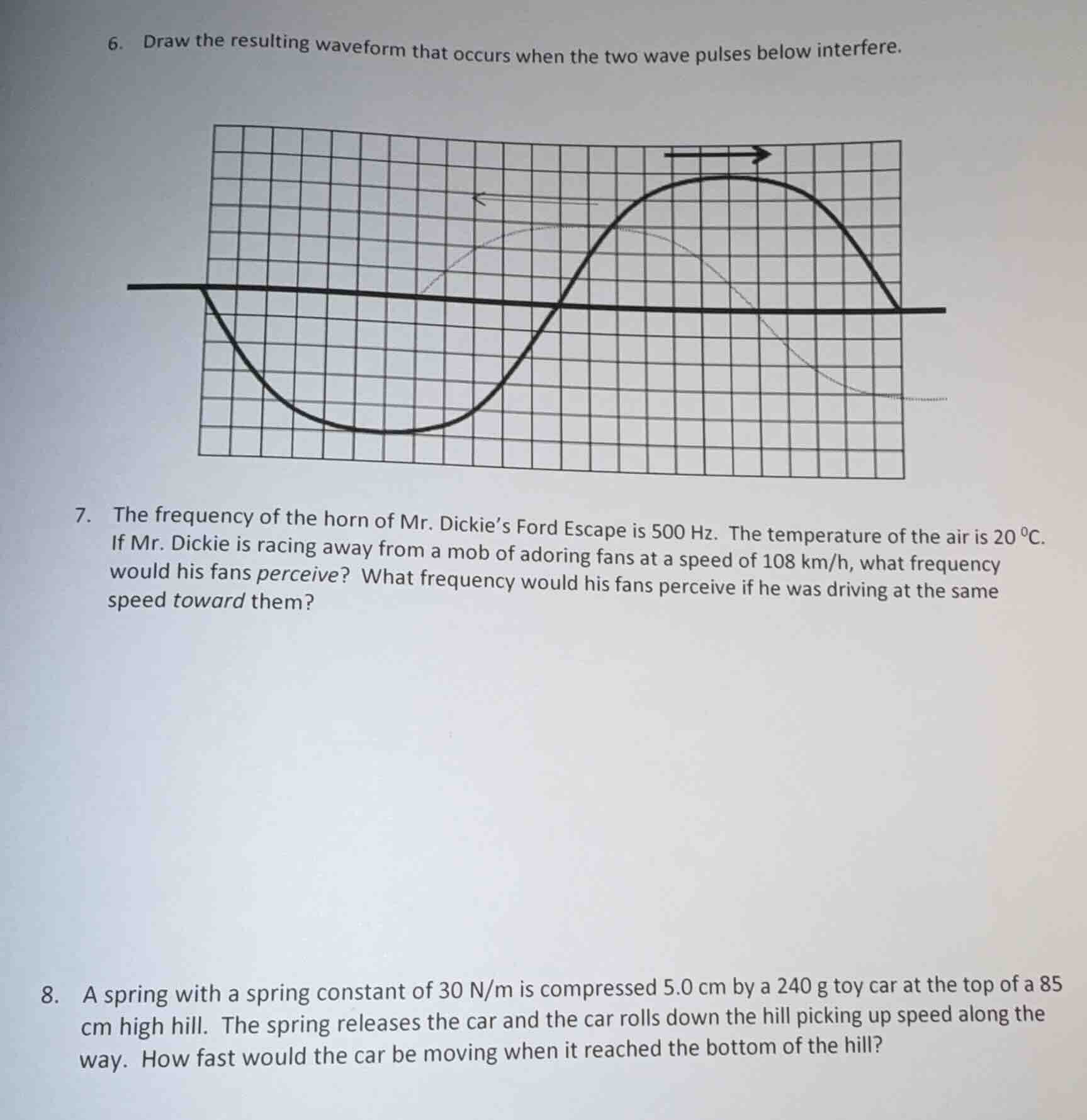
- draw the resulting waveform that occurs when the two wave pulses below interfere.
- the frequency of the horn of mr. dickie’s ford escape is 500 hz. the temperature of the air is 20 °c. if mr. dickie is racing away from a mob of adoring fans at a speed of 108 km/h, what frequency would his fans perceive? what frequency would his fans perceive if he was driving at the same speed toward them?
- a spring with a spring constant of 30 n/m is compressed 5.0 cm by a 240 g toy car at the top of a 85 cm high hill. the spring releases the car and the car rolls down the hill picking up speed along the way. how fast would the car be moving when it reached the bottom of the hill?
Question 6
Step1: Recall Superposition Principle
When two waves interfere, the resulting displacement at any point is the vector sum of the displacements of the individual waves at that point. For transverse waves (like the pulses here), we add the y - displacements (heights) of the two waves at each x - coordinate.
Step2: Analyze the Pulses
One pulse is a downward (negative y - displacement) pulse and the other is an upward (positive y - displacement) pulse? Wait, no, looking at the graph: the black pulse has a trough (negative displacement) on the left and a crest (positive displacement) on the right? Wait, no, the black pulse: left side goes down (trough) and then up, and the dashed pulse is a smaller pulse moving left, with a crest? Wait, actually, to draw the resultant, at each point, add the displacement of the two pulses. Let's consider the grid. Let's take the x - axis as the equilibrium (y = 0). The black pulse: for the part where the two pulses overlap, we add their y - values. Let's assume the black pulse (moving right) has a displacement \( y_1(x) \) and the dashed pulse (moving left) has \( y_2(x) \). At each x, \( y_{result}(x)=y_1(x)+y_2(x) \). So we plot the sum of the two waveforms. For example, where the black pulse is at \( y = - 3 \) (grid units) and the dashed pulse is at \( y = + 1 \), the result is \( y=-2 \), etc. The key is to apply the principle of superposition: at every point along the medium, the displacement of the resultant wave is the algebraic sum of the displacements of the two interfering waves.
Question 7
Step1: Recall Doppler Effect Formula for Sound
The Doppler effect formula when the source is moving is \( f'=f\frac{v}{v\pm v_s} \), where \( f \) is the source frequency, \( v \) is the speed of sound in air, \( v_s \) is the speed of the source, the plus sign is when the source is moving away from the observer, and the minus sign is when the source is moving towards the observer.
First, find the speed of sound in air at \( T = 20^{\circ}C \). The formula for the speed of sound in air is \( v = 331\sqrt{1+\frac{T}{273}} \) (in m/s), where \( T \) is in \(^{\circ}C \).
Step2: Calculate Speed of Sound
\( T = 20^{\circ}C \), so \( v=331\sqrt{1 + \frac{20}{273}}\approx331\sqrt{\frac{293}{273}}\approx331\times1.0367\approx343\ m/s \)
The speed of the source \( v_s = 108\ km/h=\frac{108\times1000}{3600}=30\ m/s \)
Step3: Source Moving Away (\( f_{away} \))
When the source is moving away, the formula is \( f'=f\frac{v}{v + v_s} \) (because the source is moving away, the denominator increases). Given \( f = 500\ Hz \), \( v = 343\ m/s \), \( v_s=30\ m/s \)
\( f_{away}=500\times\frac{343}{343 + 30}=500\times\frac{343}{373}\approx500\times0.9196\approx459.8\ Hz\approx460\ Hz \)
Step4: Source Moving Towards (\( f_{toward} \))
When the source is moving towards the observer, the formula is \( f'=f\frac{v}{v - v_s} \) (denominator decreases as source moves towards, so frequency increases)
\( f_{toward}=500\times\frac{343}{343-30}=500\times\frac{343}{313}\approx500\times1.0958\approx547.9\ Hz\approx548\ Hz \)
Question 8
Step1: Recall Conservation of Mechanical Energy
The total mechanical energy (spring potential energy + gravitational potential energy + kinetic energy) is conserved. Initially, the car is at rest (kinetic energy \( K_i = 0 \)), the spring is compressed (spring potential energy \( U_s=\frac{1}{2}kx^2 \)), and the car has gravitational potential energy \( U_g = mgh \) (where \( h \) is the height of the hill). At the bottom of the hill, the spring is relaxed (so \( U_s = 0 \)), the gravitational potential energy is \( U_g'=0 \) (taking the bottom as the reference), and the car has kinetic energy \( K_f=\frac{1}{2}mv^2 \)
Step2: List Given Values
Spring constant \( k = 30\ N/m \), compression \( x = 5.0\ cm=0.05\ m \), mass \( m = 240\ g = 0.24\ kg \), height \( h = 85\ cm = 0.85\ m \), initial velocity \( v_i = 0 \)
Step3: Write Energy Conservation Equation
\( U_{s,i}+U_{g,i}+K_i=U_{s,f}+U_{g,f}+K_f \)
\( \frac{1}{2}kx^2+mgh + 0=0 + 0+\frac{1}{2}mv^2 \)
Step4: Solve for \( v \)
First, calculate \( \frac{1}{2}kx^2 \): \( \frac{1}{2}\times30\times(0.05)^2=\frac{1}{2}\times30\times0.0025 = 0.0375\ J \)
Calculate \( mgh \): \( 0.24\times9.8\times0.85=0.24\times8.33 = 1.9992\ J\approx2.0\ J \)
Sum of initial energies: \( 0.0375 + 1.9992=2.0367\ J \)
Set equal to \( \frac{1}{2}mv^2 \): \( \frac{1}{2}\times0.24\times v^2=2.0367 \)
\( 0.12v^2=2.0367 \)
\( v^2=\frac{2.0367}{0.12}\approx16.97 \)
\( v=\sqrt{16.97}\approx4.12\ m/s \)
Question 6 Answer (Description)
To draw the resulting waveform, apply the principle of superposition. At each point along the x - axis, add the y - displacements of the two interfering wave pulses. For the overlapping region, calculate the sum of the vertical (y) positions of the two pulses. The non - overlapping regions will have the shape of the individual pulses. (Since it's a drawing, the key is to show the algebraic sum of the two waveforms at each x - coordinate.)
Question 7 Answers
When moving away: \( \approx460\ Hz \)
When moving toward: \( \approx548\ Hz \)
Question 8 Answer
The speed of the car at the bottom of the hill is approximately \( \boldsymbol{4.1\ m/s} \) (or more precisely \( \approx4.12\ m/s \))

Snap & solve any problem in the app
Get step-by-step solutions on Sovi AI
Photo-based solutions with guided steps
Explore more problems and detailed explanations
Step1: Recall Conservation of Mechanical Energy
The total mechanical energy (spring potential energy + gravitational potential energy + kinetic energy) is conserved. Initially, the car is at rest (kinetic energy \( K_i = 0 \)), the spring is compressed (spring potential energy \( U_s=\frac{1}{2}kx^2 \)), and the car has gravitational potential energy \( U_g = mgh \) (where \( h \) is the height of the hill). At the bottom of the hill, the spring is relaxed (so \( U_s = 0 \)), the gravitational potential energy is \( U_g'=0 \) (taking the bottom as the reference), and the car has kinetic energy \( K_f=\frac{1}{2}mv^2 \)
Step2: List Given Values
Spring constant \( k = 30\ N/m \), compression \( x = 5.0\ cm=0.05\ m \), mass \( m = 240\ g = 0.24\ kg \), height \( h = 85\ cm = 0.85\ m \), initial velocity \( v_i = 0 \)
Step3: Write Energy Conservation Equation
\( U_{s,i}+U_{g,i}+K_i=U_{s,f}+U_{g,f}+K_f \)
\( \frac{1}{2}kx^2+mgh + 0=0 + 0+\frac{1}{2}mv^2 \)
Step4: Solve for \( v \)
First, calculate \( \frac{1}{2}kx^2 \): \( \frac{1}{2}\times30\times(0.05)^2=\frac{1}{2}\times30\times0.0025 = 0.0375\ J \)
Calculate \( mgh \): \( 0.24\times9.8\times0.85=0.24\times8.33 = 1.9992\ J\approx2.0\ J \)
Sum of initial energies: \( 0.0375 + 1.9992=2.0367\ J \)
Set equal to \( \frac{1}{2}mv^2 \): \( \frac{1}{2}\times0.24\times v^2=2.0367 \)
\( 0.12v^2=2.0367 \)
\( v^2=\frac{2.0367}{0.12}\approx16.97 \)
\( v=\sqrt{16.97}\approx4.12\ m/s \)
Question 6 Answer (Description)
To draw the resulting waveform, apply the principle of superposition. At each point along the x - axis, add the y - displacements of the two interfering wave pulses. For the overlapping region, calculate the sum of the vertical (y) positions of the two pulses. The non - overlapping regions will have the shape of the individual pulses. (Since it's a drawing, the key is to show the algebraic sum of the two waveforms at each x - coordinate.)
Question 7 Answers
When moving away: \( \approx460\ Hz \)
When moving toward: \( \approx548\ Hz \)
Question 8 Answer
The speed of the car at the bottom of the hill is approximately \( \boldsymbol{4.1\ m/s} \) (or more precisely \( \approx4.12\ m/s \))