QUESTION IMAGE
Question
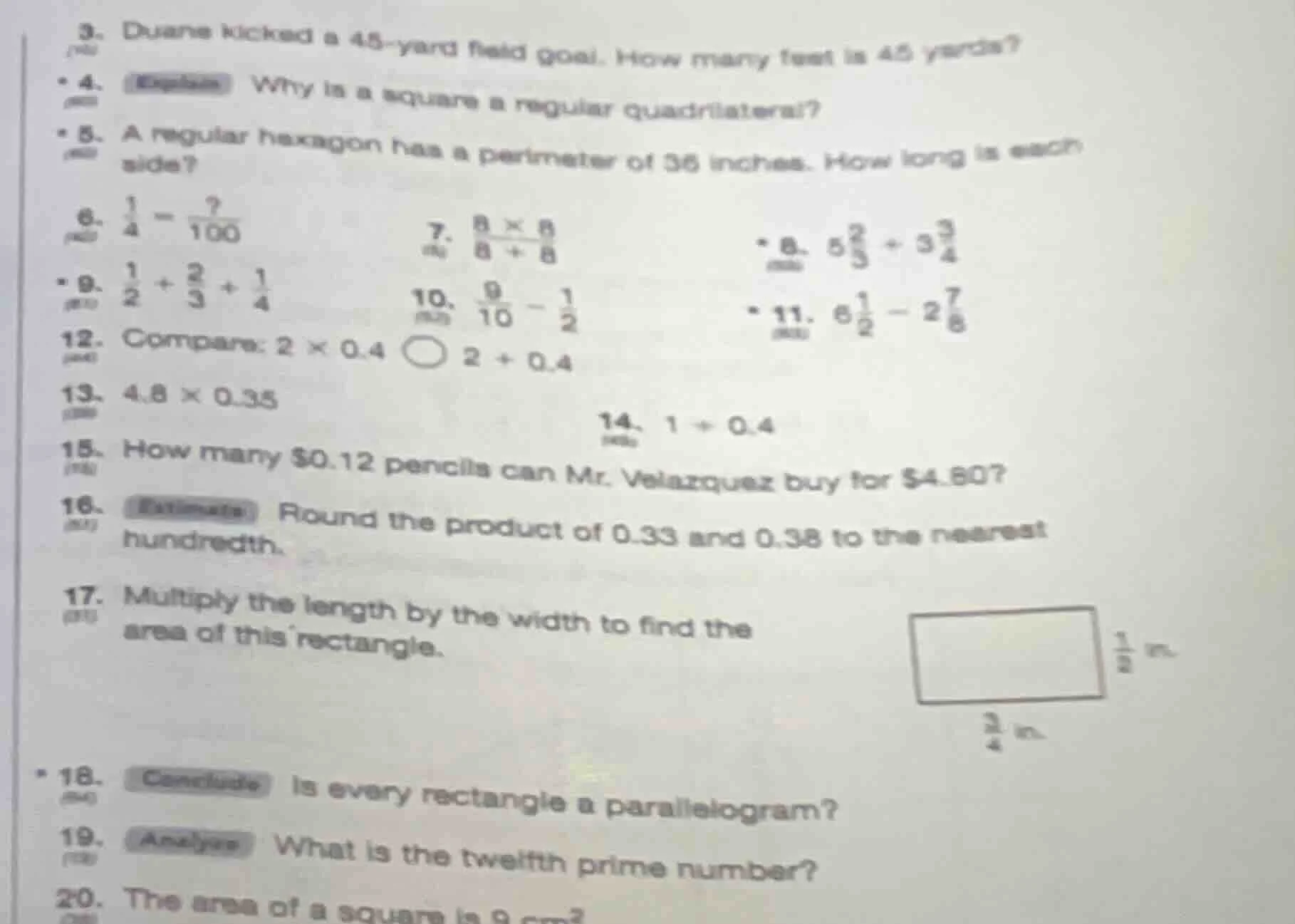
- duane kicked a 45-yard field goal. how many feet is 45 yards?
- 4. explain why is a square a regular quadrilateral?
- 5. a regular hexagon has a perimeter of 36 inches. how long is each side?
- $\frac{1}{4} = \frac{?}{100}$
- $\frac{8 \times 8}{8 + 8}$
- 8. $5\frac{2}{3} + 3\frac{3}{4}$
- 9. $\frac{1}{2} + \frac{2}{3} + \frac{1}{4}$
- $\frac{9}{10} - \frac{1}{2}$
- 11. $6\frac{1}{2} - 2\frac{7}{8}$
- compare: $2 \times 0.4 \bigcirc 2 + 0.4$
- $4.8 \times 0.35$
- $1 \div 0.4$
- how many $0.12 pencils can mr. velazquez buy for $4.80?
- estimate round the product of 0.33 and 0.38 to the nearest hundredth.
- multiply the length by the width to find the area of this rectangle.
- 18. conclude is every rectangle a parallelogram?
- analyze what is the twelfth prime number?
- the area of a square is 9 cm²
Step1: Convert yards to feet
1 yard = 3 feet, so $45 \times 3$
Step2: Calculate the product
$45 \times 3 = 135$
---
Step1: Define regular quadrilateral
A regular quadrilateral has 4 equal sides and 4 equal angles.
Step2: Match square properties
A square has 4 congruent sides and 4 right (equal) angles.
---
Step1: Divide perimeter by 6
A regular hexagon has 6 equal sides, so $\frac{36}{6}$
Step2: Compute the quotient
$\frac{36}{6} = 6$
---
Step1: Find equivalent fraction
$\frac{1}{4} = \frac{1 \times 25}{4 \times 25}$
Step2: Calculate numerator
$\frac{25}{100}$, so? = 25
---
Step1: Simplify numerator and denominator
$8 \times 8 = 64$, $8 + 8 = 16$, so $\frac{64}{16}$
Step2: Divide to get result
$\frac{64}{16} = 4$
---
Step1: Convert to improper fractions
$5\frac{2}{3} = \frac{17}{3}$, $3\frac{3}{4} = \frac{15}{4}$
Step2: Find common denominator
LCD of 3 and 4 is 12: $\frac{17 \times 4}{12} + \frac{15 \times 3}{12} = \frac{68}{12} + \frac{45}{12}$
Step3: Add fractions
$\frac{68 + 45}{12} = \frac{113}{12} = 9\frac{5}{12}$
---
Step1: Find common denominator
LCD of 2, 3, 4 is 12: $\frac{6}{12} + \frac{8}{12} + \frac{3}{12}$
Step2: Add numerators
$\frac{6 + 8 + 3}{12} = \frac{17}{12} = 1\frac{5}{12}$
---
Step1: Find common denominator
LCD of 10 and 2 is 10: $\frac{9}{10} - \frac{5}{10}$
Step2: Subtract fractions
$\frac{9 - 5}{10} = \frac{4}{10} = \frac{2}{5}$
---
Step1: Convert to improper fractions
$6\frac{1}{2} = \frac{13}{2}$, $2\frac{7}{8} = \frac{23}{8}$
Step2: Find common denominator
LCD of 2 and 8 is 8: $\frac{52}{8} - \frac{23}{8}$
Step3: Subtract fractions
$\frac{52 - 23}{8} = \frac{29}{8} = 3\frac{5}{8}$
---
Step1: Calculate both expressions
$2 \times 0.4 = 0.8$, $2 + 0.4 = 2.4$
Step2: Compare values
$0.8 < 2.4$, so use $<$
---
Step1: Multiply decimals directly
$4.8 \times 0.35 = 1.68$
---
Step1: Divide 1 by 0.4
$1 \div 0.4 = \frac{10}{4} = 2.5$
---
Step1: Divide total cost by unit cost
$\frac{4.80}{0.12}$
Step2: Compute the quotient
$\frac{4.80}{0.12} = 40$
---
Step1: Calculate the product
$0.33 \times 0.38 = 0.1254$
Step2: Round to nearest hundredth
$0.1254 \approx 0.13$
---
Step1: Multiply length and width
$\frac{3}{4} \times \frac{1}{2}$
Step2: Compute the product
$\frac{3 \times 1}{4 \times 2} = \frac{3}{8}$
---
Step1: Define parallelogram
A parallelogram has 2 pairs of parallel sides.
Step2: Match rectangle properties
A rectangle has 2 pairs of parallel sides.
---
Step1: List primes in order
2, 3, 5, 7, 11, 13, 17, 19, 23, 29, 31, 37
Step2: Count to 12th prime
The 12th prime is 37
---
Step1: Find side length of square
Area $A = s^2$, so $s = \sqrt{9} = 3$ cm
Step2: (If finding perimeter, optional)
Perimeter $= 4 \times 3 = 12$ cm

Snap & solve any problem in the app
Get step-by-step solutions on Sovi AI
Photo-based solutions with guided steps
Explore more problems and detailed explanations
- 135 feet
- A square has 4 equal sides and 4 equal right angles, meeting the definition of a regular quadrilateral.
- 6 inches
- 25
- 4
- $9\frac{5}{12}$
- $1\frac{5}{12}$
- $\frac{2}{5}$
- $3\frac{5}{8}$
- $2 \times 0.4 < 2 + 0.4$
- 1.68
- 2.5
- 40 pencils
- 0.13
- $\frac{3}{8}$ square inches
- Yes, every rectangle is a parallelogram because it has two pairs of parallel sides.
- 37
- (If finding side length: 3 cm; if finding perimeter: 12 cm)