QUESTION IMAGE
Question
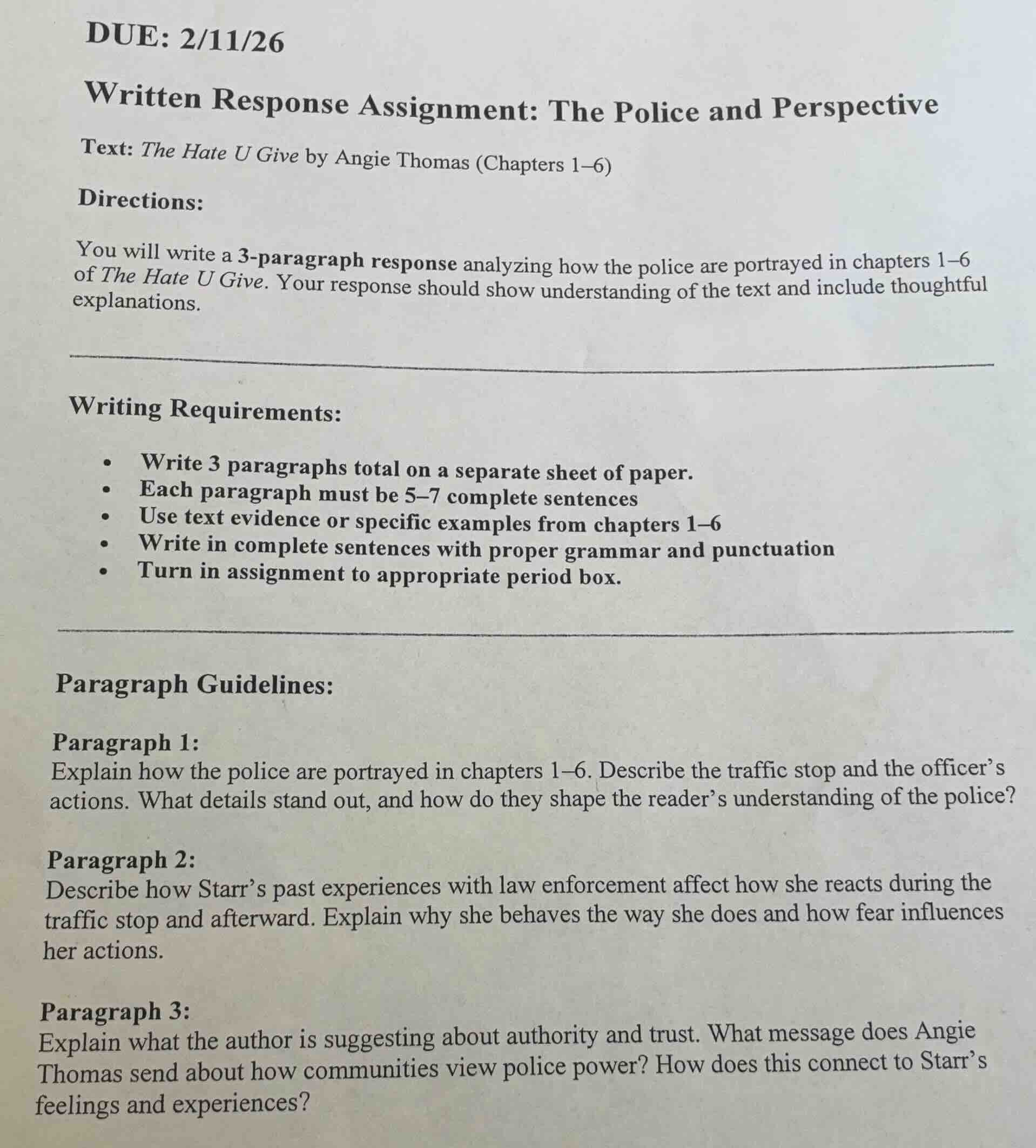
due: 2/11/26
written response assignment: the police and perspective
text: the hate u give by angie thomas (chapters 1-6)
directions:
you will write a 3-paragraph response analyzing how the police are portrayed in chapters 1-6 of the hate u give. your response should show understanding of the text and include thoughtful explanations.
writing requirements:
- write 3 paragraphs total on a separate sheet of paper.
- each paragraph must be 5-7 complete sentences
- use text evidence or specific examples from chapters 1-6
- write in complete sentences with proper grammar and punctuation
- turn in assignment to appropriate period box.
paragraph guidelines:
paragraph 1:
explain how the police are portrayed in chapters 1-6. describe the traffic stop and the officers actions. what details stand out, and how do they shape the readers understanding of the police?
paragraph 2:
describe how starrs past experiences with law enforcement affect how she reacts during the traffic stop and afterward. explain why she behaves the way she does and how fear influences her actions.
paragraph 3:
explain what the author is suggesting about authority and trust. what message does angie thomas send about how communities view police power? how does this connect to starrs feelings and experiences?
Paragraph 1:
The police are portrayed as distrustful and overly aggressive toward Black communities in the first six chapters. The defining moment is the traffic stop where Officer Cruise pulls over Starr and Khalil after a party. Key details include Cruise immediately drawing his gun on Khalil, ignoring Starr’s attempts to de-escalate, and shooting Khalil as he reaches for a hairbrush (mistaking it for a weapon). These details frame the police as quick to use lethal force against Black people without due process, shaping readers to see law enforcement as a threat rather than a protector for marginalized groups.
Paragraph 2:
Starr’s past experiences with police, specifically her parents’ "talk" about how to behave to avoid harm from officers, drive her terrified, compliant reaction during the stop. She freezes, speaks only when spoken to, and reminds Khalil to follow orders, because she knows Black people face harsher consequences for even minor perceived infractions. After Khalil’s death, her fear makes her hesitant to speak out publicly—she worries about retaliation from police and being targeted for telling the truth, showing how systemic police violence instills lifelong, paralyzing fear in Black youth.
Paragraph 3:
Angie Thomas suggests that authority figures like police often break the trust of Black communities, framing police power as an oppressive force rather than a public good. The novel sends the message that many Black communities view police as enforcers of a biased system that prioritizes white safety over Black lives. This connects directly to Starr’s experiences: her fear and reluctance to speak up stem from the community’s collective understanding that police will not hold their own accountable, leaving victims and witnesses with no recourse but silence.

Snap & solve any problem in the app
Get step-by-step solutions on Sovi AI
Photo-based solutions with guided steps
Explore more problems and detailed explanations
Paragraph 1
In the first six chapters of The Hate U Give, the police are portrayed as suspicious, overly aggressive, and quick to use lethal force against Black individuals. The pivotal traffic stop scene exemplifies this: after pulling over Starr and Khalil for a broken taillight, Officer Cruise immediately draws his gun on Khalil, cutting off his attempts to explain his actions. When Khalil reaches for a hairbrush (a detail Starr clearly tries to communicate to the officer), Cruise shoots him dead without hesitation. Small, loaded details—like Cruise ignoring Starr’s pleas, focusing only on Khalil’s race and perceived "threat"—shape readers to see the police as agents of a biased system that views Black people as inherently dangerous, rather than as citizens deserving of fair treatment. This portrayal frames law enforcement as a source of fear, not safety, for Black communities.
Paragraph 2
Starr’s past experiences with law enforcement, particularly the "talk" her parents gave her about how to act around police to stay alive, dictate her terrified, compliant reaction during the traffic stop. She freezes, speaks in a quiet, deferential tone, and begs Khalil to follow the officer’s orders, because she knows even minor missteps can lead to violence for Black people. After Khalil’s death, this fear amplifies: she avoids speaking out publicly, worried that identifying herself as the witness will make her a target for police retaliation. Her fear is not irrational—it is rooted in the community’s shared knowledge that police rarely face consequences for harming Black people, leaving her feeling powerless to challenge the system that killed her friend.
Paragraph 3
Angie Thomas suggests that when authority figures like police consistently act with bias and impunity, they destroy the trust of the communities they are supposed to protect. The core message about police power is that it is often used to oppress Black communities, reinforcing a cycle where marginalized groups view law enforcement as an enemy, not a partner. This connects directly to Starr’s feelings: her reluctance to speak up and her overwhelming fear stem from the same collective distrust that leads her neighborhood to protest Khalil’s death. Thomas makes clear that this breakdown of trust is not accidental—it is the result of a system that prioritizes white comfort over Black lives, leaving young people like Starr caught between speaking truth to power and staying alive.