QUESTION IMAGE
Question
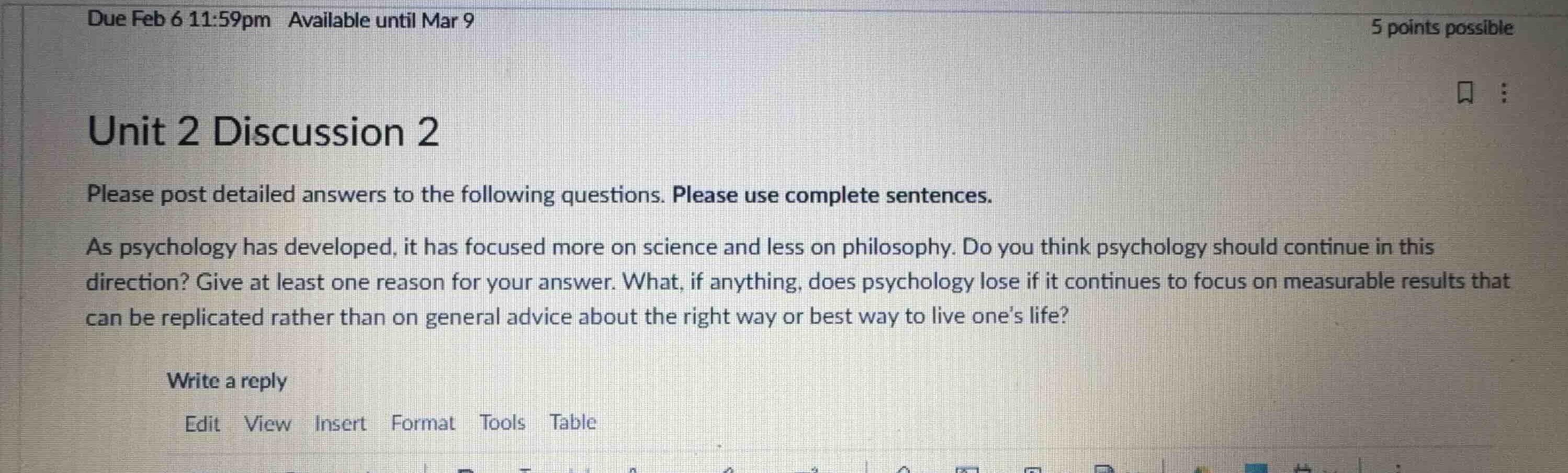
due feb 6 11:59pm available until mar 9 5 points possible unit 2 discussion 2 please post detailed answers to the following questions. please use complete sentences. as psychology has developed, it has focused more on science and less on philosophy. do you think psychology should continue in this direction? give at least one reason for your answer. what, if anything, does psychology lose if it continues to focus on measurable results that can be replicated rather than on general advice about the right way or best way to live one’s life? write a reply edit view insert format tools table
- For the first question: Focusing on science gives psychology credibility as a rigorous, evidence-based field, allowing it to produce reliable, testable insights into human behavior and mental processes that can be used to develop effective treatments and interventions.
- For the second question: If psychology only focuses on measurable, replicable results, it risks losing the ability to address deeply personal, subjective questions about meaning, purpose, and ethical living that were central to its philosophical roots, leaving a gap in supporting people's holistic well-being beyond symptom reduction or behavioral modification.

Snap & solve any problem in the app
Get step-by-step solutions on Sovi AI
Photo-based solutions with guided steps
Explore more problems and detailed explanations
- Yes, psychology should continue to focus more on science than philosophy. A key reason is that a scientific focus allows psychology to produce empirically validated, actionable knowledge—such as evidence-based therapies for mental health conditions—that can be reliably applied to improve people's lives with consistent, testable results.
- If psychology only prioritizes measurable, replicable results, it loses the ability to engage with the subjective, existential aspects of human experience. This includes addressing questions about life purpose, moral decision-making, and personal fulfillment, which are deeply meaningful to individuals but do not easily fit into quantifiable, replicable study designs, leaving a critical gap in supporting holistic human well-being.