QUESTION IMAGE
Question
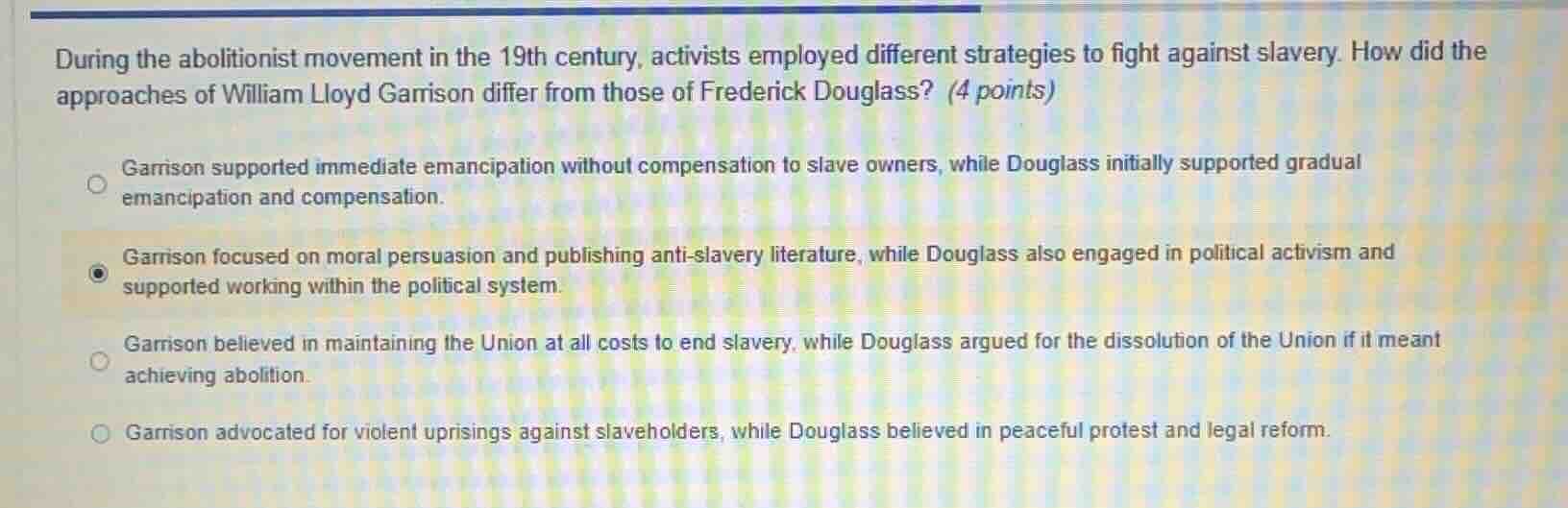
during the abolitionist movement in the 19th century, activists employed different strategies to fight against slavery. how did the approaches of william lloyd garrison differ from those of frederick douglass? (4 points)
garrison supported immediate emancipation without compensation to slave owners, while douglass initially supported gradual emancipation and compensation.
garrison focused on moral persuasion and publishing anti-slavery literature, while douglass also engaged in political activism and supported working within the political system.
garrison believed in maintaining the union at all costs to end slavery, while douglass argued for the dissolution of the union if it meant achieving abolition.
garrison advocated for violent uprisings against slaveholders, while douglass believed in peaceful protest and legal reform.
William Lloyd Garrison centered his abolitionist work on moral appeals and anti-slavery publications, like his newspaper The Liberator. Frederick Douglass, while also using moral persuasion, additionally engaged directly with political systems—he pushed for anti-slavery legislation, participated in political organizing, and supported working within existing political structures to advance abolition, unlike Garrison who rejected political involvement. The other options are incorrect: Garrison and Douglass both eventually backed immediate emancipation without compensation; Garrison argued for dissolving the Union over slavery, while Douglass prioritized preserving it to end slavery; neither advocated violent uprisings as a core strategy.

Snap & solve any problem in the app
Get step-by-step solutions on Sovi AI
Photo-based solutions with guided steps
Explore more problems and detailed explanations
Garrison focused on moral persuasion and publishing anti-slavery literature, while Douglass also engaged in political activism and supported working within the political system.