QUESTION IMAGE
Question
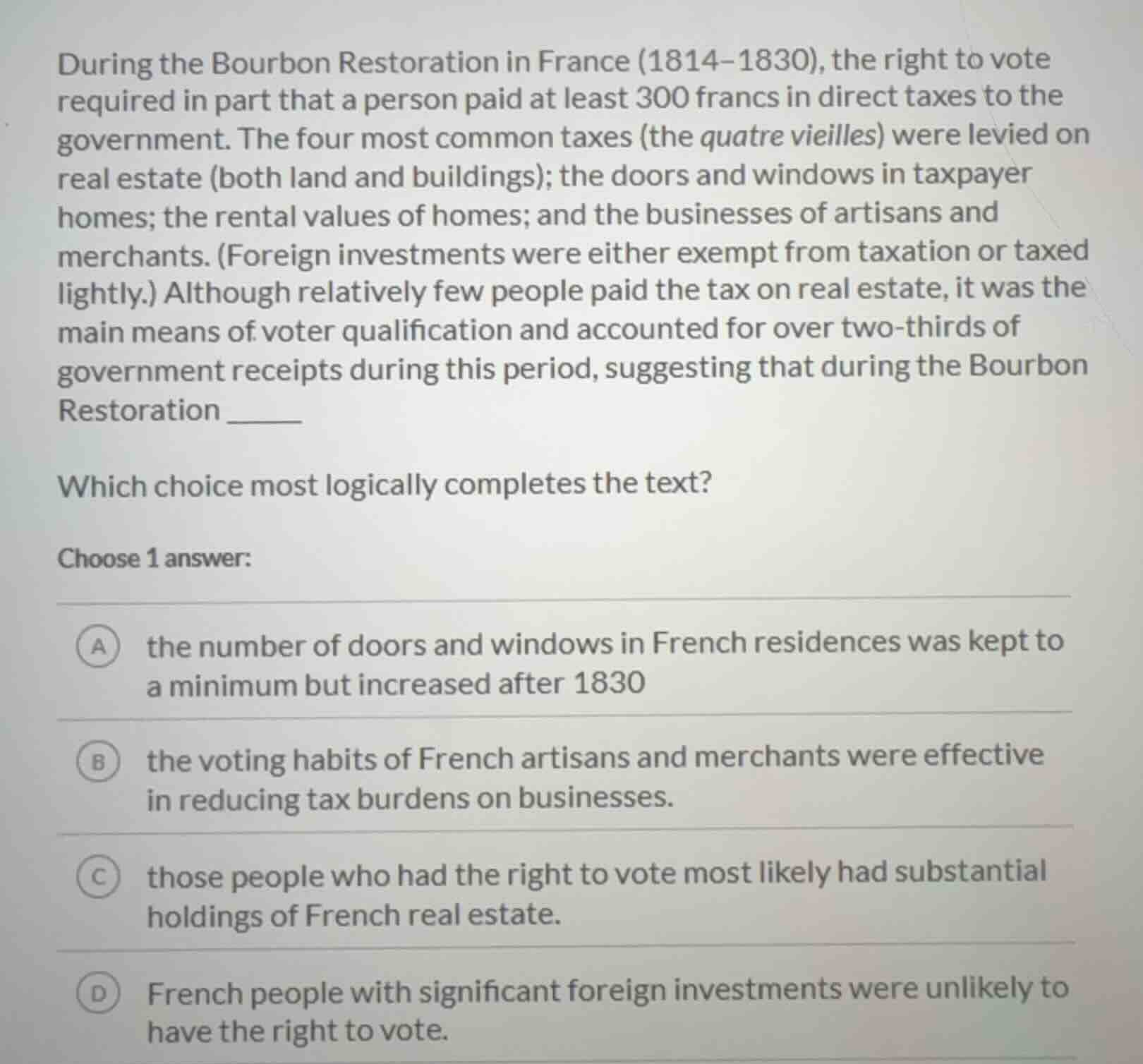
during the bourbon restoration in france (1814–1830), the right to vote required in part that a person paid at least 300 francs in direct taxes to the government. the four most common taxes (the quatre vieilles) were levied on real estate (both land and buildings); the doors and windows in taxpayer homes; the rental values of homes; and the businesses of artisans and merchants. (foreign investments were either exempt from taxation or taxed lightly.) although relatively few people paid the tax on real estate, it was the main means of voter qualification and accounted for over two - thirds of government receipts during this period, suggesting that during the bourbon restoration ______
which choice most logically completes the text?
choose 1 answer:
a the number of doors and windows in french residences was kept to a minimum but increased after 1830
b the voting habits of french artisans and merchants were effective in reducing tax burdens on businesses.
c those people who had the right to vote most likely had substantial holdings of french real estate.
d french people with significant foreign investments were unlikely to have the right to vote.
To solve this, we analyze each option:
- Option A: The text has no info about door/window numbers pre - 1830 or their change, so A is incorrect.
- Option B: There's no mention of voting habits reducing business taxes, so B is wrong.
- Option C: The real - estate tax was the main voter qualification and most people didn't pay it. But since it was the main qualification, those who could vote (paid at least 300 francs in direct taxes) and given the real - estate tax's role, they likely had substantial real - estate holdings. This makes sense.
- Option D: Foreign investments were taxed lightly or exempt, but we don't know if that means those with foreign investments couldn't meet the 300 - franc tax requirement. So D is not supported.

Snap & solve any problem in the app
Get step-by-step solutions on Sovi AI
Photo-based solutions with guided steps
Explore more problems and detailed explanations
C. those people who had the right to vote most likely had substantial holdings of French real estate.