QUESTION IMAGE
Question
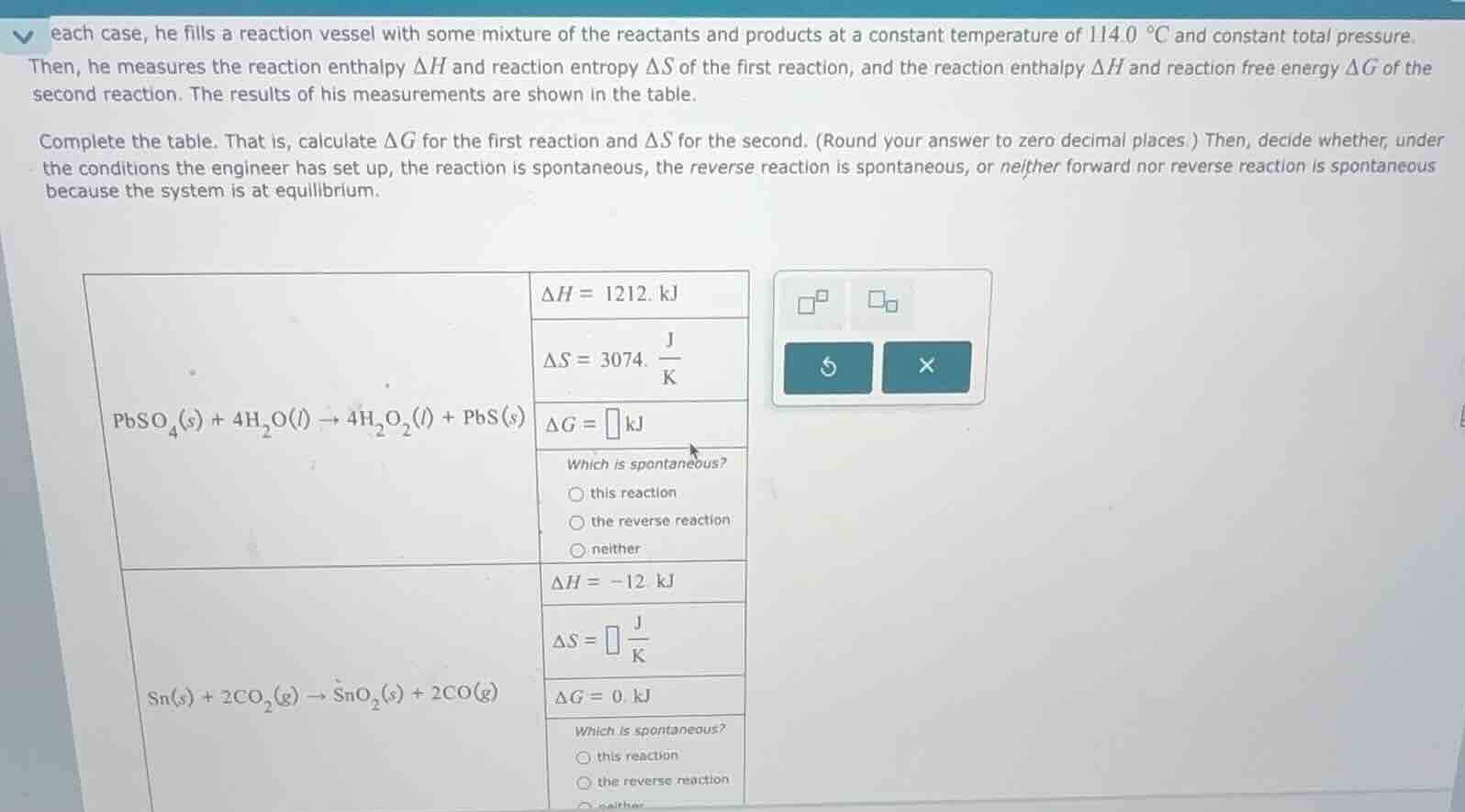
each case, he fills a reaction vessel with some mixture of the reactants and products at a constant temperature of 114.0 °c and constant total pressure. then, he measures the reaction enthalpy $\delta h$ and reaction entropy $\delta s$ of the first reaction, and the reaction enthalpy $\delta h$ and reaction free energy $\delta g$ of the second reaction. the results of his measurements are shown in the table. complete the table. that is, calculate $\delta g$ for the first reaction and $\delta s$ for the second. (round your answer to zero decimal places.) then, decide whether, under the conditions the engineer has set up, the reaction is spontaneous, the reverse reaction is spontaneous, or neither forward nor reverse reaction is spontaneous because the system is at equilibrium. \\(\ce{pbso_{4}(s) + 4h_{2}o(l) -> 4h_{2}o_{2}(l) + pbs(s)}\\) \\(\delta h = 1212.\text{ kj}\\) \\(\delta s = 3074.\frac{\text{j}}{\text{k}}\\) \\(\delta g = \square \text{ kj}\\) which is spontaneous? \\(\circ\\) this reaction \\(\circ\\) the reverse reaction \\(\circ\\) neither \\(\ce{sn(s) + 2co_{2}(g) -> sno_{2}(s) + 2co(g)}\\) \\(\delta h = -12.\text{ kj}\\) \\(\delta s = \square \frac{\text{j}}{\text{k}}\\) \\(\delta g = 0.\text{ kj}\\) which is spontaneous? \\(\circ\\) this reaction \\(\circ\\) the reverse reaction \\(\circ\\) neither
Step1: Convert temperature to Kelvin
The temperature is \( T = 114.0^\circ \text{C} + 273.15 = 387.15 \, \text{K} \)
Step2: Calculate \( \Delta G \) for the first reaction
The formula for Gibbs free energy is \( \Delta G = \Delta H - T\Delta S \)
First, convert \( \Delta S \) to kJ/K: \( \Delta S = 3074 \, \frac{\text{J}}{\text{K}} = 3.074 \, \frac{\text{kJ}}{\text{K}} \)
Now substitute the values: \( \Delta G = 1212 \, \text{kJ} - (387.15 \, \text{K} \times 3.074 \, \frac{\text{kJ}}{\text{K}}) \)
Calculate \( 387.15 \times 3.074 \approx 1190.0 \)
So \( \Delta G = 1212 - 1190.0 = 22 \, \text{kJ} \) (rounded to zero decimal places)
Step3: Determine spontaneity for the first reaction
Since \( \Delta G = 22 \, \text{kJ} > 0 \), the reverse reaction is spontaneous.
Step4: Calculate \( \Delta S \) for the second reaction
Using \( \Delta G = \Delta H - T\Delta S \), and \( \Delta G = 0 \, \text{kJ} \), \( \Delta H = -12 \, \text{kJ} \), \( T = 387.15 \, \text{K} \)
Rearrange to solve for \( \Delta S \): \( \Delta S = \frac{\Delta H - \Delta G}{T} \)
Substitute values: \( \Delta S = \frac{-12 \, \text{kJ} - 0 \, \text{kJ}}{387.15 \, \text{K}} = \frac{-12000 \, \text{J}}{387.15 \, \text{K}} \approx -31 \, \frac{\text{J}}{\text{K}} \) (rounded to zero decimal places)
Step5: Determine spontaneity for the second reaction
Since \( \Delta G = 0 \, \text{kJ} \), the system is at equilibrium, so neither forward nor reverse reaction is spontaneous.

Snap & solve any problem in the app
Get step-by-step solutions on Sovi AI
Photo-based solutions with guided steps
Explore more problems and detailed explanations
For the first reaction (\( \text{PbSO}_4(s) + 4\text{H}_2\text{O}(l)
ightarrow 4\text{H}_2\text{O}_2(l) + \text{PbS}(s) \)):
- \( \Delta G = \boxed{22} \, \text{kJ} \)
- Spontaneity: the reverse reaction
For the second reaction (\( \text{Sn}(s) + 2\text{CO}_2(g)
ightarrow \text{SnO}_2(s) + 2\text{CO}(g) \)):
- \( \Delta S = \boxed{-31} \, \frac{\text{J}}{\text{K}} \)
- Spontaneity: neither