QUESTION IMAGE
Question
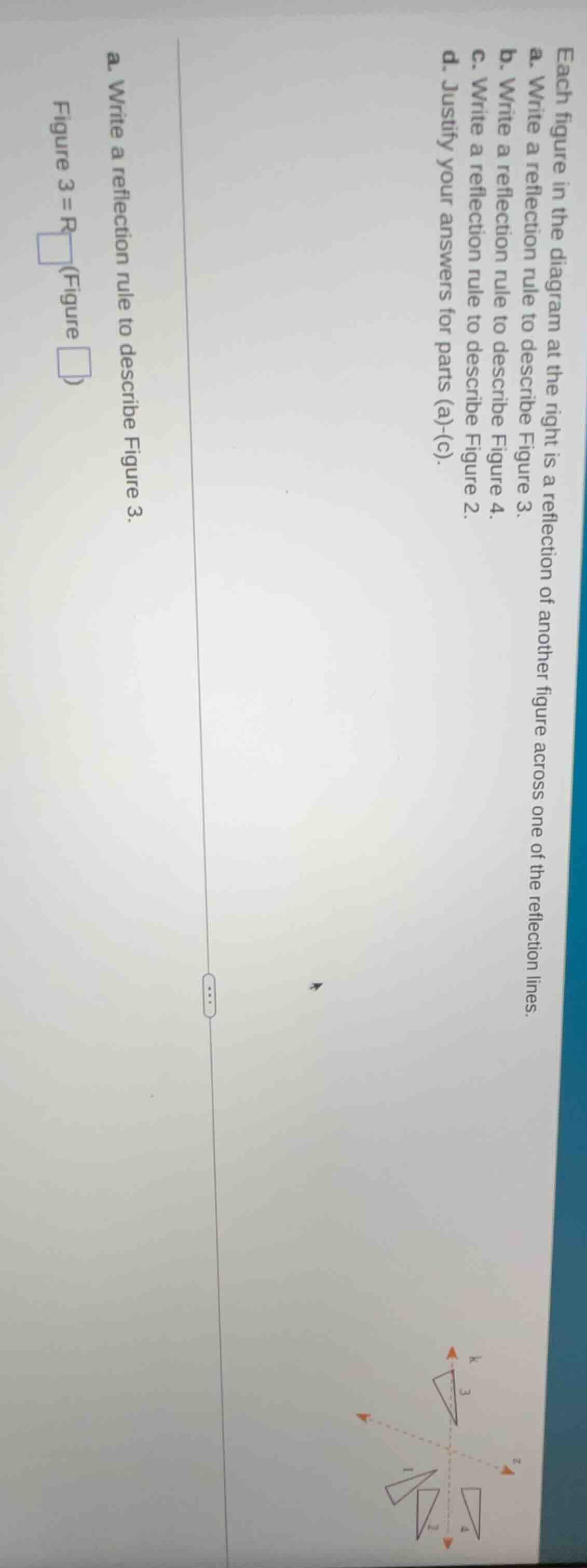
each figure in the diagram at the right is a reflection of another figure across one of the reflection lines.
a. write a reflection rule to describe figure 3.
b. write a reflection rule to describe figure 4.
c. write a reflection rule to describe figure 2.
d. justify your answers for parts (a)-(c).
a. write a reflection rule to describe figure 3.
figure 3 = r(figure )
To solve this, we analyze the reflection rule for Figure 3. From the diagram, Figure 3 is a reflection over line \( k \) (vertical line, likely the \( y \)-axis or a vertical line of symmetry). The reflection rule over a vertical line \( x = a \) is \( (x,y) \to (-x + 2a,y) \). If line \( k \) is the \( y \)-axis (\( x = 0 \)), the rule is \( (x,y) \to (-x,y) \). But from the diagram, assuming line \( k \) is vertical, let's identify the pre - image. If Figure 3 is a reflection of another figure (say Figure 1 or 2) over line \( k \), the reflection rule for a vertical line (line \( k \)):
Step 1: Identify the reflection line
From the diagram, line \( k \) is a vertical line (since it's oriented vertically with the arrow up - down). Let's assume the pre - image of Figure 3 is reflected over line \( k \). For a vertical line of reflection (let's say the line of reflection is \( x = h \)), the reflection rule is \( (x,y)\to(2h - x,y) \). If we consider the standard vertical reflection (over \( y \) - axis, \( h = 0 \)), the rule is \( (x,y)\to(-x,y) \). But from the diagram's orientation, if line \( k \) is the vertical line of reflection, and we assume the pre - image is on one side of line \( k \) and Figure 3 is on the other, the reflection rule for Figure 3 (assuming reflection over line \( k \), a vertical line) is:
If we take a general point \( (x,y) \) on the pre - image, after reflection over line \( k \) (vertical), the \( x \) - coordinate is mirrored across line \( k \), and the \( y \) - coordinate remains the same.
Step 2: Define the rule
Let's assume line \( k \) is the vertical line (let's say the \( y \) - axis for simplicity, or a vertical line through the center). The reflection rule for a vertical line (line \( k \)) is \( R_k:(x,y)\to(-x,y) \) if line \( k \) is the \( y \) - axis. But from the diagram, if we look at the triangles, the reflection over line \( k \) (vertical) would map a point \( (x,y) \) to \( (-x,y) \) (assuming line \( k \) is the \( y \) - axis).
So the reflection rule for Figure 3 (assuming reflection over the vertical line \( k \)) is: Reflect over the vertical line (line \( k \)), so the rule is \( (x,y)\to(-x,y) \) (if line \( k \) is the \( y \) - axis) or more generally, if line \( k \) has equation \( x = a \), \( (x,y)\to(2a - x,y) \). From the diagram's visual (the vertical dashed line \( k \)), the reflection rule is a reflection over the vertical line \( k \), so the rule is \( (x,y)\to(2h - x,y) \), where \( h \) is the \( x \) - coordinate of line \( k \). If we assume \( h = 0 \) (line \( k \) is \( y \) - axis), the rule is \( (x,y)\to(-x,y) \).

Snap & solve any problem in the app
Get step-by-step solutions on Sovi AI
Photo-based solutions with guided steps
Explore more problems and detailed explanations
The reflection rule for Figure 3 is a reflection over the vertical line \( k \), so the rule is \( (x,y)\to(-x,y) \) (assuming line \( k \) is the \( y \) - axis, or more precisely, if line \( k \) has equation \( x = h \), the rule is \( (x,y)\to(2h - x,y) \)). If we take the vertical line \( k \) as the line of reflection, the reflection rule is \( R_k:(x,y)\to(-x,y) \) (for \( h = 0 \)) or \( R_k:(x,y)\to(2h - x,y) \) for a general vertical line \( x = h \).