QUESTION IMAGE
Question
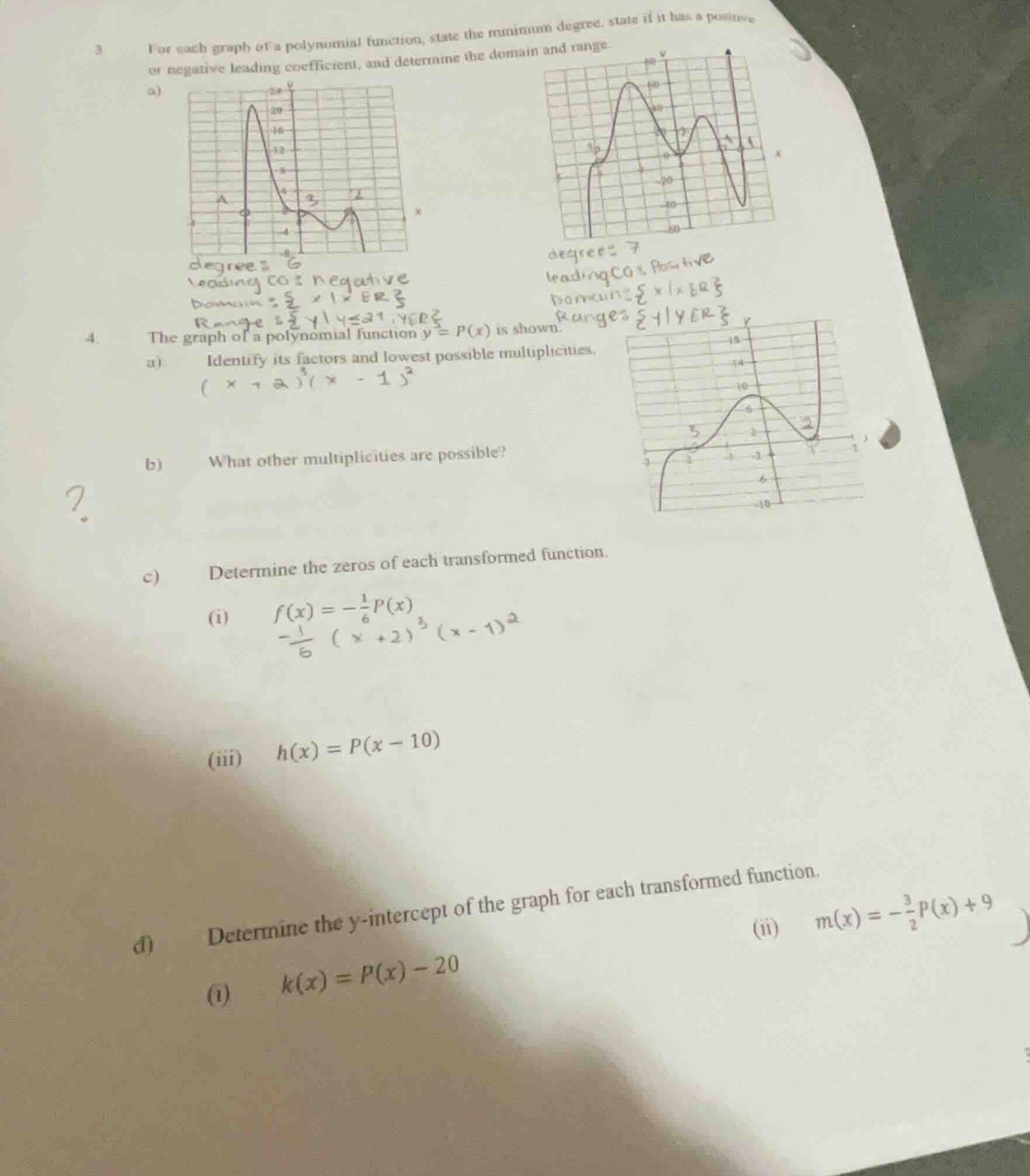
3 for each graph of a polynomial function, state the minimum degree, state if it has a positive or negative leading coefficient, and determine the domain and range
a)
- the graph of a polynomial function ( y = p(x) ) is shown.
a) identify its factors and lowest possible multiplicities.
b) what other multiplicities are possible?
c) determine the zeros of each transformed function.
(i) ( f(x) = -\frac{1}{6}p(x) )
(iii) ( h(x) = p(x - 10) )
d) determine the ( y )-intercept of the graph for each transformed function.
(i) ( k(x) = p(x) - 20 )
(ii) ( m(x) = -\frac{3}{2}p(x) + 9 )
Part 4c(i): Zeros of \( f(x) = -\frac{1}{6}P(x) \)
Step 1: Recall Zero Property
The zeros of a function \( f(x) = a \cdot g(x) \) (where \( a
eq 0 \)) are the same as the zeros of \( g(x) \), since multiplying by a non - zero constant does not change the \( x \) - values where the function equals zero.
Step 2: Analyze \( P(x) \)'s Zeros
From part 4a, we know that the factors of \( P(x) \) are \( (x + 2)^3 \) and \( (x - 1)^2 \). The zeros of \( P(x) \) occur when \( (x + 2)^3=0 \) or \( (x - 1)^2 = 0 \). Solving \( (x + 2)^3=0 \) gives \( x=-2 \), and solving \( (x - 1)^2=0 \) gives \( x = 1 \).
Step 3: Find Zeros of \( f(x) \)
Since \( f(x)=-\frac{1}{6}P(x) \), the zeros of \( f(x) \) are the same as the zeros of \( P(x) \). So we set \( f(x) = 0 \), which implies \( -\frac{1}{6}P(x)=0 \), and then \( P(x)=0 \). The solutions to \( P(x) = 0 \) are \( x=-2 \) (with multiplicity 3) and \( x = 1 \) (with multiplicity 2).
Step 1: Recall Horizontal Shift Property
For a function \( y = P(x - h) \), it is a horizontal shift of the function \( y = P(x) \) by \( h \) units. The zeros of \( y = P(x - h) \) are found by setting \( x - h \) equal to the zeros of \( P(x) \).
Step 2: Find Zeros of \( h(x) \)
Let the zeros of \( P(x) \) be \( x=-2 \) and \( x = 1 \) (from part 4a). For \( h(x)=P(x - 10) \), we set \( x-10=-2 \) and \( x - 10=1 \).
- Solving \( x-10=-2 \): Add 10 to both sides of the equation, we get \( x=-2 + 10=8 \).
- Solving \( x - 10=1 \): Add 10 to both sides of the equation, we get \( x=1 + 10=11 \).
Step 1: Recall \( y \) - intercept Definition
The \( y \) - intercept of a function \( y = k(x) \) is the value of the function when \( x = 0 \), i.e., \( k(0) \).
Step 2: Analyze \( P(0) \)
First, we need to find \( P(0) \). From the graph of \( P(x) \), we can see that when \( x = 0 \), we need to find the \( y \) - value of \( P(x) \). Let's assume from the graph (or from the fact that we can analyze the polynomial) that \( P(0) \) is the \( y \) - intercept of \( P(x) \). Looking at the graph, when \( x = 0 \), let's say \( P(0)=y_0 \). From the graph, we can estimate (or if we know the polynomial) that \( P(0) \) (the \( y \) - intercept of \( P(x) \)): Let's assume that from the graph, when \( x = 0 \), the value of \( P(x) \) is, for example, if we consider the polynomial \( P(x)=(x + 2)^3(x - 1)^2 \), then \( P(0)=(0 + 2)^3(0 - 1)^2=(8)\times(1)=8 \). Wait, but maybe from the graph, let's re - check. Wait, the graph of \( P(x) \) has a \( y \) - intercept. Let's assume that when \( x = 0 \), \( P(0) \) is the \( y \) - value at \( x = 0 \). Let's say from the graph, the \( y \) - intercept of \( P(x) \) is \( P(0)=8 \) (we can also calculate it from the factored form: \( P(x)=(x + 2)^3(x - 1)^2 \), so \( P(0)=(2)^3(-1)^2=8\times1 = 8 \)).
Step 3: Calculate \( k(0) \)
Now, \( k(x)=P(x)-20 \), so \( k(0)=P(0)-20 \). Substituting \( P(0) = 8 \), we get \( k(0)=8-20=-12 \).

Snap & solve any problem in the app
Get step-by-step solutions on Sovi AI
Photo-based solutions with guided steps
Explore more problems and detailed explanations
The zeros of \( f(x)=-\frac{1}{6}P(x) \) are \( x=-2 \) (multiplicity 3) and \( x = 1 \) (multiplicity 2).