QUESTION IMAGE
Question
for each pair of statements, choose the one that is true.
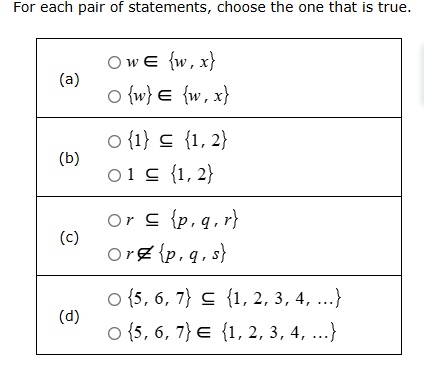
(a)
- ( w in {w, x} )
- ( {w} in {w, x} )
(b)
- ( {1} subseteq {1, 2} )
- ( 1 subseteq {1, 2} )
(c)
- ( r subseteq {p, q, r} )
- ( r
otin {p, q, s} )
(d)
- ( {5, 6, 7} subseteq {1, 2, 3, 4, dots} )
- ( {5, 6, 7} in {1, 2, 3, 4, dots} )
Step1: Analyze set membership (a)
$\in$ denotes an element belongs to a set. $w$ is an element of $\{w, x\}$, while $\{w\}$ is a subset, not an element here.
Step2: Analyze subset relation (b)
$\subseteq$ means all elements of the first set are in the second. $\{1\}$'s element $1$ is in $\{1,2\}$; $1$ is an element, not a set, so $1 \subseteq \{1,2\}$ is invalid.
Step3: Analyze subset/element logic (c)
$r$ is an element, not a set, so $r \subseteq \{p,q,r\}$ is meaningless. $r
subseteq \{p,q,s\}$ is true because $r$ is not a set, so it cannot be a subset.
Step4: Analyze infinite set subset (d)
$\{1,2,3,4,...\}$ is the set of positive integers. $\{5,6,7\}$'s elements are all positive integers, so $\{5,6,7\} \subseteq \{1,2,3,4,...\}$ holds. $\{5,6,7\}$ is a set, not an element of the infinite set, so $\in$ is invalid.

Snap & solve any problem in the app
Get step-by-step solutions on Sovi AI
Photo-based solutions with guided steps
Explore more problems and detailed explanations
(a) $w \in \{w, x\}$
(b) $\{1\} \subseteq \{1, 2\}$
(c) $r
subseteq \{p, q, s\}$
(d) $\{5, 6, 7\} \subseteq \{1, 2, 3, 4, ...\}$