QUESTION IMAGE
Question
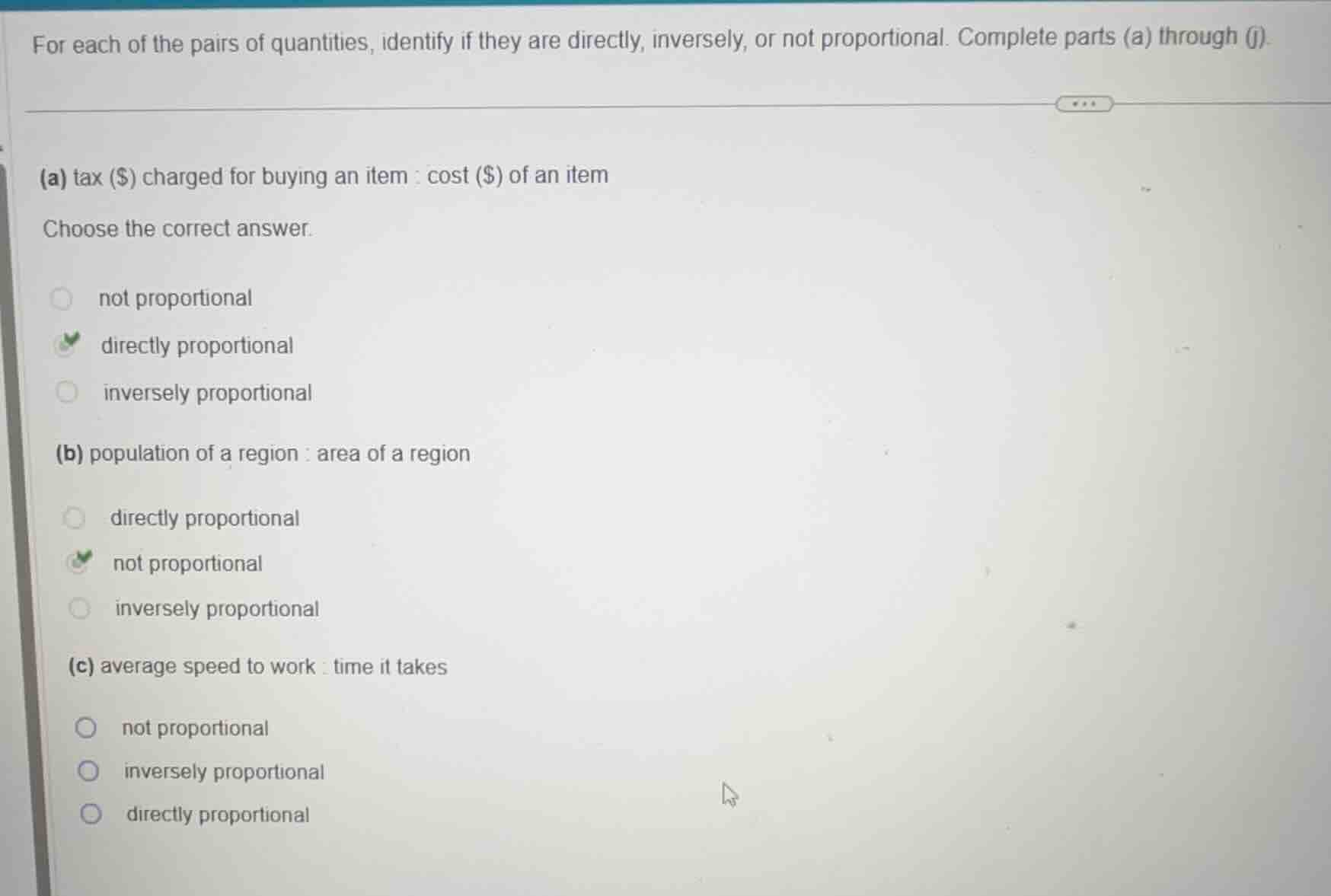
for each of the pairs of quantities, identify if they are directly, inversely, or not proportional. complete parts (a) through (j).
(a) tax ($) charged for buying an item : cost ($) of an item
choose the correct answer.
not proportional
directly proportional
inversely proportional
(b) population of a region : area of a region
directly proportional
not proportional
inversely proportional
(c) average speed to work : time it takes
not proportional
inversely proportional
directly proportional
Part (a)
Tax charged is calculated as a percentage (tax rate) of the item's cost. If the cost \( C \) increases, the tax \( T \) (where \( T = r\times C \), \( r \) is tax rate) increases proportionally. So tax and cost are directly proportional.
Population of a region depends on many factors like density, resources, not just area. A larger area doesn't guarantee a proportional increase in population (e.g., a desert region with large area may have low population). So population and area are not proportional.
The formula relating speed (\( s \)), time (\( t \)), and distance (\( d \)) is \( d = s\times t \). If distance to work is constant, then \( s=\frac{d}{t} \), so as speed increases, time decreases, and vice - versa. This is the inverse proportionality relationship (\( s\propto\frac{1}{t} \) when \( d \) is constant).

Snap & solve any problem in the app
Get step-by-step solutions on Sovi AI
Photo-based solutions with guided steps
Explore more problems and detailed explanations
directly proportional