QUESTION IMAGE
Question
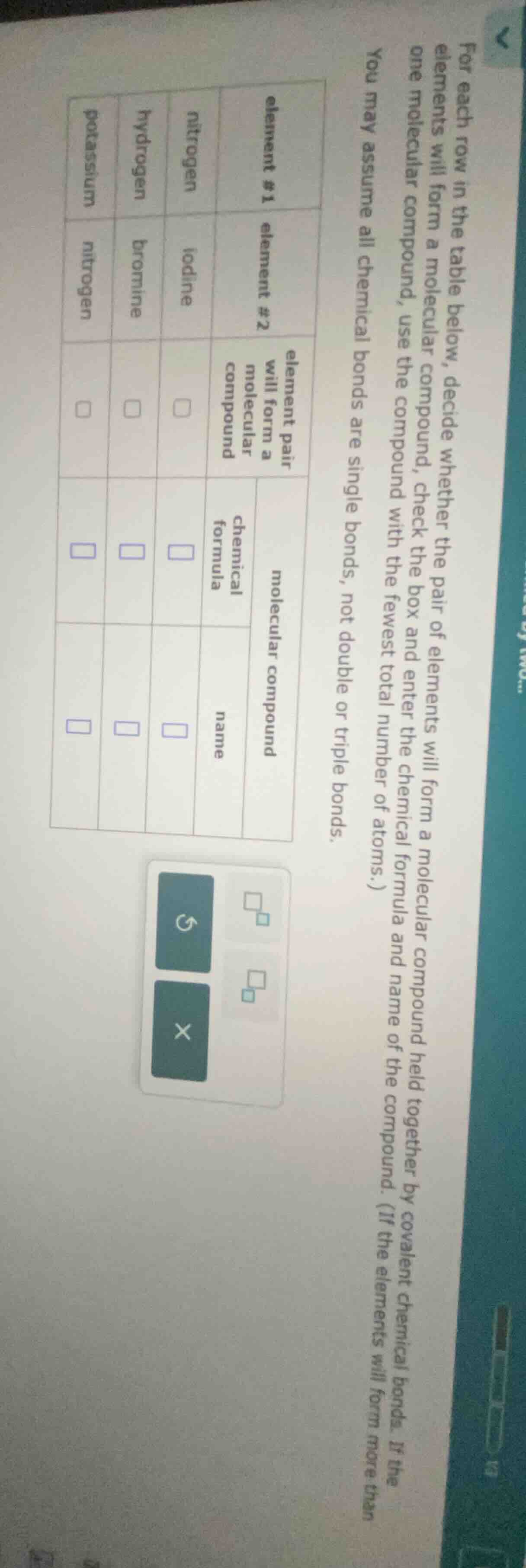
for each row in the table below, decide whether the pair of elements will form a molecular compound, check the box and enter the chemical formula and name of the compound. (if the elements will form more than one molecular compound, use the compound with the fewest total number of atoms.)
you may assume all chemical bonds are single bonds, not double or triple bonds.
| element #1 | element #2 | element pair will form a molecular compound | molecular compound chemical formula | molecular compound name |
|---|---|---|---|---|
| hydrogen | bromine | $square$ | $square$ | $square$ |
| potassium | nitrogen | $square$ | $square$ | $square$ |
To solve this, we analyze each row to see if the elements form a molecular (covalent) compound (non - metals combine covalently; metals and non - metals form ionic compounds).
Row 1: Element #1 = Nitrogen, Element #2 = Iodine
- Both nitrogen (N) and iodine (I) are non - metals. So, they can form a molecular compound.
- For the formula, we consider the simplest ratio (since we assume single bonds and the fewest atoms). Nitrogen is in group 15 (needs 3 more electrons) and iodine is in group 17 (needs 1 more electron). To satisfy the octet rule, one N atom will bond with 3 I atoms. So the formula is $NI_3$.
- The name of the compound is nitrogen triiodide.
Row 2: Element #1 = Hydrogen, Element #2 = Bromine
- Hydrogen (H) and bromine (Br) are non - metals. They will form a molecular compound.
- Hydrogen needs 1 electron, bromine needs 1 electron. So, they form a 1:1 compound. The formula is $HBr$.
- The name is hydrogen bromide.
Row 3: Element #1 = Potassium, Element #2 = Nitrogen
- Potassium (K) is a metal and nitrogen (N) is a non - metal. They will form an ionic compound, not a molecular compound. So, we leave the "will form a molecular compound" box unchecked.
Filling the Table:
| Element #1 | Element #2 | element pair will form a molecular compound | chemical formula | molecular compound name |
|---|---|---|---|---|
| Hydrogen | Bromine | $\boldsymbol{\checkmark}$ | $HBr$ | Hydrogen bromide |
| Potassium | Nitrogen | $\boldsymbol{\square}$ | - | - |

Snap & solve any problem in the app
Get step-by-step solutions on Sovi AI
Photo-based solutions with guided steps
Explore more problems and detailed explanations
To solve this, we analyze each row to see if the elements form a molecular (covalent) compound (non - metals combine covalently; metals and non - metals form ionic compounds).
Row 1: Element #1 = Nitrogen, Element #2 = Iodine
- Both nitrogen (N) and iodine (I) are non - metals. So, they can form a molecular compound.
- For the formula, we consider the simplest ratio (since we assume single bonds and the fewest atoms). Nitrogen is in group 15 (needs 3 more electrons) and iodine is in group 17 (needs 1 more electron). To satisfy the octet rule, one N atom will bond with 3 I atoms. So the formula is $NI_3$.
- The name of the compound is nitrogen triiodide.
Row 2: Element #1 = Hydrogen, Element #2 = Bromine
- Hydrogen (H) and bromine (Br) are non - metals. They will form a molecular compound.
- Hydrogen needs 1 electron, bromine needs 1 electron. So, they form a 1:1 compound. The formula is $HBr$.
- The name is hydrogen bromide.
Row 3: Element #1 = Potassium, Element #2 = Nitrogen
- Potassium (K) is a metal and nitrogen (N) is a non - metal. They will form an ionic compound, not a molecular compound. So, we leave the "will form a molecular compound" box unchecked.
Filling the Table:
| Element #1 | Element #2 | element pair will form a molecular compound | chemical formula | molecular compound name |
|---|---|---|---|---|
| Hydrogen | Bromine | $\boldsymbol{\checkmark}$ | $HBr$ | Hydrogen bromide |
| Potassium | Nitrogen | $\boldsymbol{\square}$ | - | - |