QUESTION IMAGE
Question
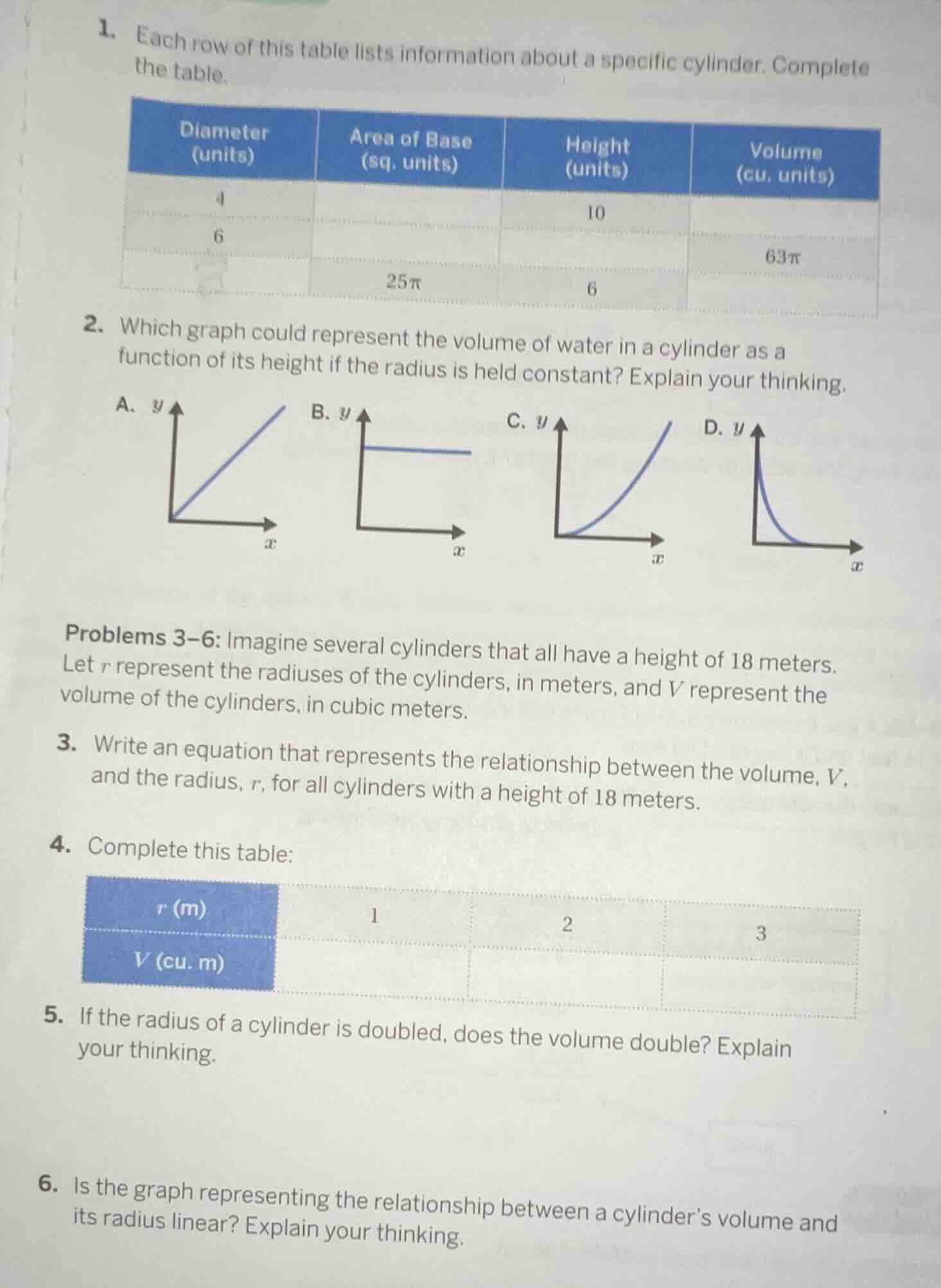
- each row of this table lists information about a specific cylinder. complete the table.
| diameter (units) | area of base (sq. units) | height (units) | volume (cu. units) |
|---|---|---|---|
| 6 | 63π | ||
| 25π | 6 |
- which graph could represent the volume of water in a cylinder as a function of its height if the radius is held constant? explain your thinking.
a. graph a b. graph b c. graph c d. graph d
problems 3–6: imagine several cylinders that all have a height of 18 meters. let ( r ) represent the radiuses of the cylinders, in meters, and ( v ) represent the volume of the cylinders, in cubic meters.
- write an equation that represents the relationship between the volume, ( v ), and the radius, ( r ), for all cylinders with a height of 18 meters.
- complete this table:
| ( r ) (m) | 1 | 2 | 3 |
|---|
- if the radius of a cylinder is doubled, does the volume double? explain your thinking.
- is the graph representing the relationship between a cylinder’s volume and its radius linear? explain your thinking.
Problem 1: Completing the Cylinder Table
Row 1 (Diameter = 4, Height = 10)
Step 1: Find the radius
The radius \( r \) is half of the diameter. So, \( r = \frac{4}{2} = 2 \) units.
Step 2: Calculate the area of the base
The area of the base of a cylinder (a circle) is \( A = \pi r^2 \). Substituting \( r = 2 \), we get \( A = \pi (2)^2 = 4\pi \) square units.
Step 3: Calculate the volume
The volume \( V \) of a cylinder is \( V = A \times h \) (where \( h \) is the height). Substituting \( A = 4\pi \) and \( h = 10 \), we get \( V = 4\pi \times 10 = 40\pi \) cubic units.
Row 2 (Diameter = 6, Volume = \( 63\pi \))
Step 1: Find the radius
\( r = \frac{6}{2} = 3 \) units.
Step 2: Calculate the area of the base
\( A = \pi (3)^2 = 9\pi \) square units.
Step 3: Find the height
Using \( V = A \times h \), we can solve for \( h \): \( h = \frac{V}{A} \). Substituting \( V = 63\pi \) and \( A = 9\pi \), we get \( h = \frac{63\pi}{9\pi} = 7 \) units.
Row 3 (Area of Base = \( 25\pi \), Height = 6)
Step 1: Find the radius
From \( A = \pi r^2 \), we have \( 25\pi = \pi r^2 \). Dividing both sides by \( \pi \), we get \( 25 = r^2 \), so \( r = 5 \) units.
Step 2: Find the diameter
The diameter is twice the radius, so \( d = 2 \times 5 = 10 \) units.
Step 3: Calculate the volume
\( V = A \times h = 25\pi \times 6 = 150\pi \) cubic units.
Problem 2: Graph of Volume vs. Height (Constant Radius)
The volume of a cylinder is given by \( V = \pi r^2 h \). If the radius \( r \) is constant, then \( \pi r^2 \) is a constant (let's call it \( k \)). So, \( V = k \times h \), which is a linear equation (in the form \( y = mx + b \) with \( b = 0 \)). A linear equation with a positive slope (since \( k \) is positive) will be a straight line passing through the origin.
- Option A: A straight line through the origin (linear, positive slope) – matches \( V = k h \).
- Option B: Horizontal line (constant volume, independent of height) – incorrect.
- Option C: Curved line (quadratic or higher) – incorrect, since \( V \) is linear in \( h \) when \( r \) is constant.
- Option D: Curved line decreasing – incorrect.
So the correct graph is A.
Problem 3: Equation for Volume and Radius (Height = 18 m)
The volume of a cylinder is \( V = \pi r^2 h \). Here, \( h = 18 \) meters. Substituting \( h = 18 \), we get:
\( V = \pi r^2 (18) = 18\pi r^2 \)
Problem 4: Completing the Volume Table (Height = 18 m)
Using the equation \( V = 18\pi r^2 \):
- For \( r = 1 \): \( V = 18\pi (1)^2 = 18\pi \) cubic meters.
- For \( r = 2 \): \( V = 18\pi (2)^2 = 18\pi \times 4 = 72\pi \) cubic meters.
- For \( r = 3 \): \( V = 18\pi (3)^2 = 18\pi \times 9 = 162\pi \) cubic meters.
Problem 5: Effect of Doubling the Radius on Volume
Let the original radius be \( r \) and height \( h \). The original volume \( V_1 = \pi r^2 h \).
If the radius is doubled, the new radius is \( 2r \). The new volume \( V_2 = \pi (2r)^2 h = \pi (4r^2) h = 4\pi r^2 h \).
Comparing \( V_2 \) and \( V_1 \): \( V_2 = 4 \times V_1 \). So, doubling the radius quadruples the volume, not doubles it.
Problem 6: Linearity of Volume vs. Radius
The volume equation is \( V = 18\pi r^2 \) (from Problem 3). This is a quadratic equation in terms of \( r \) (since \( r \) is squared). A linear relationship has the form \( y = mx + b \) (where the variable is to the first power). Since \( r \) is squared, the relationship between \( V \) and \( r \) is not linear; it is a quadratic relationship (a parabola when graphed).
Final Answers
P…

Snap & solve any problem in the app
Get step-by-step solutions on Sovi AI
Photo-based solutions with guided steps
Explore more problems and detailed explanations
Problem 1: Completing the Cylinder Table
Row 1 (Diameter = 4, Height = 10)
Step 1: Find the radius
The radius \( r \) is half of the diameter. So, \( r = \frac{4}{2} = 2 \) units.
Step 2: Calculate the area of the base
The area of the base of a cylinder (a circle) is \( A = \pi r^2 \). Substituting \( r = 2 \), we get \( A = \pi (2)^2 = 4\pi \) square units.
Step 3: Calculate the volume
The volume \( V \) of a cylinder is \( V = A \times h \) (where \( h \) is the height). Substituting \( A = 4\pi \) and \( h = 10 \), we get \( V = 4\pi \times 10 = 40\pi \) cubic units.
Row 2 (Diameter = 6, Volume = \( 63\pi \))
Step 1: Find the radius
\( r = \frac{6}{2} = 3 \) units.
Step 2: Calculate the area of the base
\( A = \pi (3)^2 = 9\pi \) square units.
Step 3: Find the height
Using \( V = A \times h \), we can solve for \( h \): \( h = \frac{V}{A} \). Substituting \( V = 63\pi \) and \( A = 9\pi \), we get \( h = \frac{63\pi}{9\pi} = 7 \) units.
Row 3 (Area of Base = \( 25\pi \), Height = 6)
Step 1: Find the radius
From \( A = \pi r^2 \), we have \( 25\pi = \pi r^2 \). Dividing both sides by \( \pi \), we get \( 25 = r^2 \), so \( r = 5 \) units.
Step 2: Find the diameter
The diameter is twice the radius, so \( d = 2 \times 5 = 10 \) units.
Step 3: Calculate the volume
\( V = A \times h = 25\pi \times 6 = 150\pi \) cubic units.
Problem 2: Graph of Volume vs. Height (Constant Radius)
The volume of a cylinder is given by \( V = \pi r^2 h \). If the radius \( r \) is constant, then \( \pi r^2 \) is a constant (let's call it \( k \)). So, \( V = k \times h \), which is a linear equation (in the form \( y = mx + b \) with \( b = 0 \)). A linear equation with a positive slope (since \( k \) is positive) will be a straight line passing through the origin.
- Option A: A straight line through the origin (linear, positive slope) – matches \( V = k h \).
- Option B: Horizontal line (constant volume, independent of height) – incorrect.
- Option C: Curved line (quadratic or higher) – incorrect, since \( V \) is linear in \( h \) when \( r \) is constant.
- Option D: Curved line decreasing – incorrect.
So the correct graph is A.
Problem 3: Equation for Volume and Radius (Height = 18 m)
The volume of a cylinder is \( V = \pi r^2 h \). Here, \( h = 18 \) meters. Substituting \( h = 18 \), we get:
\( V = \pi r^2 (18) = 18\pi r^2 \)
Problem 4: Completing the Volume Table (Height = 18 m)
Using the equation \( V = 18\pi r^2 \):
- For \( r = 1 \): \( V = 18\pi (1)^2 = 18\pi \) cubic meters.
- For \( r = 2 \): \( V = 18\pi (2)^2 = 18\pi \times 4 = 72\pi \) cubic meters.
- For \( r = 3 \): \( V = 18\pi (3)^2 = 18\pi \times 9 = 162\pi \) cubic meters.
Problem 5: Effect of Doubling the Radius on Volume
Let the original radius be \( r \) and height \( h \). The original volume \( V_1 = \pi r^2 h \).
If the radius is doubled, the new radius is \( 2r \). The new volume \( V_2 = \pi (2r)^2 h = \pi (4r^2) h = 4\pi r^2 h \).
Comparing \( V_2 \) and \( V_1 \): \( V_2 = 4 \times V_1 \). So, doubling the radius quadruples the volume, not doubles it.
Problem 6: Linearity of Volume vs. Radius
The volume equation is \( V = 18\pi r^2 \) (from Problem 3). This is a quadratic equation in terms of \( r \) (since \( r \) is squared). A linear relationship has the form \( y = mx + b \) (where the variable is to the first power). Since \( r \) is squared, the relationship between \( V \) and \( r \) is not linear; it is a quadratic relationship (a parabola when graphed).
Final Answers
Problem 1 Table:
| Diameter (units) | Area of Base (sq. units) | Height (units) | Volume (cu. units) |
|---|---|---|---|
| 6 | \( 9\pi \) | 7 | \( 63\pi \) |
| 10 | \( 25\pi \) | 6 | \( 150\pi \) |
Problem 2:
\(\boldsymbol{\text{A}}\)
Problem 3:
\(\boldsymbol{V = 18\pi r^2}\)
Problem 4 Table:
| \( r \) (m) | \( V \) (cu. m) |
|---|---|
| 2 | \( 72\pi \) |
| 3 | \( 162\pi \) |
Problem 5:
No, doubling the radius quadruples the volume (since \( V \propto r^2 \)).
Problem 6:
No, the relationship is quadratic (\( V = 18\pi r^2 \)), so it is not linear.