QUESTION IMAGE
Question
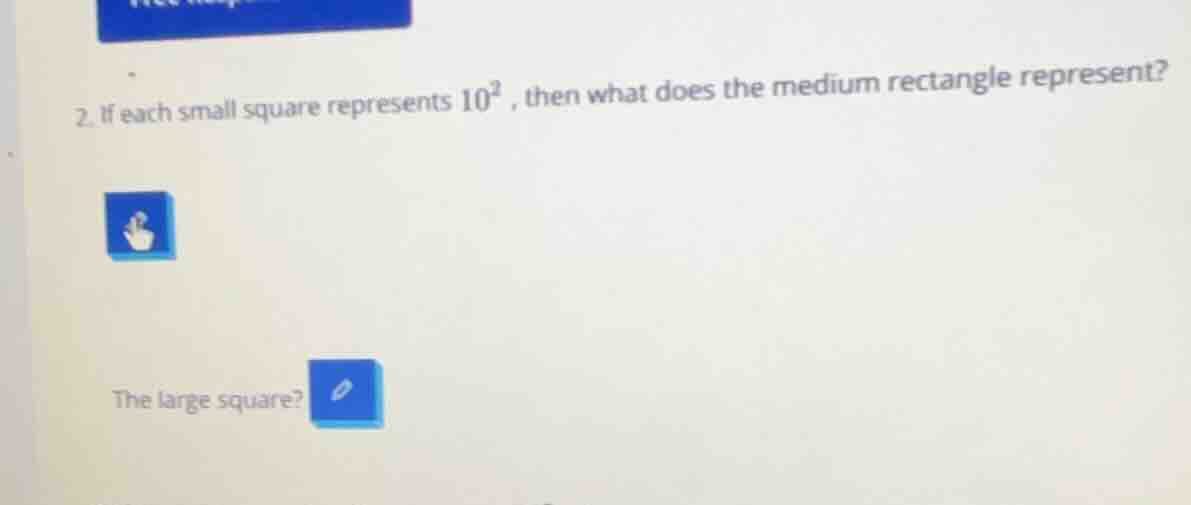
- if each small square represents $10^2$, then what does the medium rectangle represent?
the large square?
To solve this, we assume a typical base - ten block model where:
- A small square (unit square) has an area of \(1\times1\). If it represents \(10^{2}\), then we consider the side - length relationship.
- A medium rectangle (in base - ten blocks, usually a \(1\times10\) rectangle) has a length of \(10\) times the side - length of the small square and the same width as the small square.
- A large square (in base - ten blocks, a \(10\times10\) square) has a side - length that is \(10\) times the side - length of the small square.
Step 1: Analyze the medium rectangle
In base - ten block terms, if the small square (with side - length \(s\)) represents \(10^{2}\), and the medium rectangle has a length of \(10s\) and width of \(s\). The area of the medium rectangle \(A_{m}=10s\times s\). Since the area of the small square \(A_{s}=s\times s = 10^{2}\), the area of the medium rectangle is \(10\times10^{2}\).
Using the exponent rule \(a^{m}\times a^{n}=a^{m + n}\), we have \(10\times10^{2}=10^{1+2}=10^{3}\).
Step 2: Analyze the large square
The large square has a side - length of \(10s\) (where \(s\) is the side - length of the small square). The area of the large square \(A_{l}=(10s)\times(10s)=100\times s\times s\). Since \(s\times s = 10^{2}\), the area of the large square is \(100\times10^{2}\).
Using the exponent rule \(a^{m}\times a^{n}=a^{m + n}\), we get \(100\times10^{2}=10^{2}\times10^{2}=10^{2 + 2}=10^{4}\).

Snap & solve any problem in the app
Get step-by-step solutions on Sovi AI
Photo-based solutions with guided steps
Explore more problems and detailed explanations
The medium rectangle represents \(10^{3}\) and the large square represents \(10^{4}\)