QUESTION IMAGE
Question
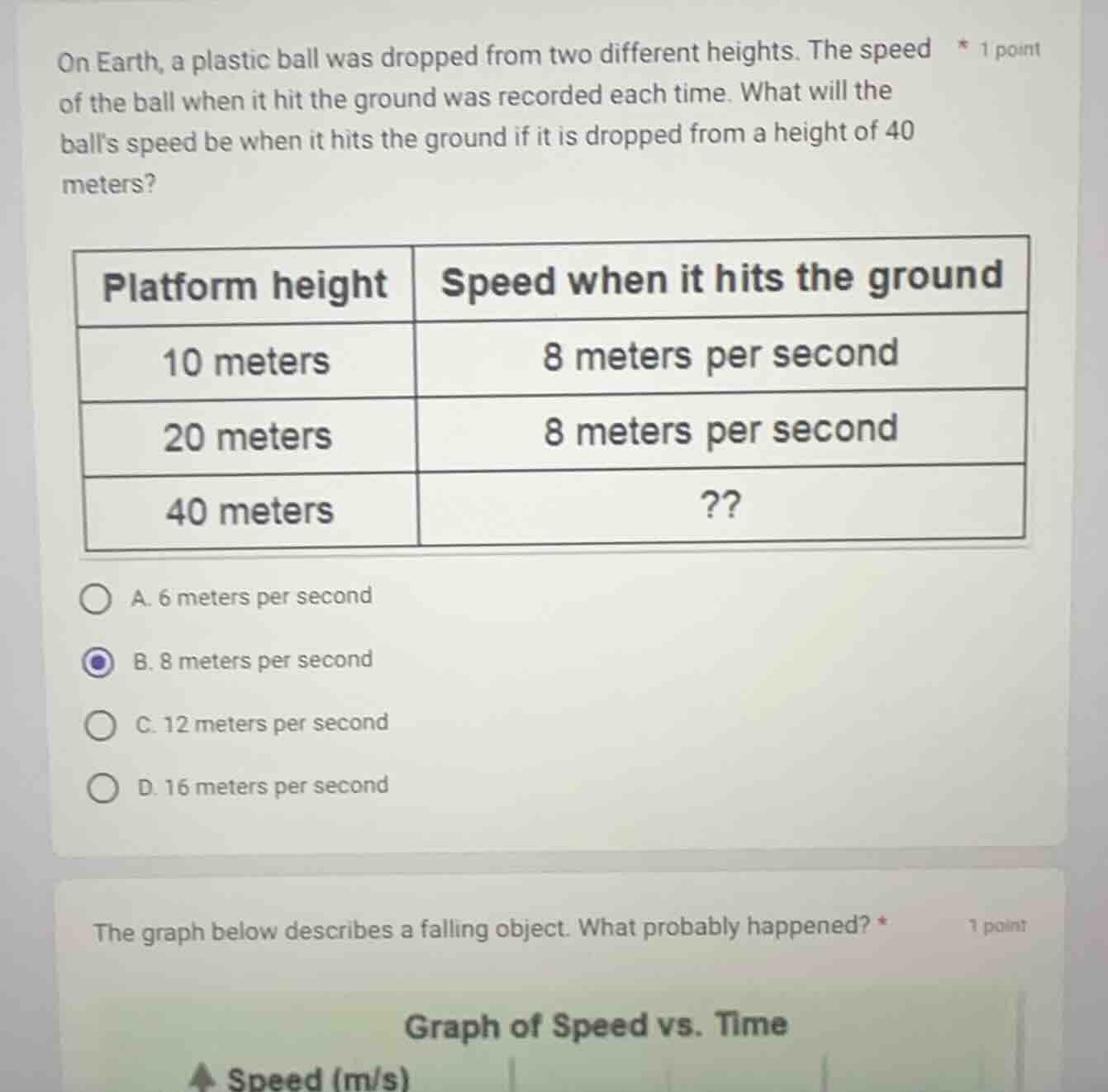
on earth, a plastic ball was dropped from two different heights. the speed of the ball when it hit the ground was recorded each time. what will the balls speed be when it hits the ground if it is dropped from a height of 40 meters?
| platform height | speed when it hits the ground |
|---|---|
| 20 meters | 8 meters per second |
| 40 meters | ?? |
a. 6 meters per second
b. 8 meters per second
c. 12 meters per second
d. 16 meters per second
the graph below describes a falling object. what probably happened?
graph of speed vs. time
speed (m/s)
First Sub - Question
Looking at the table, when the platform height is 10 meters, the speed is 8 m/s, and when it's 20 meters, the speed is also 8 m/s. This shows that the speed when hitting the ground is constant (8 m/s) regardless of the height (among the given heights). So, for 40 meters, the speed should also be 8 m/s.

Snap & solve any problem in the app
Get step-by-step solutions on Sovi AI
Photo-based solutions with guided steps
Explore more problems and detailed explanations
B. 8 meters per second
Second Sub - Question (Since the graph is not shown, we can't provide a detailed answer. But if we assume a common scenario for a falling object's speed - time graph):
If the graph of speed vs. time for a falling object is considered, a common situation is that if the speed becomes constant (terminal velocity) or has a certain pattern. For example, if the speed - time graph shows a constant speed after some time, it could mean the object reached terminal velocity (due to air resistance balancing gravity). If it's a linear increase, it could be free - fall without significant air resistance. But without the graph, we can't give a definite answer. However, if we assume the first sub - question's logic (constant speed) and extend it, maybe the object reached a constant speed (terminal velocity) and that's why the speed didn't change with height in the first question, and the graph might show a constant speed over time (horizontal line on speed - time graph) indicating terminal velocity was reached.