QUESTION IMAGE
Question
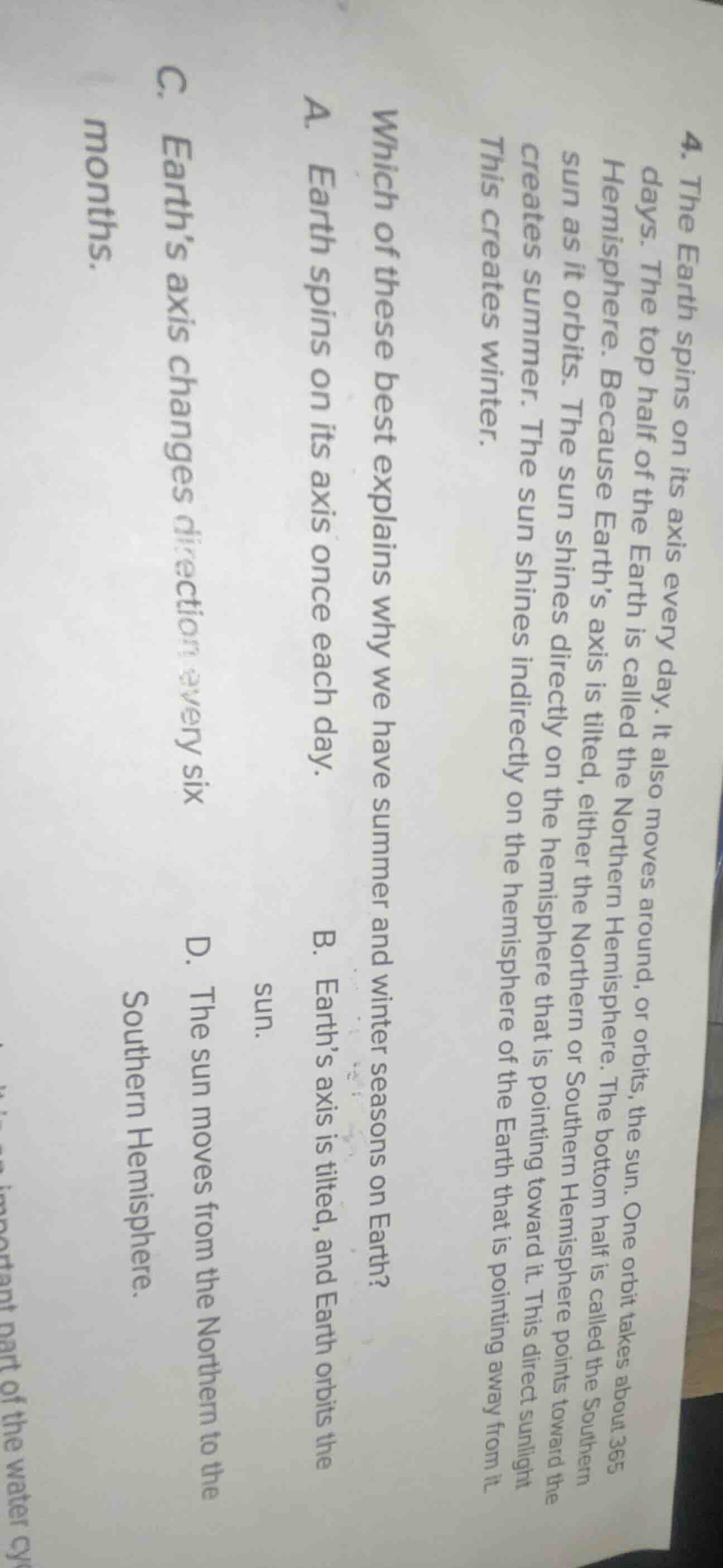
- the earth spins on its axis every day. it also moves around, or orbits, the sun. one orbit takes about 365 days. the top half of the earth is called the northern hemisphere. the bottom half is called the southern hemisphere. because earth’s axis is tilted, either the northern or southern hemisphere points toward the sun as it orbits. the sun shines directly on the hemisphere that is pointing toward it. this direct sunlight creates summer. the sun shines indirectly on the hemisphere of the earth that is pointing away from it. this creates winter.
which of these best explains why we have summer and winter seasons on earth?
a. earth spins on its axis once each day.
b. earth’s axis is tilted, and earth orbits the sun.
c. earth’s axis changes direction every six months.
d. the sun moves from the northern to the southern hemisphere.
Brief Explanations
To determine the cause of seasons, we analyze each option:
- Option A: Earth's rotation on its axis causes day and night, not seasons. Eliminate A.
- Option B: Earth's axis is tilted (about 23.5°), and as Earth orbits the sun, different hemispheres receive direct or indirect sunlight. Direct sunlight (summer) and indirect (winter) create seasons. This matches the explanation in the passage.
- Option C: Earth's axis direction (toward Polaris) is relatively constant, not changing every six months. Eliminate C.
- Option D: The sun is stationary; Earth orbits the sun, and the tilt causes hemisphere - sun angle changes, not the sun moving. Eliminate D.

Snap & solve any problem in the app
Get step-by-step solutions on Sovi AI
Photo-based solutions with guided steps
Explore more problems and detailed explanations
B. Earth’s axis is tilted, and Earth orbits the sun.