QUESTION IMAGE
Question
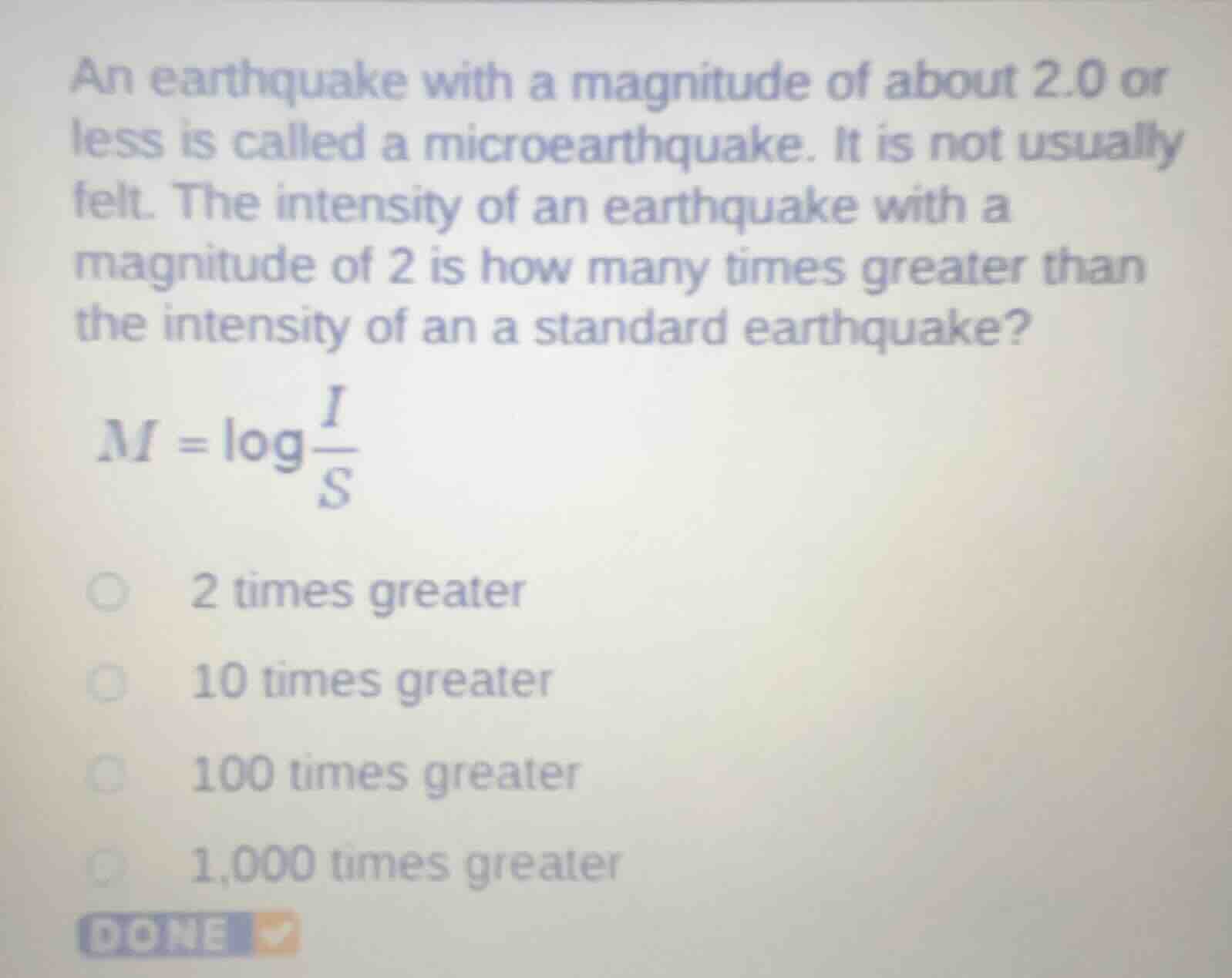
an earthquake with a magnitude of about 2.0 or less is called a microearthquake. it is not usually felt. the intensity of an earthquake with a magnitude of 2 is how many times greater than the intensity of an a standard earthquake?
$m = \log \frac{i}{s}$
2 times greater
10 times greater
100 times greater
1,000 times greater
Step1: Identify the formula and given values
We are given the formula for the magnitude of an earthquake \( M=\log\frac{I}{S} \), where \( M = 2 \) (magnitude of the earthquake), \( I \) is the intensity of the earthquake, and \( S \) is the intensity of a standard earthquake.
Step2: Substitute the given magnitude into the formula
Substitute \( M = 2 \) into the formula: \( 2=\log\frac{I}{S} \)
Step3: Convert the logarithmic equation to exponential form
Recall that if \( y = \log_bx \), then \( x=b^y \). For common logarithm (base 10), we have \( \frac{I}{S}=10^{2} \)
Step4: Calculate \( 10^{2} \)
\( 10^{2}=100 \), so \( \frac{I}{S} = 100 \), which means \( I = 100S \). This implies the intensity of the earthquake with magnitude 2 is 100 times greater than the intensity of a standard earthquake.

Snap & solve any problem in the app
Get step-by-step solutions on Sovi AI
Photo-based solutions with guided steps
Explore more problems and detailed explanations
100 times greater