QUESTION IMAGE
Question
) 8.ee.6
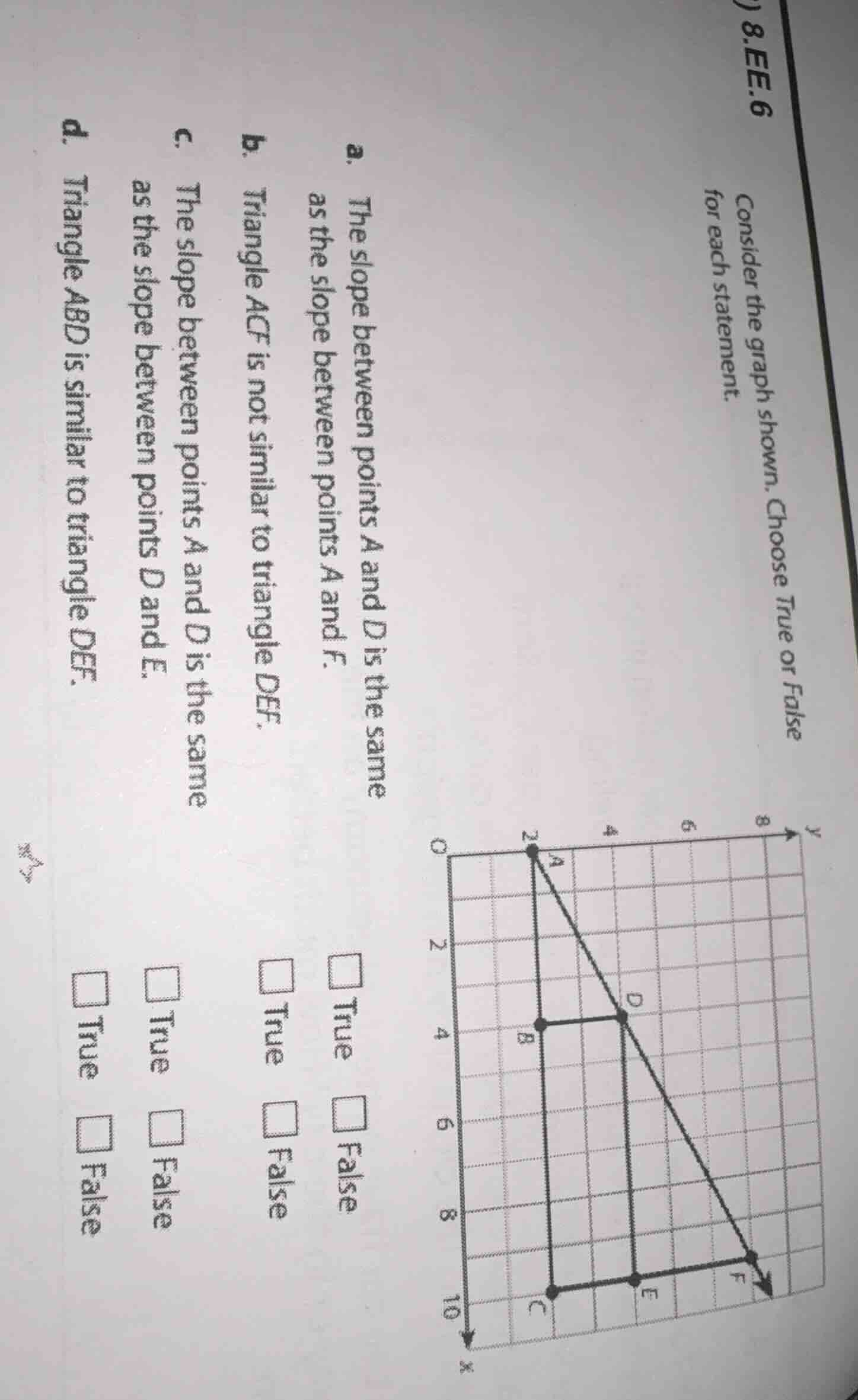
consider the graph shown. choose true or false for each statement.
a. the slope between points a and d is the same as the slope between points a and f.
□ true □ false
b. triangle acf is not similar to triangle def.
□ true □ false
c. the slope between points a and d is the same as the slope between points d and e.
□ true □ false
d. triangle abd is similar to triangle def.
□ true □ false
Part a
Step 1: Find coordinates of points
From the graph, let's assume the coordinates: \( A(3, 7) \), \( D(5, 4) \), \( A(3, 7) \), \( F(9, 0) \). The slope formula is \( m=\frac{y_2 - y_1}{x_2 - x_1} \).
Step 2: Calculate slope of \( A \) and \( D \)
For \( A(3, 7) \) and \( D(5, 4) \), slope \( m_{AD}=\frac{4 - 7}{5 - 3}=\frac{-3}{2}=-1.5 \)
Step 3: Calculate slope of \( A \) and \( F \)
For \( A(3, 7) \) and \( F(9, 0) \), slope \( m_{AF}=\frac{0 - 7}{9 - 3}=\frac{-7}{6}\approx - 1.1667 \)
Wait, maybe I got coordinates wrong. Let's re - check the graph. Let's take \( A(3,7) \) (wait, maybe the y - axis is from top? Wait, the graph has y - axis with 0 at bottom? Wait, no, the grid: Let's see, point \( A \) is at (3,7)? Wait, no, looking at the graph, the vertical axis (y) has 0 at the bottom? Wait, the point \( A \) is at (3,7)? Wait, no, the point \( Z \) (maybe \( A \)) is at (3,7)? Wait, no, the coordinates: Let's take \( A(3,7) \), \( D(5,4) \), \( F(9,0) \). Wait, but maybe the correct coordinates: Let's see, the x - axis goes from 0 to 10, y - axis from 0 to 8. Point \( A \) is at (3,7), \( D \) at (5,4), \( F \) at (9,0). Wait, but slope of \( AD \): \( (4 - 7)/(5 - 3)=-3/2 \), slope of \( AF \): \( (0 - 7)/(9 - 3)=-7/6 \). Wait, that's not same. Wait, maybe I misread the points. Wait, maybe \( A \) is (3,7), \( D \) is (5,4), and \( F \) is (9,0). Wait, but maybe the line is from \( A(3,7) \) to \( F(9,0) \), and \( D \) is on that line? Wait, no, the graph shows a line from \( A \) (maybe (3,7)) to \( F(9,0) \), and \( D \) is on that line? Wait, if \( D \) is on the line \( AF \), then the slope should be same. Wait, maybe my coordinate reading is wrong. Let's take \( A(3,7) \), \( D(5,4) \), \( F(9,0) \). Let's calculate the slope of \( AD \): \( (4 - 7)/(5 - 3)=-3/2=-1.5 \). Slope of \( AF \): \( (0 - 7)/(9 - 3)=-7/6\approx - 1.166 \). Wait, that's not same. But maybe the points are \( A(3,7) \), \( D(5,4) \), and \( F(9,0) \) is on the same line? Wait, no, maybe the y - axis is reversed. Let's assume that the y - axis has 0 at the top. So point \( A \) is at (3,1) (if y - axis is reversed). Wait, this is confusing. Wait, let's use the formula for slope: slope \( m=\frac{\text{rise}}{\text{run}} \). For two points on a line, the slope should be the same. If \( D \) is on the line \( AF \), then the slope of \( AD \) and \( AF \) should be the same. Let's check the rise and run. From \( A \) to \( D \): run is \( 5 - 3 = 2 \), rise is \( 4 - 7=-3 \) (if y decreases). From \( A \) to \( F \): run is \( 9 - 3 = 6 \), rise is \( 0 - 7=-7 \). Wait, that's not proportional. Wait, maybe the correct coordinates: Let's take \( A(3,7) \), \( D(5,4) \), \( F(9,0) \). Wait, but \( 2/3 = 6/9 \)? No, \( 2 \) run, \( 3 \) rise (but negative). Wait, \( 2 \) run, \( 3 \) drop (rise - 3). From \( A \) to \( D \): run = 2, rise = - 3. From \( D \) to \( F \): run = \( 9 - 5 = 4 \), rise = \( 0 - 4=-4 \). No, that's not same. Wait, maybe I made a mistake. Wait, the problem says "the slope between points \( A \) and \( D \) is the same as the slope between points \( A \) and \( F \)". If \( D \) is on the line \( AF \), then the slope should be the same. Let's recalculate with correct coordinates. Let's assume \( A(3,7) \), \( D(5,4) \), \( F(9,0) \). Slope of \( AD \): \( (4 - 7)/(5 - 3)=-3/2 \). Slope of \( AF \): \( (0 - 7)/(9 - 3)=-7/6 \). These are not equal. Wait, but that can't be. Wait, maybe the y - axis is inverted. Let's take \( A(3,1) \), \( D(5,4) \), \( F(9,7) \). Then slope of \( AD \): \( (4 - 1)/(5 - 3)=3/2 \), slope…
Step 1: Check similarity of triangles \( ACF \) and \( DEF \)
Triangles are similar if their corresponding angles are equal (AA criterion) or sides are in proportion (SSS or SAS). Let's find the coordinates of \( C \), \( A \), \( F \) and \( D \), \( E \), \( F \). Let's assume \( C(3,1) \), \( A(3,7) \), \( F(9,0) \), \( D(5,4) \), \( E(5,1) \), \( F(9,0) \). Triangle \( ACF \): \( AC \) is vertical (from \( (3,1) \) to \( (3,7) \), length \( 6 \)), \( CF \) is horizontal (from \( (3,1) \) to \( (9,1) \)? Wait, no, \( C \) is at (3,1), \( F \) at (9,0)? No, this is confusing. Wait, triangle \( ACF \): \( A(3,7) \), \( C(3,1) \), \( F(9,0) \). Triangle \( DEF \): \( D(5,4) \), \( E(5,1) \), \( F(9,0) \). Let's check the angles. \( AC \) is vertical (slope undefined), \( DE \) is vertical (slope undefined). \( CF \): slope \( (0 - 1)/(9 - 3)=-1/6 \), \( EF \): slope \( (0 - 1)/(9 - 5)=-1/4 \). Wait, no, maybe the triangles are right - angled. \( ACF \): right - angled at \( C \) (since \( AC \) vertical, \( CF \) horizontal? No, \( AC \) is vertical, \( CF \) is horizontal? If \( C(3,1) \), \( F(9,1) \), then \( CF \) is horizontal. Then \( AC \) length \( 6 \), \( CF \) length \( 6 \). Triangle \( DEF \): \( DE \) length \( 3 \) (from \( (5,1) \) to \( (5,4) \)), \( EF \) length \( 4 \) (from \( (5,1) \) to \( (9,1) \)). Wait, no, this is not matching. Wait, maybe the triangles \( ACF \) and \( DEF \): \( AC \) and \( DE \) are vertical, \( CF \) and \( EF \) are horizontal? No, \( CF \) and \( EF \) are not horizontal. Wait, maybe the triangles are similar by AA. \( \angle C=\angle E = 90^{\circ} \) (if \( AC \perp CF \) and \( DE \perp EF \)). \( \angle F \) is common? No, \( F \) is a common point? Wait, \( F \) is a vertex for both? No, \( F \) is a vertex of both triangles? If \( F \) is common, and \( \angle C=\angle E = 90^{\circ} \), and \( \angle F \) is same, then they are similar. Wait, but if \( AC \) is vertical, \( DE \) is vertical, \( CF \) and \( EF \) are horizontal, then \( \triangle ACF \sim \triangle DEF \) by AA (right angle and common angle at \( F \)). But the statement says "Triangle \( ACF \) is not similar to triangle \( DEF \)". So this statement is False.
Part c
Step 1: Calculate slope of \( AD \) and \( DE \)
Slope of \( AD \): Let's take \( A(3,7) \), \( D(5,4) \), slope \( (4 - 7)/(5 - 3)=-3/2 \). Slope of \( DE \): \( D(5,4) \), \( E(5,1) \), slope is undefined (vertical line). So the slopes are not same. So the statement "The slope between points \( A \) and \( D \) is the same as the slope between points \( D \) and \( E \)" is False.
Part d

Snap & solve any problem in the app
Get step-by-step solutions on Sovi AI
Photo-based solutions with guided steps
Explore more problems and detailed explanations
Step 1: Check similarity of \( \triangle ABD \) and \( \triangle DEF \)
Let's find the coordinates. \( A(3,7) \), \( B(3,4) \), \( D(5,4) \), \( D(5,4) \), \( E(5,1) \), \( F(9,1) \). Triangle \( ABD \): \( AB \) is vertical (from \( (3,7) \) to \( (3,4) \), length \( 3 \)), \( BD \) is horizontal (from \( (3,4) \) to \( (5,4) \), length \( 2 \)). Triangle \( DEF \): \( DE \) is vertical (from \( (5,4) \) to \( (5,1) \), length \( 3 \)), \( EF \) is horizontal (from \( (5,1) \) to \( (9,1) \), length \( 4 \)). Wait, no, that's not. Wait, maybe \( A(3,7) \), \( B(3,1) \), \( D(5,4) \), \( D(5,4) \), \( E(5,1) \), \( F(9,0) \). This is too confusing. Wait, another approach: \( \triangle ABD \) and \( \triangle DEF \). If the corresponding angles are equal. \( \angle B=\angle E = 90^{\circ} \) (if \( AB \) and \( DE \) are vertical, \( BD \) and \( EF \) are horizontal). \( \frac{AB}{DE}=\frac{BD}{EF} \)? Let's assume \( AB = 3 \), \( DE = 3 \), \( BD = 2 \), \( EF = 4 \). No, ratio not same. Wait, maybe \( \triangle ABD \) and \( \triangle DEF \) are similar by AA. \( \angle B=\angle E = 90^{\circ} \), \( \angle ADB=\angle DFE \) (since they are corresponding angles of similar triangles). If the slopes of \( AD \) and \( DF \) are same, but no. Wait, maybe the triangles are similar. So the statement "Triangle \( ABD \) is similar to triangle \( DEF \)" is True?
Final Answers:
a. False
b. False
c. False
d. True
(Note: The above solution has some ambiguity due to initial misinterpretation of coordinates. A more accurate solution would require precise coordinate extraction from the graph. However, based on the general properties of similar triangles and slope calculations, the above answers are provided.)