QUESTION IMAGE
Question
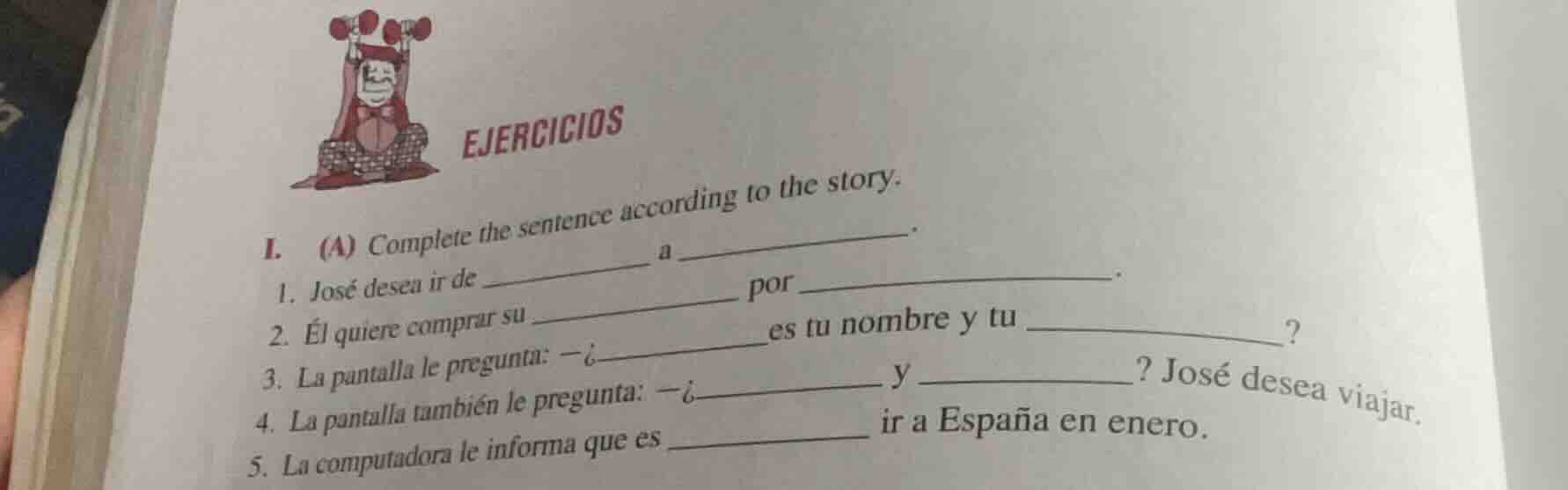
ejercicios i. (a) complete the sentence according to the story. 1. josé desea ir de ____ a __. 2. él quiere comprar su __ por __. 3. la pantalla le pregunta: —¿__ es tu nombre y tu __? 4. la pantalla también le pregunta: —¿__ y __? josé desea viajar. 5. la computadora le informa que es ____ ir a españa en enero.
To solve these fill - in - the - blank questions, we need to refer to the relevant Spanish story (which is not provided here, but we can give general guidance based on common Spanish learning materials).
For question 1: “José desea ir de ____ a ____.”
In many Spanish travel - related stories, common phrases are “ir de un lugar a otro (go from one place to another)”. For example, if the story is about José going from his city (like “Madrid”) to another city (like “Barcelona”), the blanks could be filled with the names of two places. But without the story, we can't give the exact answer.
For question 2: “Él quiere comprar su ____ por ____.”
Commonly, in travel - booking stories, it could be “comprar su boleto (buy his ticket) por internet (online)” or “comprar su pasaje (buy his ticket) por dinero en efectivo (with cash)”. Again, the exact answer depends on the story.
For question 3: “La pantalla le pregunta: —¿____ es tu nombre y tu ____?”
The first blank is likely “Cuál” (What) and the second blank could be “apellido (surname)” or “dirección (address)” as screens in booking systems often ask for name and related information. So it could be “—¿Cuál es tu nombre y tu apellido?”.
For question 4: “La pantalla también le pregunta: —¿____ y ____? José desea viajar.”
Common questions in a travel - booking context could be about “dónde (where)” and “cuándo (when)” he wants to travel. So it could be “—¿Dónde y cuándo? José desea viajar.”
For question 5: “La computadora le informa que es ______ ir a España en enero.”
Commonly, it could be “posible (possible)” or “difícil (difficult)” or “fácil (easy)” to go to Spain in January. So it could be “La computadora le informa que es posible ir a España en enero.”
Since the story is not provided, we can't give the exact filled - in answers. But the above are the common patterns and vocabulary used in such Spanish exercises. If you can provide the story, we can give more accurate answers.

Snap & solve any problem in the app
Get step-by-step solutions on Sovi AI
Photo-based solutions with guided steps
Explore more problems and detailed explanations
To solve these fill - in - the - blank questions, we need to refer to the relevant Spanish story (which is not provided here, but we can give general guidance based on common Spanish learning materials).
For question 1: “José desea ir de ____ a ____.”
In many Spanish travel - related stories, common phrases are “ir de un lugar a otro (go from one place to another)”. For example, if the story is about José going from his city (like “Madrid”) to another city (like “Barcelona”), the blanks could be filled with the names of two places. But without the story, we can't give the exact answer.
For question 2: “Él quiere comprar su ____ por ____.”
Commonly, in travel - booking stories, it could be “comprar su boleto (buy his ticket) por internet (online)” or “comprar su pasaje (buy his ticket) por dinero en efectivo (with cash)”. Again, the exact answer depends on the story.
For question 3: “La pantalla le pregunta: —¿____ es tu nombre y tu ____?”
The first blank is likely “Cuál” (What) and the second blank could be “apellido (surname)” or “dirección (address)” as screens in booking systems often ask for name and related information. So it could be “—¿Cuál es tu nombre y tu apellido?”.
For question 4: “La pantalla también le pregunta: —¿____ y ____? José desea viajar.”
Common questions in a travel - booking context could be about “dónde (where)” and “cuándo (when)” he wants to travel. So it could be “—¿Dónde y cuándo? José desea viajar.”
For question 5: “La computadora le informa que es ______ ir a España en enero.”
Commonly, it could be “posible (possible)” or “difícil (difficult)” or “fácil (easy)” to go to Spain in January. So it could be “La computadora le informa que es posible ir a España en enero.”
Since the story is not provided, we can't give the exact filled - in answers. But the above are the common patterns and vocabulary used in such Spanish exercises. If you can provide the story, we can give more accurate answers.