QUESTION IMAGE
Question
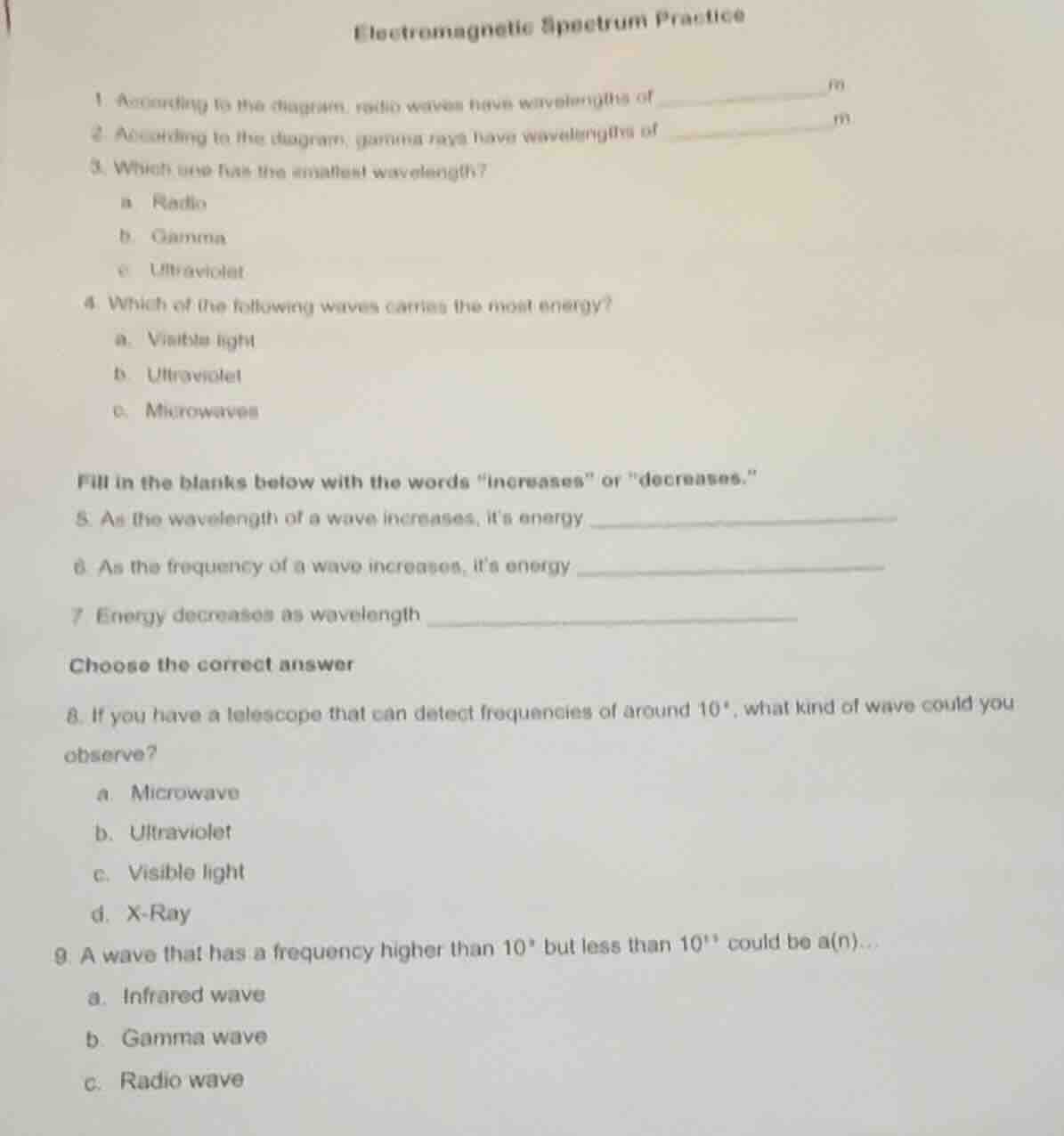
electromagnetic spectrum practice
- according to the diagram, radio waves have wavelengths of ______ m
- according to the diagram, gamma rays have wavelengths of ______ m
- which one has the smallest wavelength?
a. radio
b. gamma
c. ultraviolet
- which of the following waves carries the most energy?
a. visible light
b. ultraviolet
c. microwaves
fill in the blanks below with the words \increases\ or \decreases.\
- as the wavelength of a wave increases, its energy ______
- as the frequency of a wave increases, its energy ______
- energy decreases as wavelength ______
choose the correct answer
- if you have a telescope that can detect frequencies of around $10^8$, what kind of wave could you observe?
a. microwave
b. ultraviolet
c. visible light
d. x-ray
- a wave that has a frequency higher than $10^9$ but less than $10^{13}$ could be a(n)...
a. infrared wave
b. gamma wave
c. radio wave
Step1: Recall radio wave wavelength range
Radio waves have wavelengths of $\geq 10^{-1}\ \text{m}$ (or typically stated as $10^{-1}\ \text{m}$ to $10^{4}\ \text{m}$; standard value is $\geq 10^{-1}\ \text{m}$)
Step2: Recall gamma ray wavelength range
Gamma rays have wavelengths of $\leq 10^{-11}\ \text{m}$ (or $10^{-16}\ \text{m}$ to $10^{-11}\ \text{m}$; standard value is $\leq 10^{-11}\ \text{m}$)
Step3: Identify smallest wavelength wave
Electromagnetic spectrum order (smallest to largest wavelength): Gamma < UV < Radio
Step4: Relate energy to frequency/wavelength
Energy formula: $E=h
u=\frac{hc}{\lambda}$, where $h$=Planck's constant, $
u$=frequency, $\lambda$=wavelength, $c$=speed of light. Higher frequency/shorter wavelength = higher energy.
Step5: Match frequency to wave type
Microwaves: $10^{8}-10^{12}\ \text{Hz}$; UV: $10^{15}-10^{17}\ \text{Hz}$; Visible: $4\times10^{14}-7.5\times10^{14}\ \text{Hz}$; X-ray: $10^{17}-10^{20}\ \text{Hz}$; Infrared: $10^{12}-10^{14}\ \text{Hz}$; Gamma: $>10^{19}\ \text{Hz}$; Radio: $<10^{9}\ \text{Hz}$
Step6: Fill energy-wavelength/frequency blanks
From $E=\frac{hc}{\lambda}$, longer $\lambda$ = lower $E$; higher $
u$ = higher $E$.
Step7: Solve frequency range question
$10^{9}<\text{frequency}<10^{13}$ matches infrared's range.

Snap & solve any problem in the app
Get step-by-step solutions on Sovi AI
Photo-based solutions with guided steps
Explore more problems and detailed explanations
- $\geq 10^{-1}$ (or $10^{-1}$ to $10^{4}$)
- $\leq 10^{-11}$ (or $10^{-16}$ to $10^{-11}$)
- b. Gamma
- b. Ultraviolet
- decreases
- increases
- increases
- a. Microwave
- a. Infrared wave