QUESTION IMAGE
Question
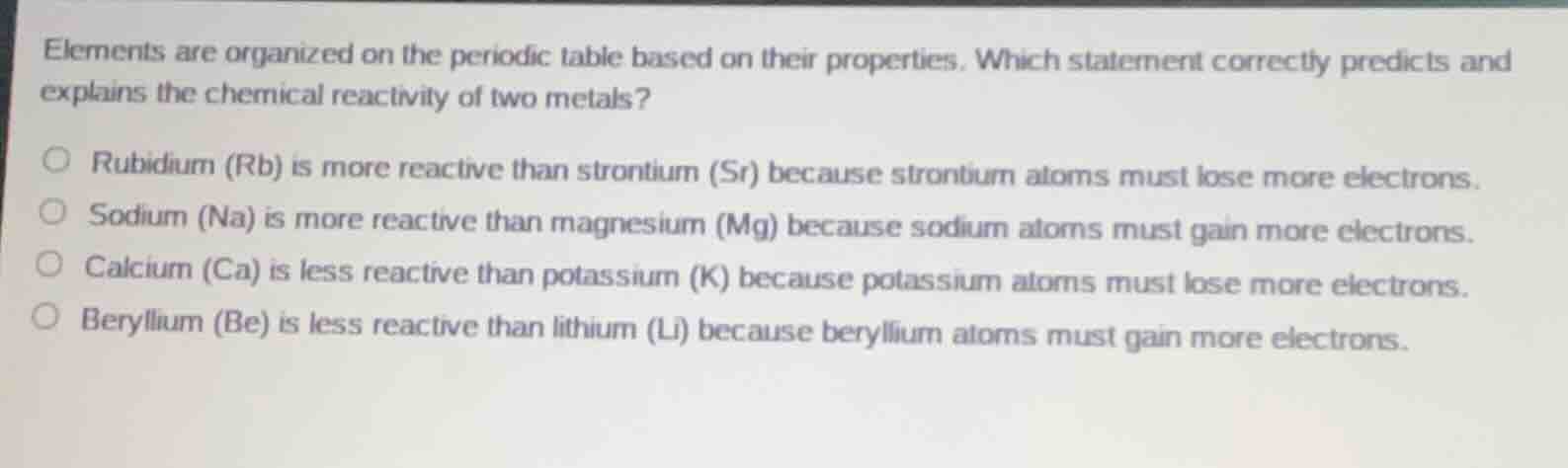
elements are organized on the periodic table based on their properties. which statement correctly predicts and explains the chemical reactivity of two metals?
○ rubidium (rb) is more reactive than strontium (sr) because strontium atoms must lose more electrons.
○ sodium (na) is more reactive than magnesium (mg) because sodium atoms must gain more electrons.
○ calcium (ca) is less reactive than potassium (k) because potassium atoms must lose more electrons.
○ beryllium (be) is less reactive than lithium (li) because beryllium atoms must gain more electrons.
- Analyze Option A: Rubidium (Group 1) loses 1 electron, Strontium (Group 2) loses 2. Group 1 metals are more reactive than Group 2 in the same period because losing 1 electron is easier than losing 2. This statement's reasoning is incorrect (it misstates the cause, but the reactivity claim is right, but let's check others).
- Analyze Option B: Sodium (Group 1) loses 1 electron, it does not gain electrons. Metals lose electrons, so this reasoning is wrong.
- Analyze Option C: Potassium (Group 1) loses 1 electron, Calcium (Group 2) loses 2. Group 1 metals are more reactive than Group 2 in the same period because losing 1 electron requires less energy than losing 2. This correctly states that Ca is less reactive than K, and the underlying reason relates to the number of electrons lost (Group 1 loses fewer electrons, making it more reactive).
- Analyze Option D: Beryllium (Group 2) and Lithium (Group 1) are metals, they lose electrons, not gain. This reasoning is wrong.

Snap & solve any problem in the app
Get step-by-step solutions on Sovi AI
Photo-based solutions with guided steps
Explore more problems and detailed explanations
Calcium (Ca) is less reactive than potassium (K) because potassium atoms must lose more electrons.