QUESTION IMAGE
Question
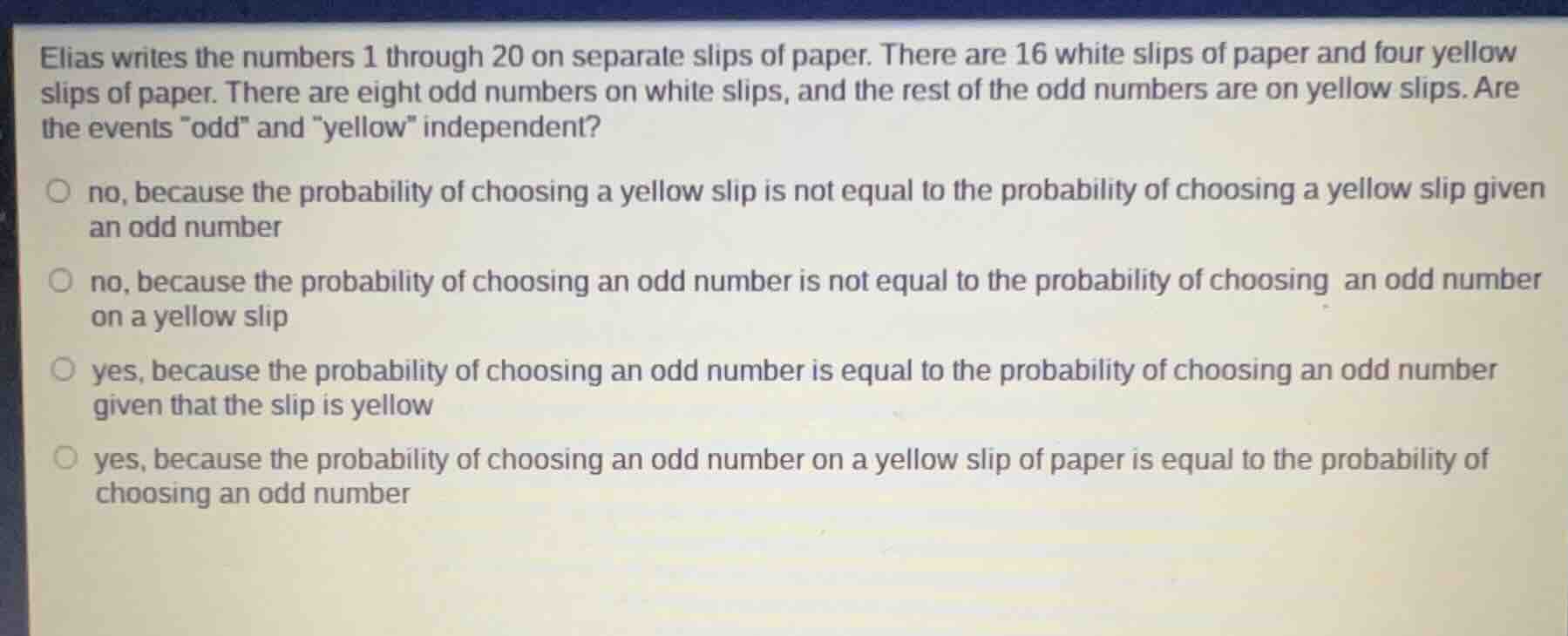
elias writes the numbers 1 through 20 on separate slips of paper. there are 16 white slips of paper and four yellow slips of paper. there are eight odd numbers on white slips, and the rest of the odd numbers are on yellow slips. are the events \odd\ and \yellow\ independent?
no, because the probability of choosing a yellow slip is not equal to the probability of choosing a yellow slip given an odd number
no, because the probability of choosing an odd number is not equal to the probability of choosing an odd number on a yellow slip
yes, because the probability of choosing an odd number is equal to the probability of choosing an odd number given that the slip is yellow
yes, because the probability of choosing an odd number on a yellow slip of paper is equal to the probability of choosing an odd number
Step1: Find total odd numbers
Numbers 1 - 20: odd numbers are 1, 3, 5, 7, 9, 11, 13, 15, 17, 19. So total odd numbers \( n(\text{odd}) = 10 \). Total slips \( N = 20 \). Probability of odd, \( P(\text{odd})=\frac{10}{20}=\frac{1}{2} \).
Step2: Find odd numbers on yellow slips
White slips: 16, yellow slips: 4. White odd: 8, so yellow odd: \( 10 - 8 = 2 \).
Step3: Probability of odd given yellow
\( P(\text{odd}|\text{yellow})=\frac{\text{yellow odd}}{\text{yellow slips}}=\frac{2}{4}=\frac{1}{2} \).
Step4: Check independence
For independent events, \( P(\text{odd}|\text{yellow}) = P(\text{odd}) \). Here, both are \( \frac{1}{2} \), so events are independent. The correct option is the one stating this equality.

Snap & solve any problem in the app
Get step-by-step solutions on Sovi AI
Photo-based solutions with guided steps
Explore more problems and detailed explanations
C. yes, because the probability of choosing an odd number is equal to the probability of choosing an odd number given that the slip is yellow