QUESTION IMAGE
Question
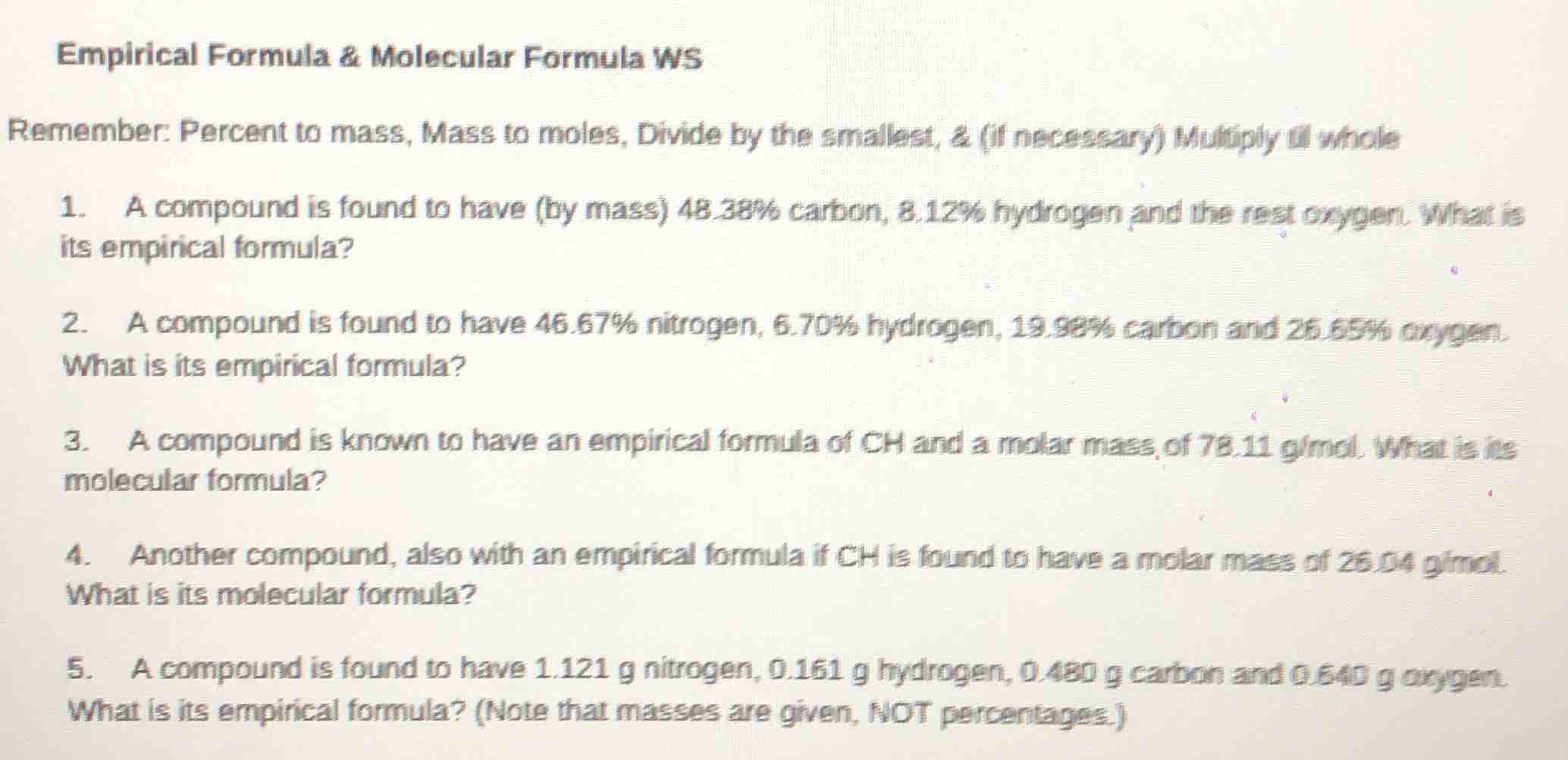
empirical formula & molecular formula ws
remember: percent to mass, mass to moles, divide by the smallest, & (if necessary) multiply till whole
- a compound is found to have (by mass) 48.38% carbon, 8.12% hydrogen and the rest oxygen. what is its empirical formula?
- a compound is found to have 46.67% nitrogen, 6.70% hydrogen, 19.98% carbon and 26.65% oxygen. what is its empirical formula?
- a compound is known to have an empirical formula of ch and a molar mass of 78.11 g/mol. what is its molecular formula?
- another compound, also with an empirical formula if ch is found to have a molar mass of 26.04 g/mol. what is its molecular formula?
- a compound is found to have 1.121 g nitrogen, 0.161 g hydrogen, 0.480 g carbon and 0.640 g oxygen. what is its empirical formula? (note that masses are given, not percentages.)
Problem 1
Step1: Assume 100g of the compound.
Mass of C = 48.38g, Mass of H = 8.12g, Mass of O = \(100 - 48.38 - 8.12 = 43.5\)g.
Step2: Convert mass to moles.
Moles of C: \(\frac{48.38\mathrm{g}}{12.01\mathrm{g/mol}} \approx 4.028\)mol
Moles of H: \(\frac{8.12\mathrm{g}}{1.008\mathrm{g/mol}} \approx 8.056\)mol
Moles of O: \(\frac{43.5\mathrm{g}}{16.00\mathrm{g/mol}} \approx 2.719\)mol
Step3: Divide by the smallest (O's moles).
C: \(\frac{4.028}{2.719} \approx 1.48\) (≈1.5), H: \(\frac{8.056}{2.719} \approx 2.96\) (≈3), O: \(\frac{2.719}{2.719} = 1\)
Step4: Multiply by 2 to get whole numbers.
C: \(1.5\times2 = 3\), H: \(3\times2 = 6\), O: \(1\times2 = 2\)
Step1: Assume 100g of the compound.
Mass of N = 46.67g, H = 6.70g, C = 19.98g, O = 26.65g.
Step2: Convert to moles.
Moles of N: \(\frac{46.67\mathrm{g}}{14.01\mathrm{g/mol}} \approx 3.331\)mol
Moles of H: \(\frac{6.70\mathrm{g}}{1.008\mathrm{g/mol}} \approx 6.647\)mol
Moles of C: \(\frac{19.98\mathrm{g}}{12.01\mathrm{g/mol}} \approx 1.663\)mol
Moles of O: \(\frac{26.65\mathrm{g}}{16.00\mathrm{g/mol}} \approx 1.666\)mol
Step3: Divide by the smallest (C or O, ≈1.66).
N: \(\frac{3.331}{1.663} \approx 2\), H: \(\frac{6.647}{1.663} \approx 4\), C: \(\frac{1.663}{1.663} = 1\), O: \(\frac{1.666}{1.663} \approx 1\)
Step1: Calculate empirical formula mass (CH).
Empirical mass = \(12.01 + 1.008 = 13.018\mathrm{g/mol}\)
Step2: Find the ratio \(n = \frac{\text{Molar Mass}}{\text{Empirical Mass}}\).
\(n = \frac{78.11\mathrm{g/mol}}{13.018\mathrm{g/mol}} \approx 6\)
Step3: Multiply empirical formula by \(n\).
Molecular formula: \( (CH)_6 = C_6H_6 \)

Snap & solve any problem in the app
Get step-by-step solutions on Sovi AI
Photo-based solutions with guided steps
Explore more problems and detailed explanations
\(C_3H_6O_2\)