QUESTION IMAGE
Question
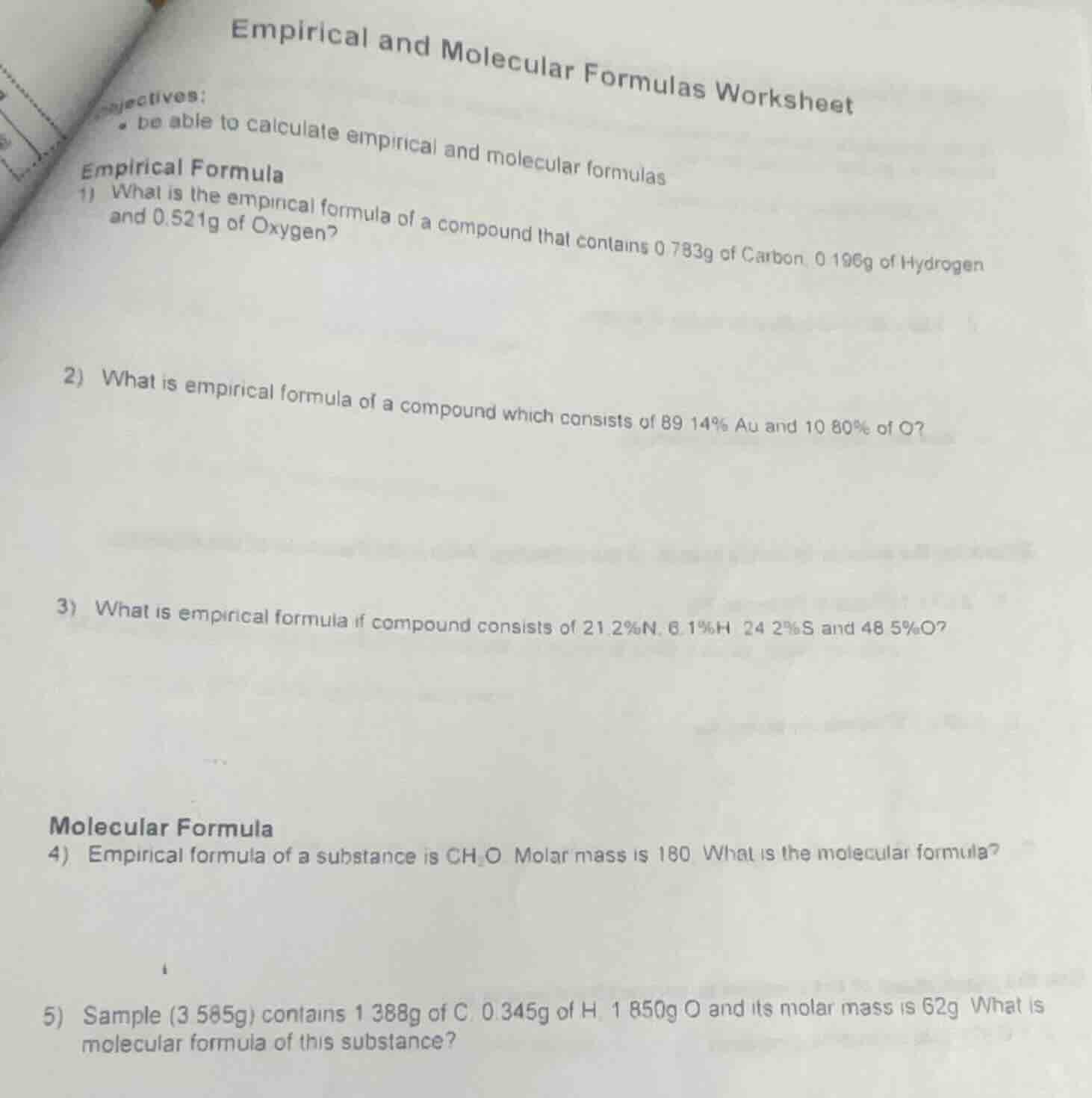
empirical and molecular formulas worksheet
objectives:
- be able to calculate empirical and molecular formulas
empirical formula
- what is the empirical formula of a compound that contains 0.783g of carbon, 0.196g of hydrogen and 0.521g of oxygen?
- what is empirical formula of a compound which consists of 89.14% au and 10.80% of o?
- what is empirical formula if compound consists of 21.2%n, 6.1%h, 24.2%s and 48.5%o?
molecular formula
- empirical formula of a substance is ch₂o. molar mass is 180. what is the molecular formula?
- sample (3.585g) contains 1.388g of c, 0.345g of h, 1.850g o and its molar mass is 62g. what is molecular formula of this substance?
---
Problem 1
Step1: Convert mass to moles
Molar masses: $C=12.01\ \text{g/mol}$, $H=1.008\ \text{g/mol}$, $O=16.00\ \text{g/mol}$
$n_C=\frac{0.783}{12.01}\approx0.0652\ \text{mol}$, $n_H=\frac{0.196}{1.008}\approx0.194\ \text{mol}$, $n_O=\frac{0.521}{16.00}\approx0.0326\ \text{mol}$
Step2: Divide by smallest mole value
Smallest $n=0.0326\ \text{mol}$
$C: \frac{0.0652}{0.0326}=2$, $H: \frac{0.194}{0.0326}\approx6$, $O: \frac{0.0326}{0.0326}=1$
---
Problem 2
Step1: Assume 100g sample, find moles
Molar masses: $Au=196.97\ \text{g/mol}$, $O=16.00\ \text{g/mol}$
$n_{Au}=\frac{89.14}{196.97}\approx0.4525\ \text{mol}$, $n_O=\frac{10.80}{16.00}=0.675\ \text{mol}$
Step2: Divide by smallest mole value
Smallest $n=0.4525\ \text{mol}$
$Au: \frac{0.4525}{0.4525}=1$, $O: \frac{0.675}{0.4525}\approx1.5$
Step3: Multiply to get whole numbers
Multiply by 2: $Au=2$, $O=3$
---
Problem 3
Step1: Assume 100g sample, find moles
Molar masses: $N=14.01\ \text{g/mol}$, $H=1.008\ \text{g/mol}$, $S=32.07\ \text{g/mol}$, $O=16.00\ \text{g/mol}$
$n_N=\frac{21.2}{14.01}\approx1.51\ \text{mol}$, $n_H=\frac{6.1}{1.008}\approx6.05\ \text{mol}$, $n_S=\frac{24.2}{32.07}\approx0.755\ \text{mol}$, $n_O=\frac{48.5}{16.00}\approx3.03\ \text{mol}$
Step2: Divide by smallest mole value
Smallest $n=0.755\ \text{mol}$
$N: \frac{1.51}{0.755}=2$, $H: \frac{6.05}{0.755}\approx8$, $S: \frac{0.755}{0.755}=1$, $O: \frac{3.03}{0.755}\approx4$
---
Problem 4
Step1: Calculate empirical formula mass
$M_{CH_2O}=12.01 + 2(1.008) + 16.00=30.026\ \text{g/mol}$
Step2: Find multiplier $n$
$n=\frac{\text{Molar Mass}}{\text{Empirical Mass}}=\frac{180}{30.026}\approx6$
Step3: Scale empirical formula
Multiply each subscript by 6
---
Problem 5
Step1: Convert mass to moles
$n_C=\frac{1.388}{12.01}\approx0.1156\ \text{mol}$, $n_H=\frac{0.345}{1.008}\approx0.342\ \text{mol}$, $n_O=\frac{1.850}{16.00}\approx0.1156\ \text{mol}$
Step2: Find empirical formula
Divide by smallest $n=0.1156\ \text{mol}$
$C:1$, $H:\frac{0.342}{0.1156}\approx3$, $O:1$ → Empirical formula: $CH_3O$
Step3: Calculate empirical formula mass
$M_{CH_3O}=12.01 + 3(1.008) + 16.00=31.034\ \text{g/mol}$
Step4: Find multiplier $n$
$n=\frac{62}{31.034}\approx2$
Step5: Scale empirical formula
Multiply each subscript by 2
---

Snap & solve any problem in the app
Get step-by-step solutions on Sovi AI
Photo-based solutions with guided steps
Explore more problems and detailed explanations
- $\boldsymbol{C_2H_6O}$
- $\boldsymbol{Au_2O_3}$
- $\boldsymbol{N_2H_8SO_4}$ (or $\boldsymbol{(NH_4)_2SO_4}$)
- $\boldsymbol{C_6H_{12}O_6}$
- $\boldsymbol{C_2H_6O_2}$