QUESTION IMAGE
Question
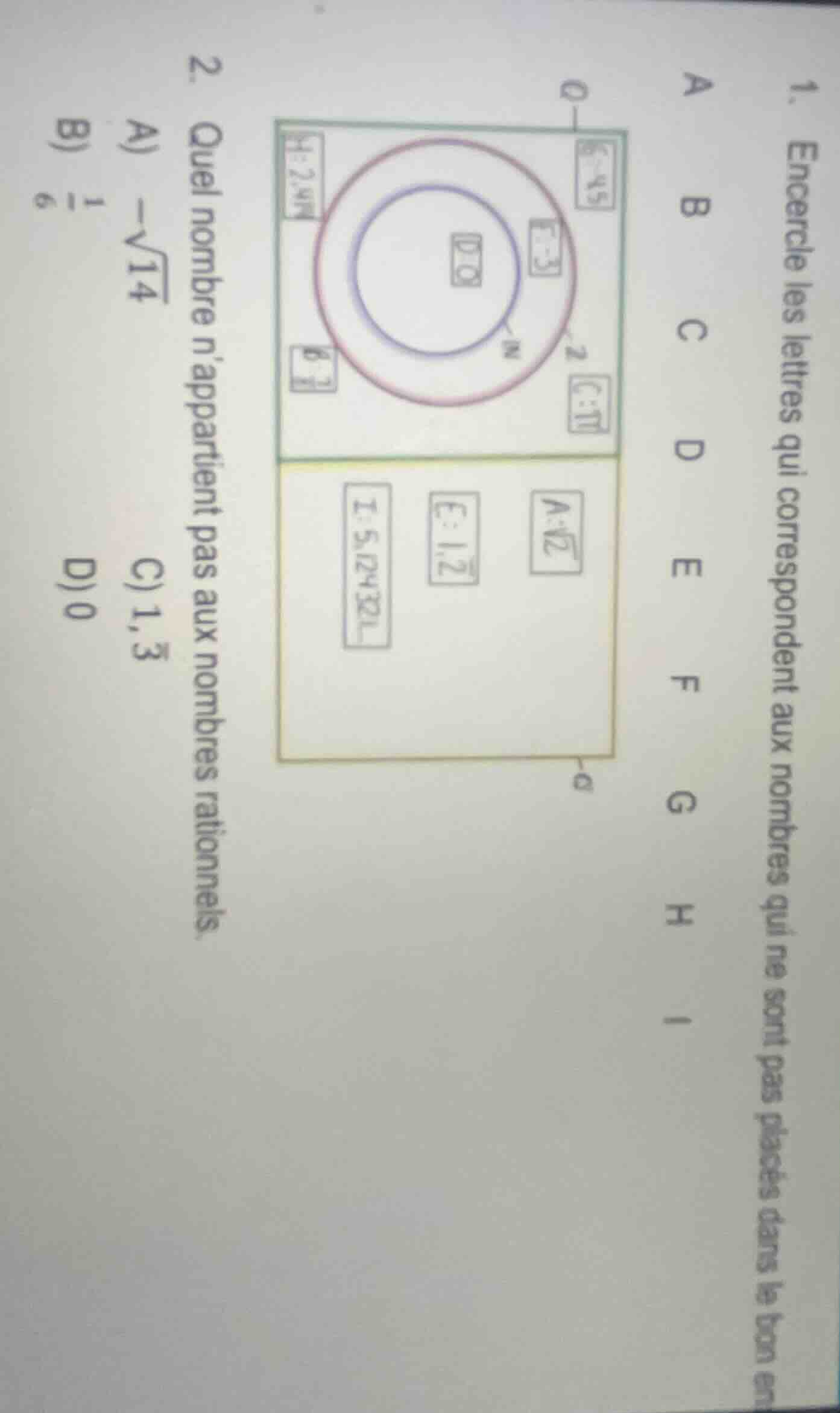
- encercle les lettres qui correspondent aux nombres qui ne sont pas placés dans le bon en a b c d e f g h 2. quel nombre nappartient pas aux nombres rationnels a) $-sqrt{14}$ b) $\frac{1}{6}$ c) $1, overline{3}$ d) 0
Question 2: Quel nombre n'appartient pas aux nombres rationnels ? (Which number does not belong to the rational numbers?)
To determine which number is not rational, we recall that rational numbers can be expressed as a fraction \(\frac{p}{q}\) where \(p\) and \(q\) are integers and \(q
eq 0\). Irrational numbers are non - repeating, non - terminating decimals and cannot be expressed as such a fraction.
Step 1: Analyze Option A
The number is \(-\sqrt{14}\). We know that 14 is not a perfect square. So, \(\sqrt{14}\) is an irrational number, and multiplying it by \(- 1\) (i.e., \(-\sqrt{14}\)) still gives an irrational number.
Step 2: Analyze Option B
The number is \(\frac{1}{6}\). By the definition of rational numbers, since 1 and 6 are integers and \(6
eq0\), \(\frac{1}{6}\) is a rational number.
Step 3: Analyze Option C
The number is \(1.\overline{3}\) (the bar indicates that 3 repeats). A repeating decimal can be expressed as a fraction. Let \(x = 1.\overline{3}=1.333\cdots\). Then \(10x=13.333\cdots\). Subtracting \(x\) from \(10x\) gives \(10x - x=13.333\cdots - 1.333\cdots\), so \(9x = 12\) and \(x=\frac{12}{9}=\frac{4}{3}\), which is a rational number.
Step 4: Analyze Option D
The number is 0. We can write 0 as \(\frac{0}{1}\), where 0 and 1 are integers and \(1
eq0\). So, 0 is a rational number.

Snap & solve any problem in the app
Get step-by-step solutions on Sovi AI
Photo-based solutions with guided steps
Explore more problems and detailed explanations
A. \(-\sqrt{14}\)