QUESTION IMAGE
Question
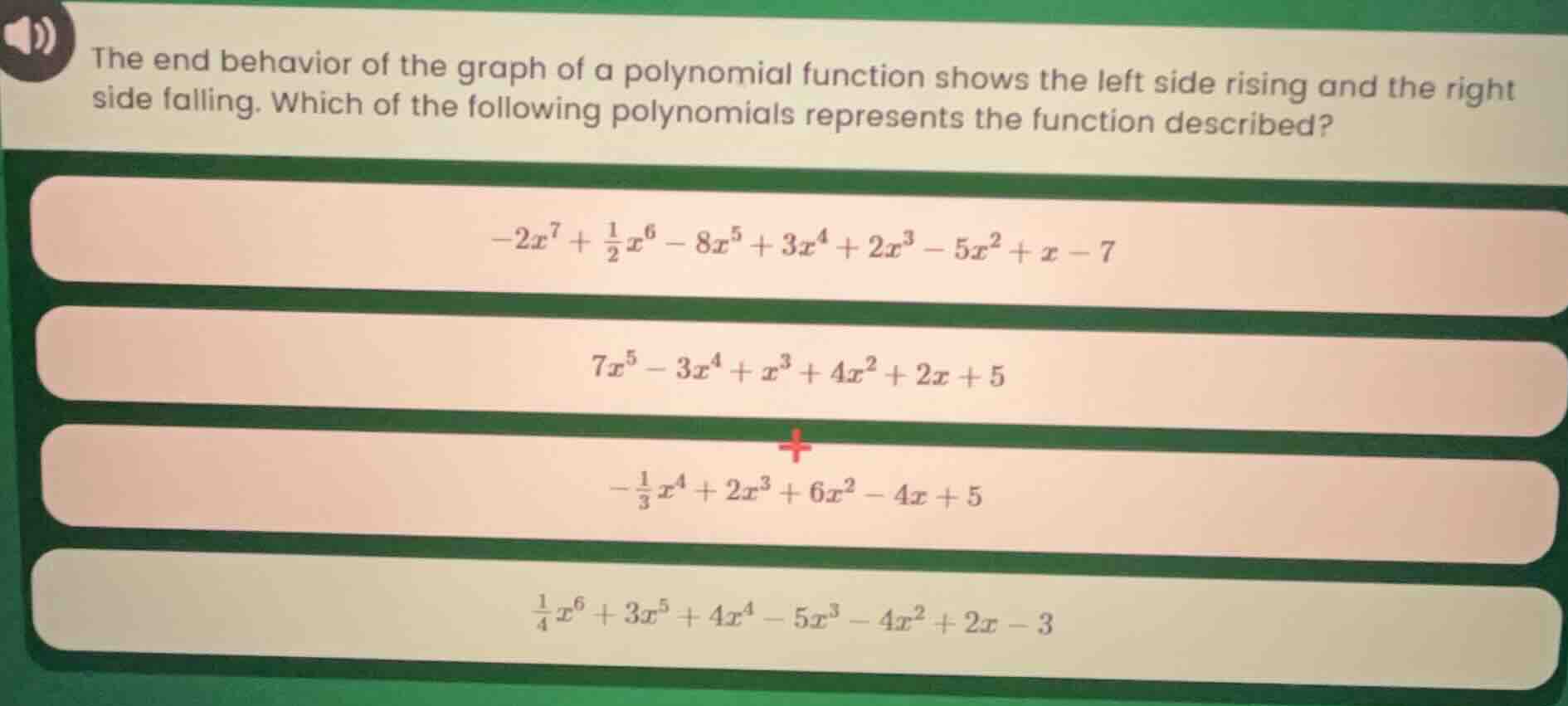
the end behavior of the graph of a polynomial function shows the left side rising and the right side falling. which of the following polynomials represents the function described?
$-2x^{7}+\frac{1}{2}x^{6}-8x^{5}+3x^{4}+2x^{3}-5x^{2}+x - 7$
$7x^{5}-3x^{4}+x^{3}+4x^{2}+2x + 5$
$-\frac{1}{3}x^{4}+2x^{3}+6x^{2}-4x + 5$
$\frac{1}{4}x^{6}+3x^{5}+4x^{4}-5x^{3}-4x^{2}+2x - 3$
Step1: Recall end behavior rules
For a polynomial $f(x)=a_nx^n+...+a_0$:
- If $n$ odd, $a_n>0$: Left falls, right rises.
- If $n$ odd, $a_n<0$: Left rises, right falls.
- If $n$ even, $a_n>0$: Both sides rise.
- If $n$ even, $a_n<0$: Both sides fall.
Step2: Match required end behavior
We need left rising, right falling: odd degree, negative leading coefficient.
Step3: Analyze each option
- $-2x^7+\frac{1}{2}x^6-8x^5+3x^4+2x^3-5x^2+x-7$: Degree $7$ (odd), leading coefficient $-2<0$.
- $7x^5-3x^4+x^3+4x^2+2x+5$: Degree $5$ (odd), leading coefficient $7>0$.
- $-\frac{1}{3}x^4+2x^3+6x^2-4x+5$: Degree $4$ (even), leading coefficient $-\frac{1}{3}<0$.
- $\frac{1}{4}x^6+3x^5+4x^4-5x^3-4x^2+2x-3$: Degree $6$ (even), leading coefficient $\frac{1}{4}>0$.

Snap & solve any problem in the app
Get step-by-step solutions on Sovi AI
Photo-based solutions with guided steps
Explore more problems and detailed explanations
$-2x^7+\frac{1}{2}x^6-8x^5+3x^4+2x^3-5x^2+x-7$