QUESTION IMAGE
Question
energy in chemical reactions
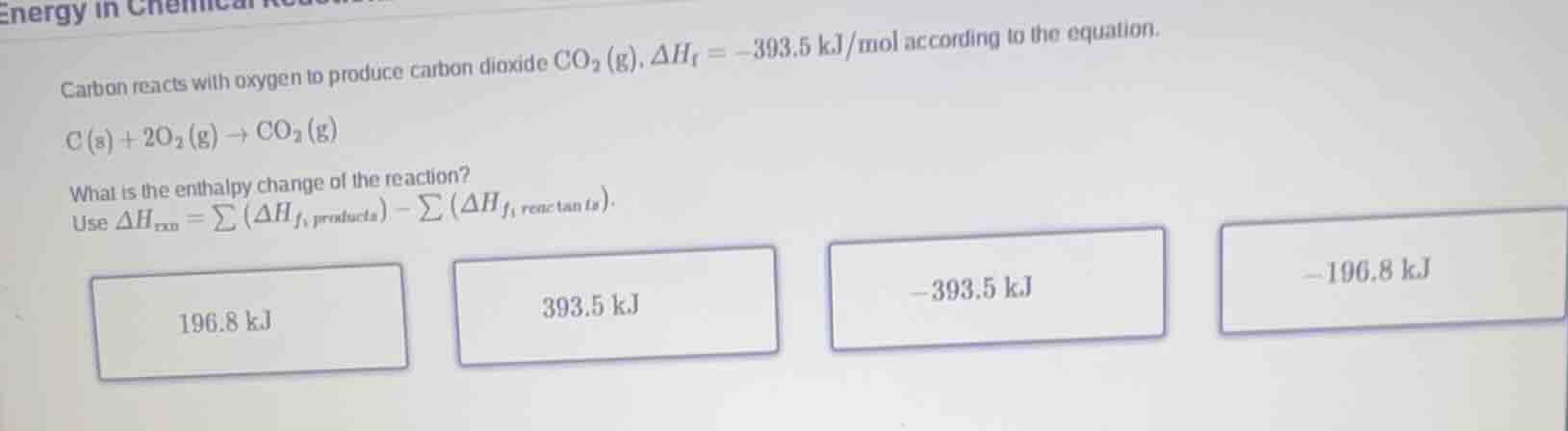
carbon reacts with oxygen to produce carbon dioxide co₂ (g), δh_f = -393.5 kj/mol according to the equation.
c (s) + 2o₂ (g) → co₂ (g)
what is the enthalpy change of the reaction?
use δh_rxn = σ(δh_f, products) - σ(δh_f, reactants).
options: 196.8 kj, 393.5 kj, -393.5 kj, -196.8 kj
Step1: Define enthalpy of formation rules
The standard enthalpy of formation ($\Delta H_f$) for elements in their standard state is 0. For $\text{C}(s)$ and $\text{O}_2(g)$, $\Delta H_f = 0\ \text{kJ/mol}$.
Step2: Apply reaction enthalpy formula
Use $\Delta H_{\text{rxn}} = \sum (\Delta H_{f,\text{products}}) - \sum (\Delta H_{f,\text{reactants}})$
$\Delta H_{\text{rxn}} = \Delta H_f(\text{CO}_2(g)) - [\Delta H_f(\text{C}(s)) + 2\times\Delta H_f(\text{O}_2(g))]$
Step3: Substitute values into formula
$\Delta H_{\text{rxn}} = -393.5\ \text{kJ/mol} - [0 + 2\times0]$
$\Delta H_{\text{rxn}} = -393.5\ \text{kJ/mol}$

Snap & solve any problem in the app
Get step-by-step solutions on Sovi AI
Photo-based solutions with guided steps
Explore more problems and detailed explanations
-393.5 kJ