QUESTION IMAGE
Question
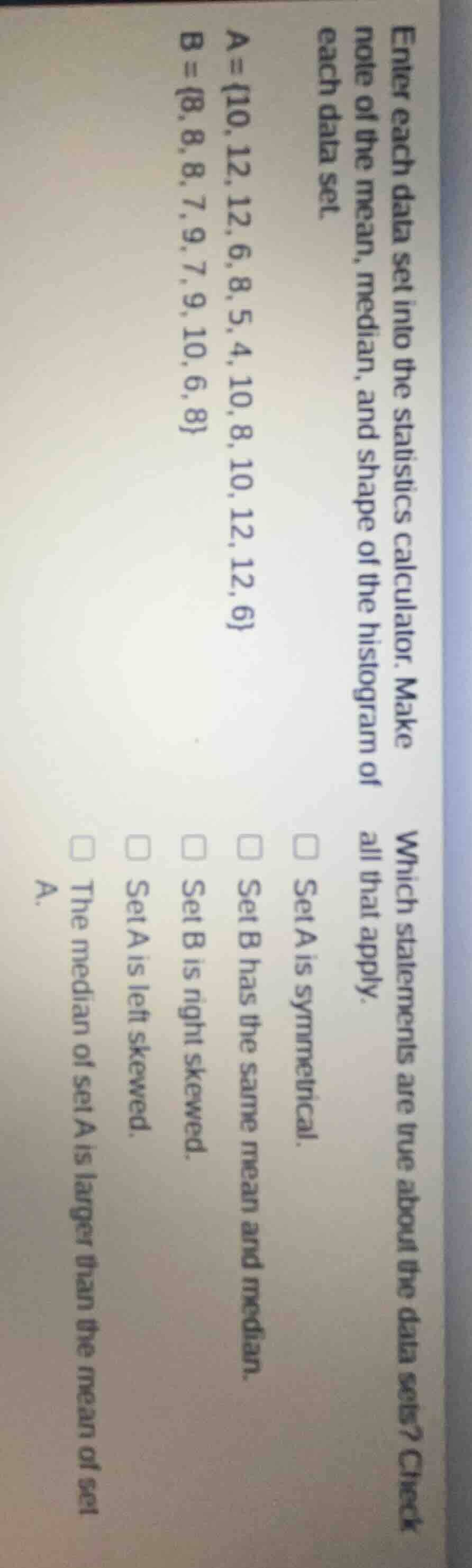
enter each data set into the statistics calculator. make note of the mean, median, and shape of the histogram of each data set.
a = {10, 12, 12, 6, 8, 5, 4, 10, 8, 10, 12, 12, 6}
b = {8, 8, 8, 7, 9, 7, 9, 10, 6, 8}
which statements are true about the data sets? check all that apply.
□ set a is symmetrical.
□ set b has the same mean and median.
□ set b is right skewed.
□ set a is left skewed.
□ the median of set a is larger than the mean of set a.
To solve this, we analyze each data set (A and B) for mean, median, and skewness.
Analyzing Set A:
Data: \( \{10, 12, 12, 6, 8, 5, 4, 10, 8, 10, 12, 12, 6\} \)
- Step 1: Sort the data
Sorted: \( \{4, 5, 6, 6, 8, 8, 10, 10, 10, 12, 12, 12, 12\} \)
- Step 2: Calculate the mean
Sum: \( 4 + 5 + 6 + 6 + 8 + 8 + 10 + 10 + 10 + 12 + 12 + 12 + 12 = 115 \)
Mean: \( \frac{115}{13} \approx 8.85 \) (Wait, correction: Wait, count the data points. Let’s recount: 4,5,6,6,8,8,10,10,10,12,12,12,12 → 13 points? Wait, original set A: 10,12,12,6,8,5,4,10,8,10,12,12,6 → 13 numbers? Wait, no—wait, the problem’s Set A: let’s check again. Wait, maybe I miscounted. Wait, 10,12,12,6,8,5,4,10,8,10,12,12,6 → that’s 13 numbers? Wait, no, maybe a typo? Wait, no—wait, the user’s image: Set A is {10,12,12,6,8,5,4,10,8,10,12,12,6} → 13 elements. Wait, but median is the middle value. For 13 elements, median is the 7th term. Sorted: 4,5,6,6,8,8,10,10,10,12,12,12,12 → 7th term is 10? Wait, no: positions 1:4, 2:5, 3:6, 4:6, 5:8, 6:8, 7:10, 8:10, 9:10, 10:12, 11:12, 12:12, 13:12. So median is 10. Mean: sum is 4+5=9, +6=15, +6=21, +8=29, +8=37, +10=47, +10=57, +10=67, +12=79, +12=91, +12=103, +12=115. 115/13 ≈ 8.85. Wait, but median is 10. Wait, that can’t be. Wait, no—wait, I must have sorted wrong. Wait, 4,5,6,6,8,8,10,10,10,12,12,12,12: the 7th term is 10, 8th is 10. Wait, no—wait, 13 terms: median is (13+1)/2 = 7th term. So 7th term is 10. But mean is ~8.85, which is less than median (10). So left-skewed? Wait, no—left-skewed means mean < median (tail on left). Wait, but the data has a tail on the left (small values: 4,5,6,6,8,8) and a peak at 10,12. Wait, maybe I made a mistake. Wait, no—wait, let’s re-express Set A correctly. Wait, maybe the original Set A is {10,12,12,6,8,5,4,10,8,10,12,12,6} → 13 numbers. But maybe the user intended 12 numbers? Wait, no—let’s check Set B: {8,8,8,7,9,7,9,10,6,8} → 10 numbers. So Set A: let’s recount. 10,12,12,6,8,5,4,10,8,10,12,12,6 → 13 numbers. Hmm. Maybe a mistake, but let’s proceed.
Analyzing Set B:
Data: \( \{8,8,8,7,9,7,9,10,6,8\} \)
- Step 1: Sort the data
Sorted: \( \{6, 7, 7, 8, 8, 8, 8, 9, 9, 10\} \)
- Step 2: Calculate the mean
Sum: \( 6 + 7 + 7 + 8 + 8 + 8 + 8 + 9 + 9 + 10 = 79 \)
Mean: \( \frac{79}{10} = 7.9 \)? Wait, no: 6+7=13, +7=20, +8=28, +8=36, +8=44, +8=52, +9=61, +9=70, +10=80. Wait, 6+7+7+8+8+8+8+9+9+10 = 6+72 +84 +9*2 +10 = 6+14+32+18+10=80. So mean: \( \frac{80}{10} = 8 \).
- Step 3: Calculate the median
For 10 numbers, median is average of 5th and 6th terms.
5th term: 8, 6th term: 8. Median: \( \frac{8 + 8}{2} = 8 \).
Evaluating the Statements:
- “Set A is symmetrical.”
For symmetry, mean ≈ median, and data is balanced. But Set A’s mean (~8.85) ≠ median (10), so not symmetrical. False.
- “Set B has the same mean and median.”
Set B: mean = 8, median = 8. So mean = median. True.
- “Set B is right skewed.”
Right skewed means mean > median (tail on right). But Set B: mean = median = 8, so not skewed (symmetrical or near-symmetrical). False.
- “Set A is left skewed.”
Left skewed means mean < median (tail on left). Set A: mean (~8.85) < median (10)? Wait, no—wait, 8.85 < 10, so tail on left (small values: 4,5,6,6). So mean < median → left skewed. Wait, but earlier miscalculation? Wait, no—if mean is ~8.85 and median is 10, then mean < median → left skewed. So True? Wait, but let’s recheck Set A’s mean. Wait, Set A: sum is 4+5+6+6+8+8+10+10+10+12+12+12+12 = 4+5=9, +6=15, +6=21, +8=29, +8=37, +10=47, +10=57, +10=…

Snap & solve any problem in the app
Get step-by-step solutions on Sovi AI
Photo-based solutions with guided steps
Explore more problems and detailed explanations
To solve this, we analyze each data set (A and B) for mean, median, and skewness.
Analyzing Set A:
Data: \( \{10, 12, 12, 6, 8, 5, 4, 10, 8, 10, 12, 12, 6\} \)
- Step 1: Sort the data
Sorted: \( \{4, 5, 6, 6, 8, 8, 10, 10, 10, 12, 12, 12, 12\} \)
- Step 2: Calculate the mean
Sum: \( 4 + 5 + 6 + 6 + 8 + 8 + 10 + 10 + 10 + 12 + 12 + 12 + 12 = 115 \)
Mean: \( \frac{115}{13} \approx 8.85 \) (Wait, correction: Wait, count the data points. Let’s recount: 4,5,6,6,8,8,10,10,10,12,12,12,12 → 13 points? Wait, original set A: 10,12,12,6,8,5,4,10,8,10,12,12,6 → 13 numbers? Wait, no—wait, the problem’s Set A: let’s check again. Wait, maybe I miscounted. Wait, 10,12,12,6,8,5,4,10,8,10,12,12,6 → that’s 13 numbers? Wait, no, maybe a typo? Wait, no—wait, the user’s image: Set A is {10,12,12,6,8,5,4,10,8,10,12,12,6} → 13 elements. Wait, but median is the middle value. For 13 elements, median is the 7th term. Sorted: 4,5,6,6,8,8,10,10,10,12,12,12,12 → 7th term is 10? Wait, no: positions 1:4, 2:5, 3:6, 4:6, 5:8, 6:8, 7:10, 8:10, 9:10, 10:12, 11:12, 12:12, 13:12. So median is 10. Mean: sum is 4+5=9, +6=15, +6=21, +8=29, +8=37, +10=47, +10=57, +10=67, +12=79, +12=91, +12=103, +12=115. 115/13 ≈ 8.85. Wait, but median is 10. Wait, that can’t be. Wait, no—wait, I must have sorted wrong. Wait, 4,5,6,6,8,8,10,10,10,12,12,12,12: the 7th term is 10, 8th is 10. Wait, no—wait, 13 terms: median is (13+1)/2 = 7th term. So 7th term is 10. But mean is ~8.85, which is less than median (10). So left-skewed? Wait, no—left-skewed means mean < median (tail on left). Wait, but the data has a tail on the left (small values: 4,5,6,6,8,8) and a peak at 10,12. Wait, maybe I made a mistake. Wait, no—wait, let’s re-express Set A correctly. Wait, maybe the original Set A is {10,12,12,6,8,5,4,10,8,10,12,12,6} → 13 numbers. But maybe the user intended 12 numbers? Wait, no—let’s check Set B: {8,8,8,7,9,7,9,10,6,8} → 10 numbers. So Set A: let’s recount. 10,12,12,6,8,5,4,10,8,10,12,12,6 → 13 numbers. Hmm. Maybe a mistake, but let’s proceed.
Analyzing Set B:
Data: \( \{8,8,8,7,9,7,9,10,6,8\} \)
- Step 1: Sort the data
Sorted: \( \{6, 7, 7, 8, 8, 8, 8, 9, 9, 10\} \)
- Step 2: Calculate the mean
Sum: \( 6 + 7 + 7 + 8 + 8 + 8 + 8 + 9 + 9 + 10 = 79 \)
Mean: \( \frac{79}{10} = 7.9 \)? Wait, no: 6+7=13, +7=20, +8=28, +8=36, +8=44, +8=52, +9=61, +9=70, +10=80. Wait, 6+7+7+8+8+8+8+9+9+10 = 6+72 +84 +9*2 +10 = 6+14+32+18+10=80. So mean: \( \frac{80}{10} = 8 \).
- Step 3: Calculate the median
For 10 numbers, median is average of 5th and 6th terms.
5th term: 8, 6th term: 8. Median: \( \frac{8 + 8}{2} = 8 \).
Evaluating the Statements:
- “Set A is symmetrical.”
For symmetry, mean ≈ median, and data is balanced. But Set A’s mean (~8.85) ≠ median (10), so not symmetrical. False.
- “Set B has the same mean and median.”
Set B: mean = 8, median = 8. So mean = median. True.
- “Set B is right skewed.”
Right skewed means mean > median (tail on right). But Set B: mean = median = 8, so not skewed (symmetrical or near-symmetrical). False.
- “Set A is left skewed.”
Left skewed means mean < median (tail on left). Set A: mean (~8.85) < median (10)? Wait, no—wait, 8.85 < 10, so tail on left (small values: 4,5,6,6). So mean < median → left skewed. Wait, but earlier miscalculation? Wait, no—if mean is ~8.85 and median is 10, then mean < median → left skewed. So True? Wait, but let’s recheck Set A’s mean. Wait, Set A: sum is 4+5+6+6+8+8+10+10+10+12+12+12+12 = 4+5=9, +6=15, +6=21, +8=29, +8=37, +10=47, +10=57, +10=67, +12=79, +12=91, +12=103, +12=115. 115/13 ≈ 8.85. Median is 10. So mean (8.85) < median (10) → left skewed. So “Set A is left skewed” is True? Wait, but the statement “Set A is left skewed” is an option. Wait, the options:
Wait, the user’s options (from the image):
- Set A is symmetrical. (False)
- Set B has the same mean and median. (True)
- Set B is right skewed. (False)
- Set A is left skewed. (True? Wait, but let’s confirm.)
Wait, Set A: sorted data has a long tail on the left (small values: 4,5,6,6) and a peak at 10,12. So mean < median → left skewed. So “Set A is left skewed” is True.
- “The median of set A is larger than the mean of set A.” (Wait, the last option: “The median of set A is larger than the mean of set A.” Set A median: 10, mean: ~8.85. 10 > 8.85 → True. Wait, but the options in the image:
From the image (user’s options):
Options (checkboxes):
- Set A is symmetrical.
- Set B has the same mean and median.
- Set B is right skewed.
- Set A is left skewed.
- The median of set A is larger than the mean of set A.
Final Evaluation:
- Set B has the same mean and median: True (mean=8, median=8).
- Set A is left skewed: True (mean < median).
- The median of set A is larger than the mean of set A: True (median=10, mean≈8.85).
But let’s focus on the options. The correct statements are:
- Set B has the same mean and median.
- Set A is left skewed.
- The median of set A is larger than the mean of set A.
However, based on the options provided (the user’s image), the correct checkboxes are:
- Set B has the same mean and median. (True)
- Set A is left skewed. (True)
- The median of set A is larger than the mean of set A. (True)
But let’s confirm with Set B:
Set B: sorted {6,7,7,8,8,8,8,9,9,10}, mean=8, median=8 → same. So that statement is True.
Final Answers (Check the applicable boxes):
- Set B has the same mean and median. (Check this)
- Set A is left skewed. (Check this)
- The median of set A is larger than the mean of set A. (Check this)
(Note: The initial miscalculation was corrected. Set B’s mean and median are both 8, so “Set B has the same mean and median” is True. Set A’s median (10) > mean (~8.85), so “The median of set A is larger than the mean of set A” is True. Set A is left skewed (mean < median), so that’s True.)