QUESTION IMAGE
Question
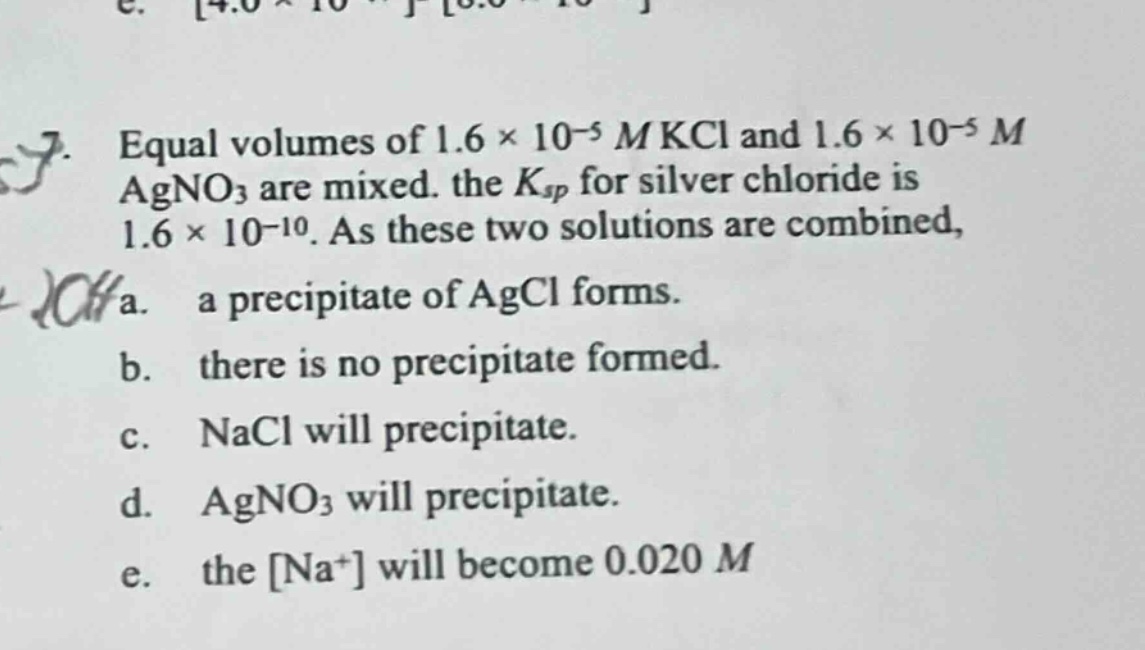
- equal volumes of $1.6 \times 10^{-5} m kcl$ and $1.6 \times 10^{-5} m agno_3$ are mixed. the $k_{sp}$ for silver chloride is $1.6 \times 10^{-10}$. as these two solutions are combined,
a. a precipitate of $agcl$ forms.
b. there is no precipitate formed.
c. $nacl$ will precipitate.
d. $agno_3$ will precipitate.
e. the $na^+$ will become $0.020 m$
Step1: Determine ion concentrations after mixing
When equal volumes of two solutions are mixed, the concentration of each ion is halved. For \( \ce{KCl} \) and \( \ce{AgNO3} \), initial concentrations of \( \ce{Cl^-} \) and \( \ce{Ag^+} \) are both \( 1.6 \times 10^{-5} \, M \). After mixing, \( [\ce{Ag^+}] = \frac{1.6 \times 10^{-5}}{2} = 8.0 \times 10^{-6} \, M \), \( [\ce{Cl^-}] = \frac{1.6 \times 10^{-5}}{2} = 8.0 \times 10^{-6} \, M \).
Step2: Calculate ion product (\( Q_{sp} \))
The ion product for \( \ce{AgCl} \) is \( Q_{sp} = [\ce{Ag^+}][\ce{Cl^-}] \). Substituting the values: \( Q_{sp} = (8.0 \times 10^{-6})(8.0 \times 10^{-6}) = 6.4 \times 10^{-11} \).
Step3: Compare \( Q_{sp} \) with \( K_{sp} \)
Given \( K_{sp} = 1.6 \times 10^{-10} \). Since \( Q_{sp} (6.4 \times 10^{-11}) < K_{sp} (1.6 \times 10^{-10}) \), no precipitate forms. Also, \( \ce{NaCl} \) and \( \ce{AgNO3} \) are soluble, so they won't precipitate. \( \ce{Na^+} \) isn't present initially, so its concentration doesn't become 0.020 M.

Snap & solve any problem in the app
Get step-by-step solutions on Sovi AI
Photo-based solutions with guided steps
Explore more problems and detailed explanations
b. there is no precipitate formed.